The decision still rankles the
company’s rivals, who have watched the search giant continue to amass
power over smartphones, data-hoovering devices and wide swaths of the
internet, unimpeded by laws meant to deter monopolies. It has fueled some lawmakers’ calls to overhaul the Federal Trade Commission, the agency that spent 19 months investigating Google’s efforts to overpower the competition — and critics say, blinked.
The
commission has never disclosed the full scope of its probe nor
explained all its reasons for letting Google’s behavior slide.
But 312 pages of confidential internal
memos obtained by POLITICO reveal what the FTC’s lawyers and economics
experts were thinking — including assumptions that were contradictory at
the time and many that turned out to be incorrect about the internet’s
future, Google’s efforts to dominate it and the harm its rivals said
they were suffering from the company’s actions. The memos show that at a
crucial moment when Washington’s regulators might have had a chance to
stem the growth of tech’s biggest giants, preventing a handful of
trillion-dollar corporations from dominating a rising share of the
economy, they misread the evidence in front of them and left much of the
digital future in Google’s hands.
The documents also add to doubts about
whether Washington is any more capable today of reining in the tech
industry’s titans, despite efforts by a new generation of antitrust
enforcers to turn up the heat on Google, Facebook, Appleand
Amazon — all of which now rank among the United States’ wealthiest
companies. That will be a crucial test awaiting President Joe Biden’s
regulators, including the outspoken Silicon Valley critic he plans to nominate to an open slot on the FTC’s five-person board.
Nearly a
decade ago, the documents show, the FTC’s investigators uncovered
evidence of how far Google was willing to go to ensure the primacy of
the search engine that is the key to its fortunes, including tactics that European regulators and the U.S. Justice Department would later label antitrust violations.
But the FTC’s economists successfully argued against suing the company,
and the agency’s staff experts made a series of predictions that would
fail to match where the online world was headed:
—
They saw only “limited potential for growth” in ads that track users
across the web — now the backbone of Google parent company Alphabet's
$182.5 billion in annual revenue.
newsweek |In this extract from When Google Met WikiLeaks Assange describes his encounter with Schmidt and how he came to conclude that it was far from an innocent exchange of views.
Eric Schmidt is an influential figure, even among the parade of
powerful characters with whom I have had to cross paths since I founded
WikiLeaks. In mid-May 2011 I was under house arrest in rural Norfolk,
England, about three hours' drive northeast of London. The crackdown
against our work was in full swing and every wasted moment seemed like
an eternity. It was hard to get my attention.
But when my
colleague Joseph Farrell told me the executive chairman of Google wanted
to make an appointment with me, I was listening.
In some ways the higher echelons of Google seemed more distant and
obscure to me than the halls of Washington. We had been locking horns
with senior U.S. officials for years by that point. The mystique had
worn off. But the power centers growing up in Silicon Valley were still
opaque and I was suddenly conscious of an opportunity to understand and
influence what was becoming the most influential company on earth.
Schmidt had taken over as CEO of Google in 2001 and built it into an
empire.
I was intrigued that the mountain would come to Muhammad. But it was
not until well after Schmidt and his companions had been and gone that I
came to understand who had really visited me.
The stated reason
for the visit was a book. Schmidt was penning a treatise with Jared
Cohen, the director of Google Ideas, an outfit that describes itself as
Google's in-house "think/do tank."
I knew little else about Cohen
at the time. In fact, Cohen had moved to Google from the U.S. State
Department in 2010. He had been a fast-talking "Generation Y" ideas man
at State under two U.S. administrations, a courtier from the world of
policy think tanks and institutes, poached in his early twenties.
He
became a senior advisor for Secretaries of State Rice and Clinton. At
State, on the Policy Planning Staff, Cohen was soon christened "Condi's
party-starter," channeling buzzwords from Silicon Valley into U.S.
policy circles and producing delightful rhetorical concoctions such as
"Public Diplomacy 2.0." On his Council on Foreign Relations adjunct staff page he listed his expertise as "terrorism; radicalization; impact of connection technologies on 21st century statecraft; Iran."
It
was Cohen who, while he was still at the Department of State, was said
to have emailed Twitter CEO Jack Dorsey to delay scheduled maintenance
in order to assist the aborted 2009 uprising in Iran. His documented
love affair with Google began the same year when he befriended Eric
Schmidt as they together surveyed the post-occupation wreckage of
Baghdad. Just months later, Schmidt re-created Cohen's natural habitat
within Google itself by engineering a "think/do tank" based in New York
and appointing Cohen as its head. Google Ideas was born.
Later that year two co-wrote a policy piece
for the Council on Foreign Relations' journal Foreign Affairs, praising
the reformative potential of Silicon Valley technologies as an
instrument of U.S. foreign policy. Describing what they called
"coalitions of the connected," Schmidt and Cohen claimed that:
Democratic states that have built
coalitions of their militaries have the capacity to do the same with
their connection technologies.…
They offer a new way to exercise the duty to protect citizens around the world [emphasis added].
"If you think human rights are more important than property rights, you're not a conservative. If you think property rights ARE human rights, you are a conservative."
And second, Frank Wilhoit's: "Conservatism consists of exactly one proposition…There must be in-groups whom the law protects but does not bind, alongside out-groups whom the law binds but does not protect."
oxforduniversitypress |Late in life, William F. Buckley made a confession to Corey Robin.
Capitalism is "boring," said the founding father of the American right.
"Devoting your life to it," as conservatives do, "is horrifying if only
because it's so repetitious. It's like sex." With this unlikely
conversation began Robin's decade-long foray into the conservative mind.
What is conservatism, and what's truly at stake for its proponents? If
capitalism bores them, what excites them?
As @CoreyRobin described in THE REACTIONARY MIND, that is the single factor that unites all the strains of conservativism, from Dominionism to Libertarianism to Monarchism to Imperalism: some are born to rule, others, to be ruled over.https://t.co/17jf9MVW8q
In The Reactionary Mind,
Robin traces conservatism back to its roots in the reaction against the
French Revolution. He argues that the right was inspired, and is still
united, by its hostility to emancipating the lower orders. Some
conservatives endorse the free market; others oppose it. Some criticize
the state; others celebrate it. Underlying these differences is the
impulse to defend power and privilege against movements demanding
freedom and equality -- while simultaneously making populist appeals to
the masses. Despite their opposition to these movements, conservatives
favor a dynamic conception of politics and society -- one that involves
self-transformation, violence, and war. They are also highly adaptive to
new challenges and circumstances. This partiality to violence and
capacity for reinvention have been critical to their success.
Written by a highly-regarded, keen observer of the contemporary political scene, The Reactionary Mind
ranges widely, from Edmund Burke to Antonin Scalia and Donald Trump,
and from John C. Calhoun to Ayn Rand. It advances the notion that all
right-wing ideologies, from the eighteenth century through today, are
improvisations on a theme: the felt experience of having power, seeing
it threatened, and trying to win it back. When its first edition
appeared in 2011, The Reactionary Mind set off a fierce debate. It has
since been acclaimed as "the book that predicted Trump" (New Yorker) and "one of the more influential political works of the last decade" (Washington Monthly). Now updated to include Trump's election and his first one hundred days in office, The Reactionary Mind is more relevant than ever.
ssrn | This article demonstrates that the histories of conquest and
slavement are foundational to U.S. property law. Over centuries, laws
and legal institutions facilitated the production of the two
commodities, or forms of property, upon which the colonial economy and
the United States came to depend above all others: enclosures of Native
nations’ land and enslaved people. By describing the role of property
law in creating markets for lands and people, this article addresses the
gap between the marginal place of these histories in the contemporary
property law canon and the growing scholarly and popular recognition
that conquest and enslavement were primary modes of property formation
in American history.
First, this article describes how the
field of property law has come to omit these histories from its common
understanding of what is basic to its subject by examining property law
casebooks published over 130 years. For most of their history, it shows,
such casebooks affirmed the racial logic of conquest and slavery and
contributed to these histories’ suppression in pedagogical materials.
Early treatises avowed the foundational nature of conquest, but after
the first property law casebook appeared, at the time of the close of
the frontier, casebooks for more than half a century emphasized English
inheritance, rather than acknowledging colonization’s formative impact
on the property system. In the same period, the era of Jim Crow,
casebooks continued to include many cases involving the illegal,
obsolete form of property in enslaved people; when they ceased to do so,
they replaced them with cases on racially restrictive covenants
upholding segregation. After several decades, during which the histories
of conquest and slavery were wholly erased, casebooks in the 1970s
began to examine these histories through a critical lens for the first
time. However, the project of understanding their consequences for the
property system has remained only partial and highly inconsistent.
The
central part of this article focuses on the acquisition of property,
which, properly understood, comprises the histories of conquest,
slavery, expropriation, and property creation in America. It examines
the three main theories of acquisition—discovery, labor and possession--
beginning with the United States’ adoption of the Discovery Doctrine,
the international law of conquest, as the legal basis of its sovereignty
and property laws. In this context, it shows that the operative
principle of the doctrine was not that of first-in-time, as commonly
taught, but the agreement of European nations on a global racial
hierarchy. Second, it turns to the labor theory, which was selectively
applied according to the hierarchy of discovery, and firmly linked
ideologies about non-whites and property value. It then reframes the
labor theory’s central question—property creation—as a matter of legal
and institutional innovation, rather than merely agricultural labor. It
examines the correlation between historical production of property value
in the colonies to show how the main elements of the Angloamerican land
system developed through the dispossession of nonwhites-- the
rectangular survey, the comprehensive title registry, headrights and the
homesteading principle, laws that racialized the condition of
enslavement to create property in human beings, and easy mortgage
foreclosure, which facilitated the trade of human beings and land as
chattel to increase colonists’ wealth. Third, it assesses how the state
organized the tremendous force required to subvert others’ possession of
their lands and selves, using the examples of the strategy of conquest
by settlement and the freedom quests that gave rise to the fugitive
slave controversy. Its analysis highlights the state’s delegation of
violence and dispossession to private actors invested in the racial
hierarchy of property through the use of incentives structured by law.
This
article concludes by summarizing how the laws that governed conquest
and slavery established property laws, practices, and institutions that
laid the groundwork for transformations to interests in land after the
abolition of slavery, which I will address in a future companion
article. This article aims throughout to offer a framework for
integrating the study of English doctrines regulating relations between
neighbors-- the traditional focus of a property law course—into an
exploration of the unique fruits of the colonial experiment -- the
singular American land system that underpins its real estate market and
its structural reliance on racial violence to produce value.
NYTimes | The coronavirus has been particularly
devastating for Indigenous communities. It has killed American Indians
and Alaska Natives at nearly twice the rate of white people, and inflicted a cultural crisis
by killing the elders who pass down language and traditional teachings.
The economic toll of the pandemic has pummeled Native economies already
racked by high poverty and unemployment.
The
vaccine rollout in Native communities has been a surprising source of
strength, especially as vaccinations of other communities, such as Black
and Hispanic Americans, continue to lag behind white populations.
Working
through the Indian Health Service and long-established networks of
tribally run clinics, tribes are outpacing much of the country, already
giving shots to healthy adults and eligible teenagers. Some have even
thrown open the doors to nontribal members inside their borders.
In
all, about 1.1 million vaccines have been distributed through the
Indian Health Service and 670,000 have been administered. Still, health
care advocates said frustrating gaps remained. Many Indigenous people in
big cities and areas without tribal health centers had struggled to
find vaccines.
Now, Native health
workers are desperately hoping to get through to people like Nora
Birdtail, 64, one of a shrinking number of Cherokee-speaking elders.
Their names are marked down in a leather notebook that was created to
inscribe their importance to Cherokee heritage and culture. Today, the
notebook is a register of loss — of at least 35 lives and numberless
stories cut short by the virus.
Even
as hundreds of elders got vaccinated, Ms. Birdtail resisted. She is
vulnerable to the coronavirus from a stroke. Her job as a teacher’s aide
brings her into close contact with children at the Cherokee Immersion
School, where in-person classes are expected to resume soon.
But Ms. Birdtail
is scared of getting vaccinated, largely because she once passed out
after getting a penicillin shot years ago. The government’s legacy of
medical malpractice in Indian Country — a history of coercive
treatments, shoddy care, forced sterilizations and more — has also
instilled a deep skepticism about taking a government-supported vaccine.
“It made me think back to the Trail of Tears, how they all got sick,” Ms. Birdtail said. “I don’t trust it.”
nbcnews | Vaccine holdouts could end up being the last obstacle to
defeating the pandemic, and a growing effort is aimed at convincing one
substantial group of skeptics: Republicans.
While efforts
to combat vaccine hesitancy and access have so far been mostly focused
on African Americans and Latinos, recent polls suggest the largest group
of Americans either hesitant about the Covid-19 vaccine or outright
opposed to it are Republicans, and efforts to reach them are only in
their infancy.
Success
convincing skeptical conservatives could be the difference between the
United States reaching herd immunity or not. That's why a group of
Republican pollsters and politicians, plus the White House, are all
already working on getting the skeptics on board.
Messages
targeted at minority groups were overt and discussion of hesitancy
among people of color was clear. But when it comes to targeting a
partisan population, appearing overtly political opens up new risks and
could backfire, those working on the efforts warn.
"Vaccines
are our only way out of this. If we don't have 80-plus percent of the
population vaccinated before next winter, this virus is going to come
back raging," Dr. Paul Offit, a member of the Food and Drug
Administration’s vaccine advisory committee, told NBC News. "What worries me is if 25 percent of Republicans say they won't get vaccinated, that's going to be hard to do."
It's simple math.
Last week, a Monmouth University poll
found that 56 percent of Republicans either wanted to wait and see
further before getting a vaccine or said they will likely never get one,
compared to just 23 percent of Democrats. Another poll, from NPR/PBS/Marist,
found that 47 percent of Trump voters and 41 percent of Republicans
said they will not get the vaccine when made available to them. And a Kaiser Family Foundation
tracking poll found the number of Republicans refusing to get the
vaccine was 28 percent, while the number of Black Americans and Hispanic
Americans who felt that stood at 14 percent and 12 percent
respectively.
Together, those groups could leave around a
quarter or more of the American population unvaccinated, while
scientists now estimate herd immunity will only be reached when 70 to 85 percent of the population carry the virus's antibodies.
"You
can't afford to not try to address that," Dr. Marcus Plescia, chief
medical officer of the Association of State and Territorial Health
Officials, said in an interview.
AIER | One year ago, between March 13 and 16, 2020, began what most of us
would agree were the most difficult days of our lives. We thought our
rights and liberties were more or less secure or could only be hobbled
on the margin. We took certain things for granted, such as that our
governments would not – and could not – order us to stay home, close
most businesses and schools, shut down travel, padlock churches and
concert halls, cancel events, much less lock down society in the name of
virus control.
This not-yet-released HHS report on COVID-19 projects an 18-month-long tsunami of nationwide disease and death. The Trump administration could’ve stemmed the tide but looked the other way until it was too late. If he had an ounce of decency, he’d resign. https://t.co/TA8iorcwW5
All that changed with a federal document issued March 13, 2020,
and declassified three months later. It was the lockdown guidelines.
Over the following days, governors panicked. People panicked.
Bureaucrats were unleashed. All the powers of the state at all levels of
society were deployed not on the virus but on the people, which is all
that governments can really control. The lockdowns were nearly
universal, implemented around the world but for a few holdouts, one of
which was in the US (South Dakota).
A year later, most states are opening up while those still clinging
to lockdowns can no longer control people. Regardless of warnings from
the top that going back to normal life is too dangerous, most people
have decided to be done with the whole dreadful episode.
All year we’ve asked ourselves the question: why did this happen?
Pathogens are part of life now and always have been. For the better part
of a century, social and economic outcomes from new viruses were ever
less disruptive. Public health had a settled consensus that disease is
something to mitigate through doctor-patient relationships. Taking away
people’s rights was out of the question. The last time that was tried in
very limited ways in 1918 demonstrated that coercion only distracts,
divides, and delays. This is why lockdowns were not attempted for
another hundred years. Wisely so.
In the severe pandemic of 1957-58, officials explicitly said:
‘‘[T]here is no practical advantage in the closing of schools or the
curtailment of public gatherings as it relates to the spread of this
disease.’’ It was the same in 1968-69, 2006, 2009, and 2012-13.
Then came 2020 and SARS-CoV-2. The 24-hour news cycle and social
media kicked in. Shocking images from China – people dropping dead in
streets, police dragging people out of their homes or otherwise sealing
whole apartment units – were blasted onto cellphones the world over.
Then a part of Italy seemed to erupt. To many, it felt like a plague,
and a primitive disease panic took over political culture.
NYTimes | Growing evidence suggests that people with cancer and other conditions
that challenge their immune systems may be incubators of mutant viruses.
The version of
the coronavirus that surfaced in Britain late last year was shocking for
many reasons. It came just as vaccines had offered a glimpse of the end
of the pandemic, threatening to dash those hopes. It was far more
contagious than earlier variants, leading to a swift increase in
hospitalizations. And perhaps most surprising to scientists: It had
amassed a large constellation of mutations seemingly overnight.
A
coronavirus typically gains mutations on a slow-but-steady pace of
about two per month. But this variant, called B.1.1.7, had acquired 23
mutations that were not on the virus first identified in China. And 17
of those had developed all at once, sometime after it diverged from its
most recent ancestor.
Experts said
there’s only one good hypothesis for how this happened: At some point
the virus must have infected someone with a weak immune system, allowing
it to adapt and evolve for months inside the person’s body before being
transmitted to others. “It appears to be the most likely explanation,”
said Dr. Ravindra Gupta, a virologist at the University of Cambridge.
If
true, the idea has implications for vaccination programs, particularly
in countries that have not yet begun to immunize their populations.
People with compromised immune systems — such as cancer patients —
should be among the first to be vaccinated, said Dr. Adam Lauring, a
virologist and infectious disease physician at the University of
Michigan. The faster that group is protected, the lower the risk that
their bodies turn into incubators for the world’s next supercharged
mutant.
theconversation | DNA and mRNA vaccines offer huge advantages over traditional types of
vaccines, since they use only genetic code from a pathogen – rather than
the entire virus or bacteria. Traditional vaccines take months, if not
years, to develop. In contrast, once scientists get the genetic sequence
of a new pathogen, they can design a DNA or mRNA vaccine in days, identify a lead candidate for clinical trials within weeks and have millions of doses manufactured within months. This is basically what happened with the coronavirus.
During the pandemic, researchers have taken full advantage of the
proliferation of smartwatches, smart rings and other wearable health and
wellness technology. These devices can measure a person’s temperature, heart rate, level of activity and other biometrics. With this information, researchers have been able to track and detect COVID-19 infections even before people notice they have any symptoms.
Proteins are the molecular machines that make your cells function. When
proteins malfunction or are hijacked by a pathogen, you often get
disease. Most drugs work by disrupting the action of one or several of
these malfunctioning or hijacked proteins.
So a logical way to look for new drugs to treat a specific disease is
to study individual genes and proteins that are directly affected by
that disease. For example, researchers know that the BRCA gene – a gene
that protects your DNA from being damaged – is closely related to the
development of breast and ovarian cancer. So a lot of work has focused
on finding drugs that affect the function of the BRCA protein.
dailymail | Dr Fauci tells Trump he could be a 'game changer' in the fight
against COVID if he tells his supporters to get the vaccine after HALF
of Republican men said they will not get the shot
Asked
whether Trump should speak to his supporters directly, given the recent
poll numbers, Fauci said: 'I think it would make all the difference in
the world'
Trump, Fauci said, 'is a such a strongly popular person...it would be very helpful'
The
government's top infectious disease expert said politics needs to be
separated from 'commonsense, no-brainer' public health measures
Trump did tell supporters at CPAC last month to 'go get your shot'
The
other living former U.S. presidents are set to appear in two public
service announcements for the vaccine alongside their wives, without
Trump
Joe Biden and other
political leaders received their shots publicly to encourage Americans
to get vaccinated; Trump was vaccinated privately in January
Dr Anthony Fauci has said 'wildly popular'
Donald Trump could be a 'game changer' if he tells his supporters to
get the COVID-19 vaccine.
Almost half
of Republican men say they will not get the vaccine when it is
available to them compared with just six percent of Democrat men,
according to a new poll.
Asked whether Trump should speak to his supporters directly, given those numbers, Fauci told Fox News: 'I think it would make all the difference in the world.'
Trump, Fauci said, 'is a such a strongly popular person...it would be very helpful for the effort for that to happen.'
Fauci
added: 'If he came out and said, "Go and get vaccinated. It´s really
important for your health, the health of your family and the health of
the country," it seems absolutely inevitable that the vast majority of
people who are his close followers would listen to him.
'I think it would make all the difference in the world. He’s a very wildly popular person among Republicans.'
Though
it wasn't publicized at the time, Trump and First Lady Melania Trump
got the vaccine in January before they left the White House, a Trump
adviser told DailyMail.com in February.
In
a round of interviews on the morning news shows, the government's top
infectious disease expert said politics needs to be separated from
'commonsense, no-brainer' public health measures.
AP | Nearly a year after
California Gov. Gavin Newsom ordered the nation’s first statewide
shutdown because of the coronavirus, masks remain mandated, indoor
dining and other activities are significantly limited, and Disneyland
remains closed.
By
contrast, Florida has no statewide restrictions. Republican Gov. Ron
DeSantis has prohibited municipalities from fining people who refuse to
wear masks. And Disney World has been open since July.
Despite their differing approaches, California and Florida have experienced almost identical outcomes in COVID-19 case rates.
How have two states that took such divergent tacks arrived at similar points?
“This is going to be
an important question that we have to ask ourselves: What public health
measures actually were the most impactful, and which ones had
negligible effect or backfired by driving behavior underground?” said
Amesh Adalja, a senior scholar at the Johns Hopkins Center for Health
Security.
Though research has found
that mask mandates and limits on group activities such as indoor dining
can help slow the spread of the coronavirus, states with greater
government-imposed restrictions have not always fared better than those
without them.
California
and Florida both have a COVID-19 case rate of around 8,900 per 100,000
residents since the pandemic began, according to the federal Centers for
Disease Control and Prevention. And both rank in the middle among
states for COVID-19 death rates — Florida was 27th as of Friday;
California was 28th.
Connecticut
and South Dakota are another example. Both rank among the 10 worst
states for COVID-19 death rates. Yet Connecticut Gov. Ned Lamont, a
Democrat, imposed numerous statewide restrictions over the past year
after an early surge in deaths, while South Dakota Gov. Kristi Noem, a
Republican, issued no mandates as virus deaths soared in the fall.
While
Lamont ordered quarantines for certain out-of-state visitors, Noem
launched a $5 million tourism advertising campaign and welcomed people
to a massive motorcycle rally, which some health experts said spread the coronavirus throughout the Midwest.
Both contend their approach is the best.
“Even
in a pandemic, public health policy needs to take into account people’s
economic and social well-being,” Noem said during a recent conservative
convention.
abcnews | "Look, we know what we need to do to beat this virus. Tell the truth.
Follow the scientists and the science. Work together. Put trust and
faith in our government to fulfill its most important function, which is
protecting the American people. No function more important. We need to
remember the government isn't some foreign force in a distant capital.
No, it's us. All of us. We, the people.
In the coming weeks, we will issue further guidance on what you can
and cannot do once fully vaccinated to lessen the confusion, to keep
people safe, and encourage more people to get vaccinated. And, finally,
fifth, and maybe most importantly, I promise I will do everything in my
power. I will not relent until we beat this virus.
"But I need
you, the American people. I need you. I need every American to do their
part. And that's not hyperbole. I need you. I need you to get vaccinated
when it's your turn and when you can find an opportunity. And to help
your family, your friends, your neighbors get vaccinated as well.
Because here's the point.
"If we do all this, if we do our part,
if we do this together, by July the 4, there's a good chance you, your
families and friends, will be able to get together in your backyard or
in your neighborhood and have a cookout or a barbecue and celebrate
Independence Day. That doesn't mean large events with lots of people
together, but it does mean small groups will be able to get together.
consentfactory | So, we’re almost a year into the “New Normal” (a/k/a “pathologized
totalitarianism”) and things are still looking … well, pretty
totalitarian.
“Vaccine passports” (which are definitely creepy, but which bear no resemblance to Aryan Ancestry Certificates,
or any other fascistic apartheid-type documents, so don’t even think
about making such a comparison!) are in the pipeline in a number of
countries. They have already been rolled out in Israel.
In other words, as predicted by us “conspiracy theorists,” the
“temporary emergency public health measures” implemented by GloboCap in
March of 2020 are still very much in effect, and then some. That said,
as you have probably noticed, the tenor of things is shifting a bit,
which is unsurprising, as GloboCap is now making the transition from
Phase 1 to Phase 2 of the “New Normal” roll-out.
But the “shock and awe” phase can’t go on forever, nor is it ever
intended to. Its purpose is (a) to terrorize the targeted masses into a
state of submission, (b) to irreversibly destabilize their society, so
that it can be radically “restructured,” and (c) to convincingly
demonstrate an overwhelming superiority of force, so that resistance is
rendered inconceivable. This shock and awe (or “rapid dominance”) tactic
has been deployed by empires, and aspiring empires, throughout the
course of military history. It has just been deployed by GloboCap
against … well, against the entire world. And now, that phase is coming
to an end.
reportingforbeauty | To anyone in the habit of dismissing people who are questioning,
investigative and sceptical as tin foil hat wearing, paranoid,
science-denying Trump supporters, the question is: what do you believe
in? Where have you placed your faith and why? How is it that while no
one trusts governments, you appear to trust nascent global governance
organisations without question? How is this rational? If you are
placing faith in such organisations, consider that in the modern global
age, these organisations, as extraordinarily well presented as they are,
are simply grander manifestations of the local versions we know
we can't trust. They are not our parents and demonstrate no loyalty to
humane values. There is no reason to place any faith whatsoever in any
of them. If you haven't consciously developed a faith or questioned why
you believe as you do to some depth, such a position might seem
misanthropic, but in truth, it is the opposite. These organisations have
not earned your trust with anything other than PR money and glossy
lies. True power remains, as ever, with the people.
There is a
reason why Buddhists strongly advise the placing of one's faith in the
Dharma, or the natural law of life, rather than in persons, and that
similar refrains are common in other belief systems. Power corrupts.
And, in the world today, misplaced and unfounded trust could well be one
of the greatest sources of power there is.
Massive criminal
conspiracies exist. The evidence is overwhelming. The scope of those
currently underway is unknown, but there is no reason to imagine, in the
new global age, that the sociopathic quest for power or the possession
of the resources required to move towards it is diminishing. Certainly
not while dissent is mocked and censored into silence by gatekeepers,
‘useful idiots’, and conspiracy deniers, who are, in fact, directly
colluding with the sociopathic agenda through their unrelenting attack
on those who would shine a light on wrongdoing. It is every humane
being's urgent responsibility to expose sociopathic agendas wherever they exist - never
to attack those who seek to do so. Now, more than ever, it is time to
put away childish things, and childish impulses, and to stand up as
adults to protect the future of the actual children who have no choice
but to trust us with their lives.
This essay has focussed on what I
consider to be the deepest psychological driver of conspiracy denial.
There are certainly others, such as the desire to be accepted; the
avoidance of knowledge of, and engagement with, the internal and
external shadow; the preservation of a positive and righteous
self-image: a generalised version of the 'flying monkey' phenomenon, in
which a self-interested and vicious class protect themselves by
coalescing around the bully; the subtle unconscious adoption of the
sociopathic worldview (e.g. 'humanity is the virus'); outrage addiction/
superiority complex/ status games; a stunted or unambitious intellect
that finds validation through maintaining the status quo; the
dissociative protective mechanism of imagining that crimes and horrors
committed repeatedly within our lifetime are somehow not happening now,
not 'here'; and plain old fashioned laziness and cowardice. My
suggestion is that, to some degree, all of these build on the foundation
of the primary cause I've outlined here.
off-guardian | James Corbett is likely not long for the YouTube world, having received his second warning his channel is on the chopping block.
There are still many platforms on which you can follow his work (detailed in the above video), most importantly his website. We do suggest you subscribe either via email or RSS. (Also here is a list of Corbett’s videos that YouTube has already removed).
For creators out there, this is a timely reminder: ALWAYS have
hardcopy back-ups of your work and sign up to multiple platforms. The
indy platforms are growing in both number and size. From BitChute to
LBRY.tv to social networks like Gab and Parler.
Corbett is not the only independent media facing increased censorship
and denial of service. Whitney Webb, a great independent researcher and
journalist who has written for many outlets and runs UnlimitedHangout.com, is also in danger of having her Patreon shut down.
Likewise, in just the last few weeks, The Last American Vagabond has had both its twitter shut down and its Patreon put “on review”.
Worrying signs. It looks like we might be in for a spring cull of the
alternate media herd. Rest assured, we at OffG are already looking into
alternate options, should Patreon (or PayPal) decide we are also persona non grata.
worldboxingnews | Former middleweight
rival Thomas Hearns has claimed Marvin Hagler’s death at the age of 66
was linked to the coronavirus vaccine he received recently.
Hearns, known as ‘The Hitman’ during his career, took to social media to
report that Hagler was ‘fighting for his life in the ICU’ on Saturday.
The ex-boxer also added that Hagler was there due to the ‘after-effects
of the vaccine.’
In a sad final statement, Hearns said he believed ‘he’ll be just fine,
but we could use the positive energy and Prayer for his full recovery.’
Sadly, that didn’t happen, and Hagler passed away a short time later.
Hearns’ revelation will be a massive blow to the continued roll-out of
the vaccination program.
Reports in Europe of the AstraZeneca/Oxford vaccine causing blood clots
in three patients already dealt a debilitating thud as countries have
paused using the UK-based jab.
Social media conspiracy theories have gone into overdrive, and there
will be some work to be done to assure those taking the vaccine that
it’s safe.
greenwald |As it turns out, we did not have to wait long for the initiation of the censorship campaign aimed at Substack. It has arrived. And amazingly, the trigger for it was my criticism of the work of a front-page New York Times reporter
which, as I wrote yesterday, is — like all criticisms of journalists in
Good Standing and Decent Liberal Society — being recast as “abuse” and
“harassment” and “violence” in order to justify the banning and
outlawing of that criticism.
A long-time tech reporter at BuzzFeed who was fired by that outlet in June for serial plagiarism, Ryan Broderick, wrote an article
on Wednesday night warning that Substack is now dangerously providing a
platform to a “cadre of writers” which, in addition to me, includes
such societal menaces as “Bari Weiss, Andrew Sullivan, Jesse Singal,
and, I’d argue, Slate Star Codex writer Scott Alexander Siskind.” He
darkly notes: “There are more.” This group of writers, he says, is
“focusing on culture war Twitter drama about being ‘canceled’ and trans
people in bathrooms and woke college students.”
Broderick detailed how he had carefully reviewed a prior article of mine,
one that examined the emergence of “tattletale culture” in the
country’s largest corporate media outlets, to determine — like the good
little diligent junior-high hall monitor that he is — whether it ran
afoul of Substack’s terms of service rules against “doxing” and
“harassment.”
That article of mine was devoted to a critique of
the prevailing journalistic practices at the most powerful and
influential media corporations on the planet: The New York Times, CNN, and NBC News. But to Broderick, whether that article
should be banned on the grounds of harassment is a close call. While
reluctantly conceding that I did not “dox” anyone, he called the article
“a vicious screed” and said that the danger signs from my critiques of
corporate journalists are clear: “online harassment is a constantly
evolving process of boundary testing.” He lamented that Substack’s terms
of service are too permissive (“One thing that worried me was how
simplistic their definition of harassment was”) and insisted that
Substack is soon going to have to step in and put a stop to this:
Right
now most of the abuse being carried out by this group is confined to
Twitter, but it stands to reason that it will eventually spill over to
Substack. And dealing with people like Greenwald is going to be much
harder to moderate than your average troll.
[Please permit me to pause here just a moment and marvel at the towering irony that a journalist who spent years at BuzzFeed doing absolutely nothing of value and then got fired for serial plagiarism (again: he got fired for ethical breaches by BuzzFeed)
is now, with a straight face, holding himself out as the Guardian and
Defender of Real Journalism. Even more amazingly, he believes he is
fulfilling that role by demanding that I — not a journalist but just a
“troll” who is the enemy of Real Journalism despite having more
impactful scoops and journalism awards and, as I detailed yesterday,
resulting persecution campaigns from governments than all of these
petulant fragile babies combined — be silenced in the name of saving
journalism and protecting real reporters like him and his friends from
harassment].
In case Broderick’s article was not explicit enough
in his demand that Substack start censoring me and others, he took to
Twitter to promote his article, where he made that even clearer. He
described his article this way: “I wrote about the attacks against @TaylorLorenz and the growing community of right-wing culture warriors and TERFs that are using Substack to network and organize.”
greenwald |The most powerful and influential newspaper in the U.S., arguably the West, is The New York Times. Journalists
who write for it, especially those whose work is featured on its front
page or in its op-ed section, wield immense power to shape public
discourse, influence thought, set the political agenda for the planet’s
most powerful nation, expose injustices, or ruin the lives of public
figures and private citizens alike. That is an enormous amount of power
in the hands of one media institution and its employees. That’s why it
calls itself the Paper of Record.
One of the Paper of Record’s
star reporters, Taylor Lorenz, has been much discussed of late. That is
so for three reasons. The first is that the thirty-six-year-old tech and
culture reporter has helped innovate a new kind of reportorial beat
that seems to have a couple of purposes. She publishes articles
exploring in great detail the online culture of teenagers and very young adults,
which, as a father of two young Tik-Tok-using children, I have found
occasionally and mildly interesting. She also seeks to catch famous and
non-famous people alike using bad words or being in close digital
proximity to bad people so that she can alert
the rest of the world to these important findings. It is natural that
journalists who pioneer a new form of reporting this way are going to be
discussed.
The second reason Lorenz is the topic of recent discussion is that she
has been repeatedly caught fabricating claims about influential people,
and attempting to ruin the reputations and lives of decidedly non-famous
people. In the last six weeks alone, she twicepublicly lied
about Netscape founder Marc Andreessen: once claiming he used the word
“retarded” in a Clubhouse room in which she was lurking (he had not) and
then accusing him of plotting with a white nationalist in a different
Clubhouse room to attack her (he, in fact, had said nothing).
She also often uses her large, powerful public platform to malign
private citizens without any power or public standing by accusing them
of harboring bad beliefs and/or associating with others who do. (She is
currently being sued by a citizen named Arya Toufanian, who claims
Lorenz has used her private Twitter account to destroy her reputation
and business, particularly with a tweet that Lorenz kept pinned at the
top of her Twitter page for eight months, while several other
non-public figures complain that Lorenz has “reported” on their
non-public activities). It is to be expected that a New York Times journalist
who gets caught lying as she did against Andreessen and trying to
destroy the reputations of non-public figures will be a topic of
conversation.
The third reason this New York Times
reporter is receiving attention is because she has become a leading
advocate and symbol for a toxic tactic now frequently used by wealthy
and influential public figures (like her) to delegitimize criticisms and
even render off-limits any attempt to hold them accountable.
Specifically, she and her media allies constantly conflate criticisms of
people like them with “harassment,” “abuse” and even “violence.”
That is what Lorenz did on Tuesday when she co-opted International Women’s Day to announce
that “it is not an exaggeration to say that the harassment and smear
campaign I have had to endure over the past year has destroyed my life.”
She began her story by proclaiming: “For international women’s day
please consider supporting women enduring online harassment.” She
finished it with this: “No one should have to go through this.” Notably,
there was no mention, by her or her many media defenders, of the lives
she has harmed or otherwise deleteriously affected with her massive
journalistic platform.
greenwald |Not even two months into their reign as the majority
party that controls the White House and both houses of Congress, key
Democrats have made clear that one of their top priorities is censorship
of divergent voices. On Saturday, I detailed
how their escalating official campaign to coerce and threaten social
media companies into more aggressively censoring views that they dislike
— including by summoning social media CEOs to appear before them for
the third time in less than five months — is implicating, if not already
violating, core First Amendment rights of free speech.
Now they
are going further — much further. The same Democratic House Committee
that is demanding greater online censorship from social media companies
now has its sights set on the removal of conservative cable outlets,
including Fox News, from the airwaves.
Since when is it the role of the U.S. Government to arbitrate and
enforce precepts of “journalistic integrity”? Unless you believe in the
right of the government to regulate and control what the press says — a
power which the First Amendment explicitly prohibits — how can anyone be
comfortable with members of Congress arrogating unto themselves the
power to dictate what media outlets are permitted to report and control
how they discuss and analyze the news of the day?
But what House
Democrats are doing here is far more insidious than what is revealed by
that creepy official announcement. Two senior members of that Committee,
Rep. Anna Eshoo (D-Silicon-Valley) and Rep. Jerry McNerney (D-CA) also
sent their own letters
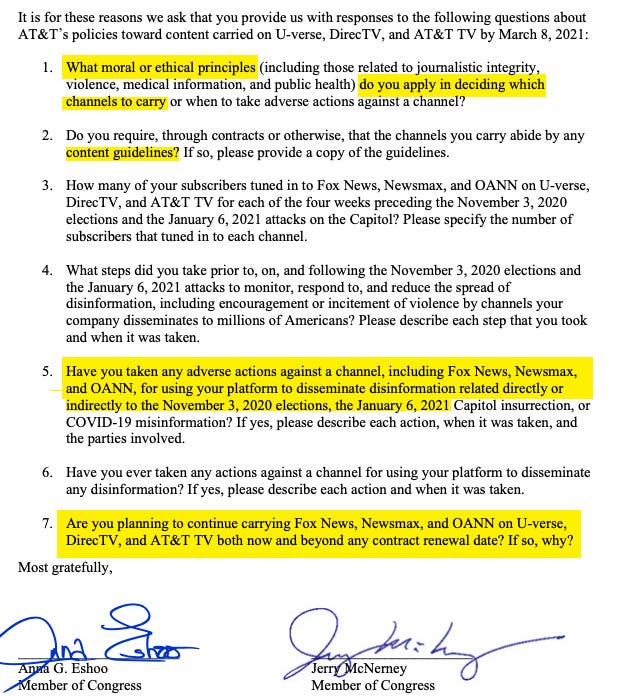
to seven of the nation’s largest cable providers — Comcast, AT&T,
Spectrum, Dish, Verizon, Cox and Altice — as well as to digital
distributors of cable news (Roku, Amazon, Apple, Google and Hulu)
demanding to know, among other things, what those cable distributors did
to prevent conservative “disinformation” prior to the election and
after — disinformation, they said, that just so happened to be spread by
the only conservative cable outlets: Fox, Newsmax and OANN.
In
case there was any doubt about their true goal — coercing these cable
providers to remove all cable networks that feature conservative voices,
including Fox (just as their counterparts on that Committee want to ban
right-wing voices from social media) — the House Democrats in their
letter said explicitly what they are after: namely, removal of those
conservative outlets by these cable providers:
CTH | In modern politics not a single member of the House of
Representatives or Senator writes a law, or puts pen to paper to write
out a legislative construct. This simply doesn’t happen.
Closer Look → Lobbying Congress •1986: $61 million spent, avg $113,700 per lawmaker •2016: $3.1 billion spent, avg $5.8 million per lawmaker pic.twitter.com/UgbBfsPZyq
— Fox News Research (@FoxNewsResearch) July 22, 2017
Over the past several decades a system of constructing legislation has taken over Washington DC that more resembles a business operation than a legislative body. Here’s how it works right now.
Outside groups, often called “special interest groups”, are entities
that represent their interests in legislative constructs. These groups
are often representing foreign governments, Wall Street multinational
corporations, banks, financial groups or businesses; or smaller groups
of people with a similar connection who come together and form a larger
group under an umbrella of interest specific to their affiliation.
Sometimes the groups are social interest groups; activists, climate
groups, environmental interests etc. The social interest groups are
usually non-profit constructs who depend on the expenditures of
government to sustain their cause or need.
The for-profit groups (mostly business) have a purpose in Washington
DC to shape policy, legislation and laws favorable to their interests.
They have fully staffed offices just like any business would – only
their ‘business‘ is getting legislation for their unique interests.
These groups are filled with highly-paid lawyers who represent the
interests of the entity and actually write laws and legislation briefs.
In the modern era this is actually the origination of the laws that
we eventually see passed by congress. Within the walls of these
buildings within Washington DC is where the ‘sausage’ is actually made.
Again, no elected official is usually part of this law origination process.
Almost all legislation created is not ‘high profile’, they are
obscure changes to current laws, regulations or policies that no-one
pays attention to. The passage of the general bills within legislation
is not covered in media. Ninety-nine percent of legislative activity
happens without anyone outside the system even paying any attention to
it.
WaPo | We
had our chance to elect a woman as president in 2016 — and we blew it.
Not electing Hillary Clinton, a moderate, competent candidate, was one
of the worst blunders in U.S. history. Odds are that, if Clinton had
won, a lot of victims of covid-19 would still be alive. (The British
medical journal the Lancet attributed 40 percent of U.S. coronavirus deaths to Trump’s “inept” response, while other studies suggest that female leaders did better at dealing with covid-19 than male counterparts.)
We
are likely to have another opportunity to elect a woman as president in
2024. While there are two potential Republican contenders — former
United Nations ambassador Nikki Haley and South Dakota Gov. Kristi L.
Noem — the most likely woman, by far, to win the presidency is Vice
President Harris. That’s not only because 15 previous vice presidents
have become president, but also because Joe Biden, already the oldest
U.S. president in history, will be 82 in 2024. He has previously spoken
of himself as a “transition candidate” and signaled that he would serve only one term.
Of
course, now that he has finally attained the presidency on his third
try, Biden may not want to give it up, but it’s imperative that Harris
acquire the stature and experience not only to win the next race but
also to govern effectively. That’s especially important given the
likelihood that Republicans will nominate either Trump or a Trump
mini-me. America can’t survive another four years of Trumpism. Helping
Harris get ready for the presidency, therefore, may be Biden’s most
important job, beyond responding to immediate crises such as the coronavirus and global warming.
That’s why I was delighted to read a report
from my Post colleague Olivier Knox that says Harris is taking an
active role in foreign policy, including meeting regularly with the
secretaries of state and defense, becoming a “vocal participant” in
policy discussions regarding Iran and Saudi Arabia, and calling world
leaders on her own. National security policy is the most important part
of the president’s portfolio, but it is an area where Harris, a former
attorney general of California and U.S. senator, does not have much
experience. She has 1,337 days to fill that gap on her résumé and get
ready to break the ultimate glass ceiling.
acleddata |In March 2020, the Trump
administration declared the novel coronavirus pandemic a national
emergency in the United States. Although the US is home to just 4% of
the world’s population, it now accounts for a quarter of all confirmed
COVID-19 cases and a fifth of the death toll (New York Times, 2021). A year on, more than half a million people have died of COVID-19 across the country (CDC, 2021), and the new Biden administration has officially extended the national emergency beyond its March 2021 expiration date (CNBC, 25 February 2021).
The health crisis has exacerbated
existing inequalities and political faultlines in the US, contributing
to a surge of unrest throughout the country. New analysis of ACLED data —
now extended to the beginning of 2020 — reveals the full scope of the
pandemic’s impact on American protest patterns for the first time.
Key Findings
Trends in pandemic-related
demonstrations are closely correlated with trends in COVID-19 cases,
with spikes in unrest matching infection waves reported throughout 2020.
ACLED data show that the majority of these demonstrations have been
organized around five main drivers: the risks faced by health workers, the safety of prisoners and ICE detainees, anti-restriction mobilization, the eviction crisis, and school closures.
Health workers
have protested to call for safer working conditions and a stronger
government response to the pandemic. Demonstrations organized by health
workers have contributed to protest spikes throughout the year, with
surges during each wave of the pandemic. These protests have been
peaceful and less than 1% have faced intervention from the authorities.
Health worker protests have taken place in 38 states and the District of
Columbia.
Prisoners and ICE detainees
are at high risk of contracting the coronavirus due to a combination of
cramped quarters, poor ventilation, limited time outdoors, and
restrictive measures that prevent the use of masks and other PPE.
Demonstrations by and in solidarity with prisoners and ICE detainees
have called on the government to reduce these risks, and have been
organized in 37 states and the District of Columbia. Solidarity
demonstrations have been overwhelmingly peaceful — over 99% of all
events — and the majority of demonstrations involving prisoners and
detainees have been peaceful as well — over 77% of all events.
Nevertheless, demonstrations by prisoners are frequently met with force:
in more than a third — over 37% — of all peaceful coronavirus-related
protests held by prisoners and detainees, guards have used force like
firing pepper spray and pepper balls.
Government measures to curb the spread of the coronavirus have prompted thousands of anti-restriction demonstrations
calling for the country to reopen. These demonstrations have taken
place in every state and the District of Columbia. Right-wing
mobilization against COVID-19 restrictions has been a critical means for
far-right armed groups to build networks around the country, serving as
a key precursor to ‘Stop the Steal’ organizing after the election
leading up to the US Capitol riot in January 2021. Over 23% of all
demonstrations involving right-wing militias and militarized social
movements across the country have been organized in opposition to
pandemic-related restrictions. Anti-restriction demonstrations involving
these groups turn violent or destructive over 55% of the time, relative
to less than 4% of the time when they are not present, underscoring the
destabilizing role that militias and other militarized movements can
play in right-wing mobilization.
Demonstrations over the eviction
crisis triggered by the pandemic — largely spearheaded by the ‘Cancel
the Rents’ movement — have urged the government to cancel rent and
provide financial relief amid the economic downturn. These
demonstrations — which have been overwhelmingly peaceful, at over 99% of
all events — have fluctuated in response to federal and state relief
packages as well as measures to postpone or ban evictions. These
demonstrations have taken place in 35 states and the District of
Columbia.
The battle around school reopenings
has led to waves of protests both for and against a return to in-person
teaching. School-related demonstrations account for approximately 25%
of all coronavirus-related demonstrations in the US. Approximately
two-fifths of these demonstrations have been organized against the
reopening of schools (i.e. for continued online learning) while about
three-fifths have been organized in favor of reopening (i.e. for
in-person teaching). Both movements have been widespread geographically,
with 43 states and the District of Columbia hosting demonstrations
against reopening and all but Arkansas and District of Columbia hosting
demonstrations in support of reopening.
The full picture of the Biden
administration’s response to the crisis — and its impacts on
pandemic-related protest patterns — remains to be seen. If the
government is able to meet Biden’s promise that vaccines will be
available to all Americans by the end of May 2021 (NPR, 3 March 2021), and if this in turn leads to a sustained decline in COVID-19 cases, pandemic-related mobilization may subside.
At the same time, much of the population remains resistant to vaccination (The Hill, 10 February 2021),
which could stymie efforts to combat the virus and reopen the country.
If partial vaccination prevents a decrease in new cases, or enables a
future resurgence, it could prolong lockdown measures, prompting an
increase in anti-restriction protests. Prolonged lockdowns will do
additional harm to the economy, which will fuel further unrest over the
eviction crisis as well as demonstrations calling for financial
support.
However, if the administration
responds with a mandatory vaccination policy or imposes new national
restrictions to curb the pandemic, it could reinvigorate right-wing
mobilization, including militia activity, against the federal
government. While right-wing organizing and militia activity has
temporarily abated amid the crackdown on groups and individuals
connected to the Capitol riot, these networks — bolstered during reopen
rallies throughout 2020 — are likely to reactivate when the next
politically salient moment arrives. The ‘anti-vax’ movement could serve
as such a catalyst, as anti-vaccine activists are already a growing
force at reopen demonstrations (New York Times, 4 May 2020),
and have increasingly found common cause with right-wing anti-lockdown
demonstrators as they shift their focus to the vaccination rollout (New York Times, 6 February 2021).
Many of these demonstrators are new to the ‘anti-vax’ movement, joining
as a reaction to the coronavirus pandemic and what they perceive as an
attack on civil liberties mounted by the government in response to the
health crisis (New York Times, 6 February 2021).
Building on the reopen organizing that began in early 2020, organized
opposition to the vaccine rollout in early 2021 could serve as an
important nexus allowing militias, militant street groups, and other
right-wing social movements to develop additional networks for future
mobilization.
abcnews | Halfway into his first 100 days, President Joe Biden
has yet to hold a formal, solo news conference, raising questions about
accountability with the White House under increasing pressure to
explain why.
Even as the nation deals with multiple crises -- a
deadly pandemic and the devastating economic fallout -- Biden has gone
longer without facing extended questions from reporters than any of his
15 predecessors over the past 100 years.
The tough exchanges in such a setting can reveal much more to
Americans about a president's thinking and test his explanations, as
opposed to what so far have been Biden's brief answers -- often
one-liner quips -- in the tightly-controlled and often-scripted events
the White House has arranged to date.
The contrast with former President Donald Trump
has been especially striking, especially given Biden's repeated
promises to Americans that he'd always be "straight" and "transparent."
The
previous record was set by President George W. Bush, who waited 33 days
before hosting a formal, solo press conference. But that was more of an
anomaly: Many others held them within a handful of days or a few weeks
of taking office, according to an analysis of documents in a database maintained by the American Presidency Project at the University of California, Santa Barbara.
CNN first reported on Biden surpassing his predecessors' record.
The White House last week pledged Biden would hold a news conference
before this month was out, but it has not yet set a date. It did
schedule his first primetime address for Thursday, though, "to
commemorate the one year anniversary of the COVID-19 shutdown."
Celebrating 113 years of Mama Rosa McCauley Parks
-
*February 4, 1913 -- February 4, 2026*
*Some notes: The life of the courageous activist Mama Rosa McCauley Parks*
Mama Rosa's grandfather Sylvester Ed...
Monsters are people too
-
Comet 3I/Atlas is on its way out on a hyberbolic course to, I don't know
where. I do know that 1I/Oumuamua is heading for the constellation Pegasus,
and ...
Remembering the Spanish Civil War
-
This year marks the 90th anniversary of the launch of the Spanish Civil
War, an epoch-defining event for the international working class, whose
close study...
Return of the Magi
-
Lately, the Holy Spirit is in the air. Emotional energy is swirling out of
the earth.I can feel it bubbling up, effervescing and evaporating around
us, s...
Covid-19 Preys Upon The Elderly And The Obese
-
sciencemag | This spring, after days of flulike symptoms and fever, a man
arrived at the emergency room at the University of Vermont Medical Center.
He ...
-
(Damn, has it been THAT long? I don't even know which prompts to use to
post this)
SeeNew
Can't get on your site because you've gone 'invite only'?
Man, ...
First Member of Chumph Cartel Goes to Jail
-
With the profligate racism of the Chumph Cartel, I don’t imagine any of
them convicted and jailed is going to do too much better than your run of
the mill ...