technologyreview | In July,
Joseph Giaime, a physics professor at Louisiana State University and
Caltech, gave me a tour of one of the most complex science experiments
in the world. He did it via Zoom on his iPad. He showed me a control
room of LIGO, a large physics collaboration based in Louisiana and Washington state. In 2015, LIGO was the first project to directly detect gravitational waves, created by the collision of two black holes 1.3 billion light-years away.
About
30 large monitors displayed various aspects of LIGO’s status. The
system monitors tens of thousands of data channels in real time. Video
screens portrayed light scattering off optics, and data charts depicted
instrument vibrations from seismic activity and human movement.
I was visiting this complicated operation, on which hundreds of
specialists in discrete scientific subfields work together, to try to
answer a seemingly simple question: What does it really mean to know
anything? How well can we understand the world when so much of our
knowledge relies on evidence and argument provided by others?
The
question matters not only to scientists. Many other fields are becoming
more complex, and we have access to far more information and informed
opinions than ever before. Yet at the same time, increasing political
polarization and misinformation are making it hard to know whom or what
to trust. Medical advances, political discourse, management practice,
and a good deal of daily life all ride on how we evaluate and distribute
knowledge.
We overstate enormously the individual’s ability to
amass knowledge, and understate society’s role in possessing it. You may
know that diesel fuel is bad for gas engines and that plants use
photosynthesis, but can you define diesel or explain photosynthesis, let
alone prove photosynthesis happens? Knowledge, as I came to recognize
while researching this article, depends as much on trust and
relationships as it does on textbooks and observations.
Thirty-five years ago, the philosopher John Hardwig published a paper
on what he called “epistemic dependence,” our reliance on others’
knowledge. The paper—well-cited in some academic circles but largely
unknown elsewhere—only grows in relevance as society and knowledge
become more complex.
One common definition of knowledge is
“justified true belief”—facts you can support with data and logic. As
individuals, though, we rarely have the time or skills to justify our
own beliefs. So what do we really mean when we say we know something?
Hardwig posed a dilemma: Either much of our knowledge can be held only
by a collective, not an individual, or individuals can “know” things
they don’t really understand. (He chose the second option.)
This is my third rapid test in 24 hours. SMH. It’s routine to take c19 test before a livestream broadcast for all band and crew. Earlier I took 2 and one was positive the other neg in separate nostrils ?? We need to investigate these tests further. I want my $ back . pic.twitter.com/AFIfX9Kg1q
technologyreview | Hundreds
of thousands of Americans are dead in a pandemic, and one of the
infected is the president of the United States. But not even personally
contracting covid-19 has stopped him from minimizing the illness in
Twitter messages to his supporters.
Meanwhile, suburban moms
steeped in online health propaganda are printing out Facebook memes and
showing up maskless to stores, camera in hand and hell-bent on forcing
low-paid retail workers to let them shop anyway. Armed right-wing
militias are patrolling western towns, embracing online rumors of
“antifa” invasions. And then there’s QAnon, the online conspiracy theory
that claims Trump is waging a secret war against a ring of satanist
pedophiles.
QAnon drew new energy from the uncertainty and panic caused by the
pandemic, growing into an “omniconspiracy theory”: a roaring river fed
by dozens of streams of conspiratorial thinking. Researchers have
documented how QAnon is amplifying health misinformation about covid-19,
and infiltrating other online campaigns by masking outlandish beliefs
in a more mainstream-friendly package. “Q,” the anonymous account
treated as a prophet by QAnon’s believers, recently instructed followers
to “camouflage” themselves online and “drop all references re: ‘Q’
‘Qanon’ etc. to avoid ban/termination.” Now wellness communities,
mothers’ groups, churches, and human rights organizations are trying to
deal with the spread of this dangerous conspiracy theory in their
midst.
When Pew Research polled Americans on QAnon in early
2020, just 23% of adults knew a little or a lot about it. When Pew
surveyed people again in early September, that number had doubled—and
the way they felt about the movement was split down party lines, Pew
said: “41% of Republicans who have heard something about it say QAnon is
somewhat or very good for the country.” Meanwhile, 77% of Democrats
thought it was “very bad.”
Major platforms like Facebook and
Twitter have started to take aggressive action against QAnon accounts
and disinformation networks. Facebook banned QAnon groups altogether on Tuesday, aiming directly at one of the conspiracy theory’s more powerful distribution networks.But
those networks were able to thrive, relatively undisturbed, on social
media for years. The QAnon crackdown feels too late, as if the platforms
were trying to stop a river from flooding by tossing out water in
buckets.
mises | The 2020 election has revealed jaw-dropping levels of "liberal" or
progressive bias in the media, from the increasing ascendance of woke
language, enforced by the thought police, to deliberately ignored issues
and information considered uncongenial to those dominating the agenda.
To many, it seems as if the power being exercised against freedom of
uncoerced and uncensored expression had metastasized full-blownout of
almost nowhere. However, that ignores the fact that the bias extends
beyond the media, to think tanks and “research” devoted to creating
ammunition for the left/progressive conclusions the media loves to
reach, and this bias has been around for a substantial period of time.
An excellent example of the production of the groundwork for the bias
infusing media today is “research” published in 2003, in the American
Psychological Association’s Psychological Bulletin. Supported
by $1.2 million in federal money, “Political Conservatism as Motivated
Social Cognition” supposedly provided an “elegant and unifying
explanation” for political conservatism. If you have been paying
attention this year, some of its themes will seem familiar.
The authors found resistance to change and tolerance for inequality
at the core of political conservatism. While proclaiming their findings
to be nonjudgmental, they also concluded that conservatism was
“significantly linked with mental rigidity and close-mindedness,
increased dogmatism and intolerance of ambiguity, decreased cognitive
complexity, decreased openness to experience, uncertainty avoidance,
personal needs for order and structure, need for cognitive closure,
lowered self-esteem; fear, anger, and aggression; pessimism, disgust,
and contempt.”
The researchers also equated Hitler and Mussolini with Ronald Reagan
as “right-wing conservatives…because they all preached a return to an
idealized past and favored or condoned inequality in some form.” And the
types of inequality conservatives supposedly favored included the
Indian caste system, South African apartheid, and segregation in the US.
Of course, according to the study, that “does not mean that
conservatism is pathological or that conservative beliefs are
necessarily false, irrational, or unprincipled.” But its authors
certainly implied it.
Unfortunately, the hit-piece “research” overlooked crucial distinctions.
“Conservative” and “liberal,” as well as “progressive,” are
adjectives that have been converted into nouns. But adjectives modify
something else. That means the questions that must be addressed if bias
is to be avoided include what it is someone is trying to conserve, in
what ways whether we are liberal is to be judged, and what is to be
considered progress.
slate | On
Thursday night, Justice Sam Alito delivered the keynote address at this
year’s all-virtual Federalist Society National Lawyers Convention. The
Federalist Society, a well-funded network
of conservative attorneys, has come under unusual scrutiny after Donald
Trump elevated scores of its members to the federal judiciary. Its
leaders insist that it is a mere debate club, a nonpartisan forum for
the exchange of legal ideas. But Alito abandoned any pretense of
impartiality in his speech, a grievance-laden tirade against Democrats,
the progressive movement, and the United States’ response to the
COVID-19 pandemic. Alito’s targets included COVID-related restrictions,
same-sex marriage, abortion, Plan B, the contraceptive mandate, LGBTQ
nondiscrimination laws, and five sitting Democratic senators.
Ironically, Alito began his prerecorded address by condemning an effort
by the U.S. Judicial Conference to forbid federal judges from being
members of the Federalist Society. He then praised, by name, the four
judges who spearheaded a successful effort to defeat the ban—or, as
Alito put it, who “stood up to an attempt to hobble the debate that the
Federalist Society fosters.” Alito warned that law school students who
are members of the Federalist Society tell him they “face harassment and
retaliation if they say anything that departs from the law school
orthodoxy.”
These
comments revealed early on that Alito would not be abiding by the usual
ethics rules, which require judges to remain impartial and avoid any
appearance of bias. The rest of his speech served as a burn book for
many cases he has participated in, particularly those in which he
dissented. Remarkably, Alito did not just grouse about the outcome of
certain cases, but the political context of those decisions, and the
broader cultural and political forces behind them. Although the justice
accused several Democratic senators of being unprofessional, he himself
defied the basic principles of judicial conduct.
For
instance, the justice criticized state governors who’ve issued strict
lockdown orders in response to COVID-19, referring to specific cases
that came before the court. Alito said these “sweeping” and “previously
unimaginable restrictions on individual liberty” have served as a
“constitutional stress test,” with ominous results. The government’s
response to COVID-19, Alito continued, has “highlighted disturbing
trends that were already present before the virus struck.” He complained
about lawmaking by an “elite group of appointed experts,” citing not
just COVID rules but the entire regulatory framework of the federal
government.
Alito
also warned of a broader, ongoing assault on religious liberty. “In
certain corners,” he alleged, “religious liberty is fast becoming a
disfavored right.” Alito condemned the Obama administration’s “
protracted campaign” and “unrelenting attack” against the Little Sisters
of the Poor, which refused to submit a form to the federal government
opting out of the contraceptive mandate. The group alleged that
submitting this notice burdened its religious exercise. Alito also
disparaged Washington state for requiring pharmacies to provide
emergency contraception—which, he claimed, “destroys an embryo after
fertilization.” (That is false.)
Finally, Alito rebuked Colorado for attempting to compel Jack Phillips
to bake a cake for a same-sex couple.* He noted that the couple was
given a free cake and supported by “celebrity chefs.”
jonathanturley | We have been discussing the calls for top Democrats for increased private censorship
on social media and the Internet. President-elect Joe Biden has
himself called for such censorship, including blocking President Donald
Trump’s criticism of mail-in voting. Now, shortly after the election,
one of Biden’s top aides is ramping up calls for a crackdown on Facebook
for allowing Facebook users to read views that he considers misleading —
users who signed up to hear from these individuals. Bill Russo, a
deputy communications director on Biden’s campaign press team, tweeted late Monday that Facebook “is shredding the fabric of our democracy” by allowing such views to be shared freely.
Russo tweeted that “If you thought disinformation on Facebook was a
problem during our election, just wait until you see how it is shredding
the fabric of our democracy in the days after.” Russo objected to the
fact that, unlike Twitter, Facebook did not move against statements that
he and the campaign viewed as “misleading.” He concluded.
“We pleaded with Facebook for over a year to be serious about these
problems. They have not. Our democracy is on the line. We need answers.”
For those of us in the free speech community, these threats are
chilling. We saw incredible abuses before the election in Twitter
barring access to a true story in the New York Post
about Hunter Biden and his alleged global influence peddling scheme.
Notably, no one in the Biden camp (including Biden himself) thought that
it was a threat to our democracy to have Twitter block the story (while
later admitting that it was a mistake).
I have previously objected to such regulation of speech. What is most
disturbing is how liberals have embraced censorship and even declared
that “China was right” on Internet controls.
outofthecave | Never before in history have we seen such fertile ground and
incentives toward groupthink and mass histrionics as we have today with
total saturation of social media. Once our mobile phones were converted
into near Star Trek level tricorders, and WiFi became ubiquitous we
found ourselves swimming in “The Spew”, without even realizing that we had become like fish in a digital aquarium.
The great enablers of digitized groupthink are the social media platforms.
All that time you spend on Facebook, arguing politics with people
you’ll never meet or care about. It can take over your life and you end
up having those same arguments with the people who truly matter in your
own life: your friends and family.
All of that time, all those threads, tweetstorms, pile-ons, trending
hashtags, updating your avatar in conformance with the issue de jour, at
some point you have to ask yourself why you are expending the bulk of
your mental energy chiming in with your opinion on things that are for
the most part completely out of your control and that you’ll never be
able to impact in any meaningful way.
Whose ends are you serving by participating in that? Certainly not your own. You don’t actually gain anything from going along with this, and if you actually consider the opportunity cost
you begin to see the possibilities of what you could accomplish in your
own life, for yourself and your family, if you spent your time doing
something else.
What is the difference?
Or, how can you tell the difference between participating in some
online social movement that you are told benefits the greater good vs.
acting in your own rational self interest?
When you click or “like” or share or block or comment you are generating data for the platform and the platform is not the greater good. It is not
the collective will of the people, it is aggregated data that can and
will be manipulated by the few to move the many in the direction that
serves the aims of other people, not you.
You see this exposed when the platform overtly signals what it
desires to be amplified versus what it seeks to attenuate. In a truly
digital “collective” the will of the aggregate would simply be expressed in the unfiltered propagation of certain narratives over others.
But that doesn’t happen and in it not happening the veneer of
legitimacy is removed from collectivism in totality, revealing it for
what it really is.
Collectivism is not community, it is not the greater good, and it is
not cooperation. There is only The Collective in the rhetorical or
symbolic sense, but in reality Collectivism is the manipulation of the
many by the few. That’s it. It’s basically marketing at the level of the
psyche except the payload isn’t brand awareness as much as they are
incentives for compliance and disincentives for wrongthink.
As Trump supporters believe this election was not conducted fairly...,
If you're wondering whether the president's strategy of alleging fraud and filing lawsuits is working, consider this @YouGov poll. About 80% of his supporters are not confident that the election he lost was "held fairly." pic.twitter.com/OddL8FVp7y
turcopolier | There are a lot of Trump supporters who are very frustrated, even angry,
with the silence of Attorney General Bill Barr in the wake of last
Tuesday’s attempted Democrat heist of the Presidential election. But
there are indications that Barr, who understands what it takes to fight
the entrenched bureaucracy that is aligned with a conspiracy that
involves the media, tech companies and computer software companies
supplying voting machines, is preparing to move in a dramatic, far
reaching strike to expose this fraud.
I have a dear friend who knows Barr very well. Rarely does he show
this kind of visceral anger. I find it difficult to believe that in the
ensuing two months, Barr has decided to curl up into a fetal position
and allow the Republic to be eviscerated.
Now look at the actions on Monday. Barr, following DOJ protocol,
sent a letter authorizing federal prosecutors across the U.S. to pursue
“substantial allegations” of voting irregularities. That same day, the
DOJ official in charge of voter fraud investigations, Richard Pilger, resigned.
Pilger is a compromised deep stater. I believe his resignation was, at a minimum, encouraged by Barr.
NYMag | On
September 10, Nora Dannehy resigned as the deputy to John Durham, the
federal prosecutor investigating the government’s probe into the Trump
campaign and Russia during the 2016 election. Dannehy left her post and
the Justice Department in part because of Attorney General William Barr’s
pressure on Durham to release a report on his investigation’s findings
before Election Day, according to a person familiar with her thinking.
Trump had long been hoping a report out this fall would damage
Democrats, including Joe Biden, and help him win reelection. In Trump’s
terminology, Durham’s report would reveal an “attempted overthrow” of
his administration by Democratic insiders. But Justice Department
guidelines restrict prosecutors from taking such actions within 60 days
of an election because they might affect the outcome of the election.
Both Durham and Dannehy believed that if they complied with Barr’s
demands they would be violating this doctrine, according to two people
familiar with their thinking.
Durham,
who is the U.S. Attorney for Connecticut, and Dannehy were also
troubled that Barr had purposely misrepresented their work in numerous
public comments, the two people said. According to two sources familiar
with the probe, there has been no evidence found, after 18 months of
investigation, to support Barr’s claims that Trump was targeted by
politically biased Obama officials to prevent his election. (The probe
remains ongoing.) In fact, the sources said, the Durham investigation
has so far uncovered no evidence of any wrongdoing by Biden or Barack
Obama, or that they were even involved with the Russia investigation.
There “was no evidence … not even remotely … indicating Obama or Biden
did anything wrong,” as one person put it.
Shortly
after the resignation of his prized deputy and with the election
looming on the horizon, Durham phoned Barr. He forcefully told the
attorney general that his office would not be releasing a report or
taking any other significant public actions before Election Day,
according to a person with knowledge of the phone call. Dannehy’s
resignation constituted an implied but unspoken threat to Barr that
Durham or others on his team might resign if the attorney general
attempted to force the issue, according to a person familiar with
Durham’s thinking.
After hearing from Durham in September, Barr informed the president and allies that there would be no October surprise,
causing Trump to lash out. “Unless Bill Barr indicts these people for
crimes — the greatest political crimes in the history of our country —
then we’re going to get little satisfaction unless I win,” he told Fox
Business last month. “[These] people should be indicted, this was the
greatest political crime in the history of our country. And that
includes Obama and it includes Biden.”
billmoyers | This is known as the Iron Law of Institutions: “The people who control institutions care first and foremost about their power within the institution rather than the power of the institution itself.” McConnell
wants to retain power personally, and is thinking past the upcoming
loss of power for the party. (I’ve noted how he’s setting up for a
re-run of post-Obama Republican dominance as well.)
What’s been less understood is how the Iron Law of Institutions is affecting Nancy Pelosi’s decision-making as well.
Pelosi’s appearance with Wolf Blitzer was
an absolute train wreck, with her blasting him for being a GOP
“apologist” when all he said over and over again was “people are
hurting, can’t you come to a deal?” When you get in a fight with someone
so unintelligent that he broke the record for negative dollar amounts on Celebrity Jeopardy, and you lose that badly, something is wrong with your messaging. Yet Pelosi proudly displayed the transcript on her website anyway.
What was she really doing in that interview? She was defending her
committee chairs, who she has put out front and center as objecting to
this and that part of the White House’s $1.8 trillion counter-offer.
Writ large, your macro-economic pundit might see the objections as
pretty trivial. But I guarantee you they’re important to one committee
or one sub-caucus or one bloc of Democrats. For example, money for child
care, which Pelosi has consistently called to light, is critical for
women of color, who make up a near-majority of providers. Things like
the Earned Income Tax Credit and the Child Tax Credit (which Pelosi
wants increased and made useful for the pandemic tax year) are pet
projects of Ways and Means Committee members. These are things that
Pelosi can point to and tell House Democrats that she’s fighting for
their objectives.
Underlying that is the fact that this is a purely theoretical
exercise. Pelosi taking or not taking the deal will not matter as to
whether stimulus reaches the American people. McConnell is the
roadblock, and the mission is doomed. So the only thing Pelosi needs to
protect is her status among the Democratic caucus.
So far, practically nobody inside the caucus has disagreed with her
position. One of the truly terrible after-effects of the pandemic has
been the dissolution of Congress as a legislative body. All lawmaking
has funneled up to the Speaker; the bulk of the House has been prevented
from governing. There’s something darkly comic in progressives fighting
so hard to upset incumbents and gain additional members of the Squad,
so they can sit around too until Pelosi tells them to vote for
something.
But it’s up to the caucus to be mad about that, not me. And all
indications are that they’re not mad. Pelosi’s imperiousness may have
been a problem at points during the pandemic. But people have short-term
memories, and on this negotiation, Pelosi is trying pretty hard to show
that the objections are caucus-wide, and picking out little provisions
that likely matter to key members.
The other backdrop to all of this is that Pelosi wants one last term
as Speaker with a Democratic trifecta, one last chance at a burst of
policymaking. She made a deal in 2018 that earned her the Speaker’s
gavel in this Congress, but only for two terms. And in that second term,
she needs two-thirds support of the caucus to win the Speaker’s race.
It took a lot of hustle for Pelosi to secure majority support in 2018.
So, in keeping with the Iron Law of Institutions, she’s tending to her
caucus as well.
The professional managerial class lives in an Atlassian/Tableau fantasy world (formerly Powerpoint and Excel) Their ability to ‘model’
and then ‘pitch’ (and fund) a decision (read, allocation of Other
People’s Money), using an elaborate smokescreen of elementary finance
and decision science that masks a few
dumbed down operating assumptions (or worse, ‘benchmarks and kpi's’) carries a far
higher paycheck and prestige than the hard work,
expertise and experience required to discover real world inputs.
In fact, real world experience is actively harmful in PMC
world. After all, it tends to result in ‘FUDs’ (Fear, Uncertainty,
Doubt), and therefore no greenlight and no remunerative follow on
workstreams (see ‘Bu!!sh!t Jobs)
Having a degree does not make one a member of the PMC, it is being in an institutional or professional setting where you are subject to pressure about your work product and process, despite the appearance of some degree of autonomy by virtue of elite status. It most certainly is not just about credentials or pay. And you don’t have to be senior either.
Increasingly,
if you want to get and hang on to a PMC job, that job will
involve dishonesty or exploitation of others in some way. Industries
such as finance have seized and held onto larger and larger proportions
of the economy. The same disproportionate growth can be seen in financialised healthcare and finacialised education.
In other words, being a member of the PMC critically includes that
you are sufficiently not in control of your work process or product that
if you object to widespread practices (either in the industry or at
your place of employment) that you find morally offensive,
you can expect to suffer serious career or income costs. Most people
believe they can’t afford that and so go along with the program.
1)The Professional Managerial Class (PMC) attained class consciousness.
2) The PMC was and is embubbled by a domestic psyop.
3) The press replaced reporting with advocacy.
4) Election legitimacy is determined by extra-Constitutional actors.
5) “Fascism” became an empty signifier, not an analytical tool.
Let us look at each of these claims.
1) The PMC attained class consciousness. As Thomas Frank has shown (Listen, Liberal!),
the PMC has replaced the working class as the Democrat Party base[1].
During the period 2016-2020, the PMC, collectively, experienced Trump’s
election as literal, actual trauma (as pain, as an energy suck, as
constant stress, as depression, etc. Parents wept to tell their
children, and so forth. That the burden of such trauma is — with respect
to the post-traumatic stress disorder suffered by, say, soldiers. abuse
victims, or the homeless — quite slight may lead some — well, me — to
mock it (“How was brunch?”), but the trauma is deeply felt and real).
Importantly, as Steve Randy Waldman has urged, the class position — and
hence the class consciousness — of the PMC is marked by “predatory precarity“;
the predation comes from what a professional must do to maintain their
class position in a financialized economy driven by rent-seeking; the
precarity comes from the fact that their class position is maintained,
not by the ownership of capital, or the inheritance of a title, but by
expensive “positional goods” like credentials. Trump’s right-wing
populism, with its distrust of experts — the same meritorious experts
whose Esq.s were on every foreclosure notice or dunning letter, and whose M.D.s
were on every surprise medical bill — struck directly at both exposed
nerves. Not only might they not be consulted on how best to rule, their
very credentials might turn out to be worthless. Hence the rage, the
fear, the hate, certainly universally expressed in the press, but also
in such organizations as Indivisible, the Women’s March, etc. The PMC as
a class came to consciousness screaming Make it stop!
2) The PMC was and is embubbled by a domestic psyop.Make it stop! was, however, followed hard upon by I didn’t do it! Jonathan Allen and Amie Parnes, in Shattered: Inside Hillary Clinton’s Doomed Campaign,
describes how Robbie Mook deployed RussiaGate to delegitimize the newly
elected President in a meeting with the rest of the defeated Clinton
camp the day after Election Day 2016. RussiaGate became the Goebbelsian
propaganda operation that it was — if there had been anything to it,
Pelosi would have impeached Trump for it, Mueller Report or no[2] —
through an unholy alliance of the Democrat Party apparatus, the
intelligence community, and the press. All were variously motivated —
“There in stately splendor, far removed from the squalid village below,
they fight their petty battles over power and money” (Bob and Ray) — but
the effect on the PMC was extraordinary: To this very day, any
opposing or dissenting force to the liberal Democrat orthodoxy of the
day can be dismissed with a one-liner about Putin! I’ve never seen
anything like it.[3] Both (1) and (2) combined to drive turnout,
voluntering, donations, and everything else. (That the Democrat base is
too slim to rule on its own is another issue entirely.)
jacobin | Centrist Democrats are tacking hard right on the shaky premise that calls for Medicare for All and policing reform flattened the anticipated “blue wave.”
And in statehouses, that wave proved less than a ripple: Republicans
now control both legislatures in thirty states and have a “trifecta” stranglehold (claiming the governor’s office, too) in twenty-three of those.
All this will make it harder to address one of the starkest failures
of the government’s response to the COVID-19 economic crisis: the
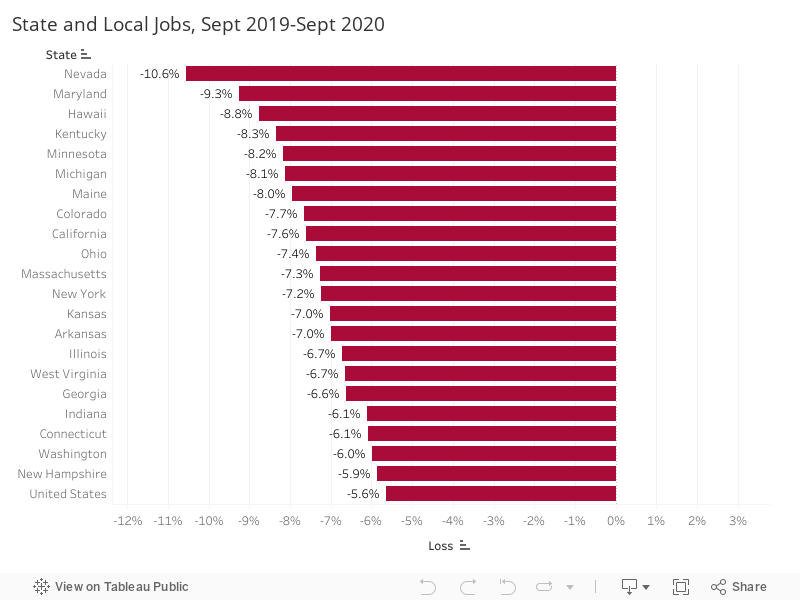
sustained neglect of state and local finances. State and local
governments are directly responsible for providing essential services,
including education and public health. And they are an important source
of (mostly) good jobs, employing almost 20 million people — or about one in eight workers — when the virus struck.
The CARES Act included $150 billion in aid to state and local governments, but with the proviso that it could only be used to defray the unanticipated costs of fighting the pandemic — not for any “regular” budgetary lines. In some states, governors either skirted these limits (using federal funds, for instance, to fill potholes) or made dubious decisions as to who to protect. Both Arizona and Iowa
used large chunks of their CARES grants to backfill their unemployment
insurance trust funds — shielding employers from future tax increases
even as their workers lost access to extended or expanded unemployment
benefits.
The only other assistance was an effort to financialize
state and local desperation. The CARES Act authorized the Federal
Reserve (through a new Municipal Liquidity Facility) to buy state and local bonds. This line of credit just kicked the crisis down the road. And the loan terms and costs were so onerous that, as the Center for Popular Democracy concluded in June, all but a handful of the jurisdictions that met the program’s population thresholds were “functionally excluded.”
dailycaller | “Despite an obvious preference by Democratic leadership to focus on
the suburbs and former Republican voters rather than working-class
communities of color, progressives like Stacey Abrams, Rep. Omar and
Rep. Rashida Tlaib are showing us – through turnout results in their
states and cities – where Democrats must invest to build the party,” the
memo says.
“We’re not going to
be successful if we’re silencing districts like mine,” Tlaib said,
according to Politico. “Me not being able to speak on behalf of many of
my neighbors right now, many of which are black neighbors, means me
being silenced. I can’t be silent.”
“We
are not interested in unity that asks people to sacrifice their freedom
and their rights any longer,” Tlaib continued. “And if we truly want to
unify our country, we have to really respect every single voice. We say
that so willingly when we talk about Trump supporters, but we don’t say
that willingly for my Black and brown neighbors and from LGBTQ
neighbors or marginalized people.”
Progressives are pushing for power in
the Joe Biden administration, despite the criticism from moderate
Democrats. Tlaib reportedly wants to see a public educator and labor
advocates in top positions. Progressives and left-wing strategists don’t
want Biden to work across the aisle with Republicans, although Biden
has expressed his desire to create a sense of unity by doing so.
“If
[voters] can walk past blighted homes and school closures and pollution
to vote for Biden-Harris, when they feel like they don’t have anything
else, they deserve to be heard,” Tlaib said, choking up as she expressed
frustration near the end of an interview this week. “I can’t believe
that people are asking them to be quiet.”
New York Rep. Alexandria Ocasio-Cortez
is calling for an “unapologetic agenda” that is distinct from the GOP
“instead of trying to play to notions of civility,” Politico reported.
Specifically, Ocasio-Cortez wants the Democratic Party to establish a
cohesive message on racism because “Democrats don’t want to talk about
race.”
straightlinelogic | The idea of individual rights protected by
the government was the foundation of the American experiment. It was
and has been imperfectly realized; it is an ideal and humanity rarely
attains its ideals. Government is and always will be the antithesis of
that still revolutionary ideal. The US government’s massive expansion
has been at the cost of the people’s liberty and has destroyed most of
their rights. That destruction has been ongoing since the beginning of
the republic and Trump has done nothing to stop or reverse i.
Philosophical insight and consistency are not among his virtues.
Nevertheless, a Biden administration will
be worse, much worse. The Democrats now openly aspire to the
collectivist ideal—the complete subjugation of the individual to the
state. We’ve gotten a preview of coming attractions with coronavirus
totalitarianism, which has obliterated the few freedoms and joys left to
Americans. For the millions of Americans who voted for him, including
me, Trump represented the last, best hope for what we consider the
American way of life.
There’s no going back, and the way forward
is for those who cherish the American ideals of individual rights,
freedom, limited government, the rule of law, and equality before that
law to break away from Washington’s and it’s aligned states’
corruptocracy and sunder the ties that bind us. Nations and governments
are not cast in stone for time and all eternity.
Certainly the bankrupt dis-United States
and its government aren’t. The bill is coming due for the debt orgy and
an unprecedented and catastrophic global economic cataclysm will take
down whomever is unlucky enough to be the president. A defeated Trump
would dodge that bullet. The resulting chaos will be unmanageable by a
government that produces only debt, can steal little or nothing from a
bankrupt economy, cannot borrow at anything but ruinous interest rates,
and which must cover its soaring budget deficits with scrip it either
prints or creates via computer entries, whether or not it outlaws real money (gold) or forces its increasingly worthless scrip to stay in the banking system.
At that time, an organized secession
movement has a real chance. A house divided against itself cannot stand.
Collapse will be freedom’s staunchest ally if the moment is seized. It
won’t be easy and it won’t be without blood. Until it happens, prepare
for the worst, it is assuredly coming and coming soon, but work towards a
brighter future in a nation that does not yet exist.
For those who don’t want to wait, almost six years ago (January 7, 2015) I published “Revolution in America,”
which presents a nonviolent way to take down the government by
attacking it at its weakest point. It requires the collective action of
millions of people and at that time I believed the recommended course of
action would remain hypothetical. Things change. Although the hour is
late, any significant fraction of Trump’s rightfully enraged 71 million
voters could still put the plan into effect. The article merits a second
look. Please pass it, and this article, on.
Asia Times | US intel is very much aware of well-documented instances of election fraud. Among them: NSA software that infiltrates any network, as previously detailed by Edward Snowden, and capable of altering vote counts; the Hammer supercomputer and its Scorecard app
that hacks computers at the transfer points of state election computer
systems and outside third party election data vaults; the Dominion software system,
known to have serious security issues since 2000, but still used in 30
states, including every swing state; those by now famous vertical jumps
to Biden in both Michigan and Wisconsin at 4am on November 4 (AFP unconvincingly tried to debunk Wisconsin and didn’t even try with Michigan); multiple instances of Dead Men Do Vote.
The key actor is the Deep State, which decides what happens next.
They have weighed the pros and cons of placing as candidate a senile,
stage 2 dementia, neocon warmonger and possible extorsionist (along with
son) as “leader of the free world”, campaigning from a basement,
incapable of filling a parking lot in hs rallies, and seconded by
someone with so little support in the Dem primaries that she was the
first to drop out.
The optics, especially seen from vast swathes of the
imperial-interfered Global South, may be somewhat terrible. Dodgy
elections are a prerogative of Bolivia and Belarus. Yet only the Empire
is able to legitimize a dodgy election – especially in its own backyard.
Welcome to the New Resistance
The GOP is in a very comfortable position. They hold the Senate and
may end up picking up as may as 12 seats in the House. They also know
that any attempt by Biden-Harris to legislate via Executive Orders will
have…consequences.
The Fox News/ New York Post angle is particularly enticing. Why are
they suddenly supporting Biden? Way beyond internal family squabbles
worthy of the Succession saga, Rupert Murdoch made it very clear, via the laptop from hell caper, that he has all sorts of kompromat on the Biden family. So they will do whatever he wants. Murdoch does not need Trump anymore.
Nor, in theory, does the GOP. Former CIA insiders assure of serious
backroom shenanigans going on between GOP honchos and the Biden-Harris
gang. Trade-offs bypassing Trump – which most of the GOP hates with a
vengeance. The most important man in Washington will be in fact GOP
Senate majority leader Mitch McConnell.
Still, to clear any lingering doubts, a vote recount would be
absolutely necessary in all 6 contested states – WI, MI, PA, GA, NV and
AZ. Through hand counting. One by one. The DoJ would need to act on it,
immediately. Not gonna happen. Recounts cost a ton of money. There’s no
evidence Team Trump – on top of it short of funds and manpower – will be
able to convince Daddy Bush asset William Barr to go for it.
While relentlessly demonizing Trump for spreading “a torrent of
misinformation” and “trying to undermine the legitimacy of the US
election”, mainstream media and Big Tech have declared a winner – a
classic case of pre-programming the sheep multitudes.
theautomaticearth | With Biden you don’t get Biden, you get the entire cabal that went
after Trump, the Democratic Party, the media, the intelligence agencies.
And yes, Biden was and is very much part of that cabal. How people do
not find that a whole lot scarier than Donald Trump is beyond me.
If -and no that is not when- Joe Biden is inaugurated on January 20
2021, that cabal will take over the country. And we’ve seen plenty
indications that they intend to make it impossible for the Republicans
to ever get one of their own elected as president again. Moreover they
will not be investigated for what they concocted over the past 4-5
years.
How the Hillary campaign and the DNC leaked things to the FBI, and
the FBI to the MSM, how they lied in courtrooms to get FISA applications
on Trump campaign people like Carter Page and George Papadopoulos. How
they set up Lt.-Gen. Michael Flynn so he wouldn’t be Trump’s National
Security Adviser, because Flynn knew too much.
It’s a scheme so full of illegal actions that it will be devastating
for the entire American political system if it is never investigated, or
even if it isn’t investigated very very thoroughly, by an impartial
party. And it won’t be if Biden becomes president.
The cabal wants you to think this is about Trump, and any given way
to get rid of him is justifiable no matter what, but that is a very
dangerous way of thinking. If crimes have been committed, they must be
brought into daylight and before a court.
Problem is, of course, that at least half the nation has no idea of
what’s been going on. Because they get their news and information from
those media that are in on the whole deal. They won’t know that the DNC
paid for the Steele Dossier, or that is was just a bunch of lies, or
that the FBI knew this even before Rosenstein appointed Mueller as
Special Counsel. All that has been kept away from them.
And yes, 4 years ago Trump said he would fight the swamp, but landed
right in the middle of it. Early in his presidency he found himself
surrounded by the likes of McMaster, John Kelly, Tillerson, and many
other swamp creatures, and today he still has people like Mike Pompeo.
But at least Trump is an outsider, and if anything can ever be done to
drain the swamp, it will have to come from an outsider. That it may take
more than 4 years is something we have to take for granted.
The swamp has fought back, and they may yet win. Joe Biden is the
face of that. But people who celebrate that victory should think again,
whether they like Trump or not. The swamp is not good for you, and it’s
not good for your country, your rights, your freedoms. Its entire MO is
to take all these away from you. This is not a partisan thing; the fat
ass of the swamp easily fits and sits across the divide.
oilprice |This is the amount of money to beinvested
in new power capacity globally over the next three decades. Most of
this—80 percent—will be poured into renewables. This certainly makes the
energy transition far from cheap, but no one—at least no one
reputable—ever said going green would be cheap. Yet the amount of
investments to be directed towards expanding wind, solar, and associated
systems will not be the only costs to be borne during the transition.
There may well be steep environmental costs as well.
BloombergnNEF,
which conducted the analysis that resulted in the investment estimate
for the next 30 years in energy, also said that between 2020 and 2050,
another $14 trillion will be invested in the grid, likely to adapt it
for a surge in solar and renewable power deployments, which, according
to the analysis, will constitute 56 percent of total global generation
capacity by 2050. And it will have spurred a mini golden age in mining.
Wind
power, like solar power, requires a lot of metals and other minerals to
produce essential components for the installations. Therefore, as the
demand for wind turbines and blades jumps, so will the demand for the
metals they are made of. It’s the same with the metals and minerals
necessary for the production of a solar panel.
Here’s just one example that could perhaps illustrate the trend: according to a 2017report
by the World Bank, demand for silver could soar from the then-current
24,000 tons annually to more than 400,000 tons. And that’s under a
best-case scenario that features a greater penetration of silver-free
thin-film PV panels in the energy mix, at the expense of crystalline
silicon panels that use silver. Under a worst-case scenario, demand for
silver could top 700,000 tons.
This
is quite an increase that will require a major expansion in mining and
mining is an energy-intensive, not particularly environmentally friendly
way of getting finite resources out of the ground, as investor Sam
Kovacs writes in anarticle
for Seeking Alpha addressing the challenges of the energy transition
from fossil fuels to renewables. Now add to silver a host of other
metals used in renewable energy installations, and the mining expansion
becomes even more substantial, adding economic, social, and
environmental costs to the transition.
Then there is energy storage. Without
it, the transition will simply not happen. In fact, some are
questioning whether it could happen given the current stage of
development of energy storage technology. Two years ago, anarticle
by James Temple for the Massachusetts Technology Review questioned the
viability of the energy transition precisely because of energy storage,
which, Temple argued, was still prohibitively expensive in light of the
scale, to which such storage would need to be developed.
theguardian |Normalcy and the restoration of a modicum of decorum to the White House: that is what many elite supporters of Joe Biden
hope for now that he has won the election. But the rest of us are
turned off by this meagre ambition. Voters who loathe Trump celebrate
his loss, but the majority rue the return to what used to pass as normal
or ethical.
When Trump contracted Covid-19, his opponents feared he might benefit
from a sympathy vote. But Trump is not a normal president seeking
voters’ sympathy. He doesn’t do sympathy. He neither needs nor banks on
it. Trump trades on anger, weaponises hatred and meticulously cultivates
the dread with which the majority of Americans have been living after
the financial bubble burst in 2008. Obscenities and contempt for the
rules of polite society were his means of connecting with a large
section of American society.
The reason 2008 was a momentous year wasn’t just because of the
magnitude of the crisis, but because it was the year when normality was
shattered once-and-for-all. The original postwar social contract broke
in the early 1970s, yielding permanent real median earnings stagnation.
It was replaced by a promise to America’s working class of another route
to prosperity: rising house prices and financialised pension schemes.
When Wall Street’s house of cards collapsed in 2008, so did this postwar
social contract between America’s working class and its rulers.
After the crash of 2008, big business deployed the central bank money
that refloated Wall Street to buy back their own shares, sending share
prices (and, naturally, their directors’ bonuses) through the
stratosphere while starving Main Street of serious investment in
good-quality jobs. A majority of Americans were thus treated, in quick
succession, to negative equity, home repossessions, collapsing pension
kitties and casualised work – all that against the spectacle of watching
wealth and power concentrate in the hands of so few.
By 2016, the majority of Americans were deeply frustrated. On the one
hand, they lived with the private anguish caused by the permanent
austerity to which their communities had been immersed since 2008. And,
on the other, they could see a ruling class whose losses were socialised
by the government, which defined the response to the crash.
Donald Trump
simply took advantage of that frustration. And he did so with tactics
that, to this day, keep his liberal opponents in disarray. Democrats
protested that Trump was a nobody, and thus unfit to be president. That
did not work in a society shaped by media which for years elevated
inconsequential celebrities.
Even worse for Trump’s opponents, portraying him as incompetent is an
own goal: Donald J Trump is not merely incompetent. George W Bush was
incompetent. No, Trump is much worse than that. Trump combines gross
incompetence with rare competence. On the one hand, he cannot string two
decent sentences together to make a point, and has failed spectacularly
to protect millions of Americans from Covid-19. But, on the other hand,
he tore up Nafta, the North American Free Trade Agreement that took
decades to put together. Remarkably, he replaced it swiftly with one
that is certainly not worse – at least from the perspective of American
blue-collar workers or, even, Mexican factory workers who now enjoy an
hourly wage considerably greater than before.
Moreover, despite his belligerent posturing, Trump not only kept his
promise to not start new wars but, additionally, he withdrew American
troops from a variety of theatres where their presence had caused
considerable misery with no tangible benefits for peace or, indeed,
American influence.
consciousnessofsheep | The geology of US oil might have been
straightforward; the economics was a little trickier. In the course of
the Second World War, the USA supplied six out of every seven barrels of
oil consumed. Venezuela accounted for most of the seventh barrel; with
small contributions from British Persia and the Soviet Caucasus.
Germany’s oil sources had been inadequate to power its civilian economy;
and its failure to capture and bring online the Caucasus oil in 1942 is the primary reason why it lost the war.
The war-torn economies which emerged from
the ashes of war in 1945, then, were almost entirely dependent upon oil
from the USA. And this allowed an internal American oil cartel – the
Texas Railroad Commission – to extend its price fixing to the entire
world. So long as US oil made up a large part of global oil production,
and so long as US oil fields had excess capacity, the TRC could
regulate the global oil price. If prices began to rise too high, the
TRC would order companies to produce more oil. If prices sank too low,
the TRC would order production cuts. As a result, throughout the boom
years 1953 to 1973, the world oil price remained stable at around $25
per barrel (at today’s prices).
When the US conventional oil
fields peaked in 1970, the TRC lost its ability to prevent prices from
rising by expanding production. This was a boon for Middle East and
North African producers whose production costs were higher than those in
the USA. And although the first – 1973 – oil shock was in part a
response to western support for Israel in the Arab-Israeli war, sooner
or later the newly empowered OPEC was going to cut supply to drive up
prices.
It is an irony that a capitalist system
which claims to be built upon competition and free markets has proved
stable only in those periods when its source of value – energy – has
been controlled by cartels. Once OPEC-led price stability was regained
in the mid-1980s, the stage was set for the global debt-boom of the
1990s and early 2000s. And with the fall of the Soviet Union and the
apparent conversion of China to state capitalism, for a brief moment the
world seemed content.
Peak oil had not, though, gone away; it
had merely been postponed. Britain discovered this the hard way after
its North Sea deposits – which had once produced more oil than Kuwait –
peaked in 1999. By 2005 – the year global conventional oil
extraction peaked – Britain had become a net importer of oil and gas.
Today, Britain’s North Sea deposits produce 60 percent less oil than in
1999; and the projected price of the remaining oil is not enough to
cover the decommissioning costs.
By 2005 though, had we but known it at
the time, we had bigger problems to deal with. The experience of the
oil shocks of the 1970s convinced many peak oilers that once the peak of
global oil extraction had been reached, prices would rise remorselessly
as a consequence of supply and demand imbalance. This, indeed, is what
appeared to happen after the 2005 peak was reached:
By 2012, Michael Kumhof and Dirk V Muir
from the International Monetary Fund were anticipating global oil
prices of more than $200 per barrel by 2020. But that isn’t what
happened. Instead, from 2014 the oil price slumped and has been on a
steadily downward trend ever since. The reason is because there is more
to peak oil than geology and engineering.
Indeed, many peak oilers make the same
mistake as economists in treating oil – and energy in general – as being
just another relatively low-cost factor of production. The wage bill,
for example, is always far higher than the energy costs of running a
business. But as economist Steve Keen explains; “capital without energy
is a statue, labour without energy is a corpse.” Or as engineering
professor Jean-Marc Jancovici explains:
“energy is what quantifies change.” Nothing happens in the world
without energy. And when the cost of the world’s biggest primary energy
source – oil – begins to spike upward, the impacts are felt in every
area of our lives.
The story of the 2008 crash is usually
told in financial terms; and is used to blame the victims. The cause of
the crisis, we are told, was so-called sub-prime borrowers taking on
mortgages that they couldn’t possibly pay back. Except, of course,
prior to 2008 they had been paying them back. So what happened
to change their circumstances so that they could no longer repay
debts? The answer is interest rate rises. The banks had based their
lending on the assumption that the economy was stable; that inflation
would grow at around two percent; and that interest rates would remain
relatively low. With house prices supposedly guaranteed to keep rising,
and having securitised the risks,
banks – with the assistance of governments – could extend home
ownership to the masses. But from 2006, central banks had been raising
interest rates; tipping borrowers into default.
Why had the central banks been raising
interest rates? Because from 2005, inflation began to break out of the 1
to 3 percent band that they were charged with maintaining. According
to all of the textbooks they had been brought up on, the central bankers
had been taught that the way to bring inflation back under control was
to raise interest rates. But they – and the economics textbooks – were
wrong. What they believed to be inflation – too much currency chasing
too few goods – was actually an economy adjusting to its first
supply-side shock since the 1970s.
c-span | I DON'T PUSH BACK, I WITNESS, I OBSERVED, I THINK IT'S REALLY IMPORTANT THAT WE BECOME OBSERVERS OF OUR EMOTIONS, FEELINGS, EXPERIENCES, THE MORE THAT YOU CAN OBSERVE EVEN THE PART OF SHAME AND GUILT IS TO NOT NOT WANTING TO LOOK AT IT, NOT WANTING TO SEE IT BUT THE MOMENT THAT YOU TAKE TIME TO OBSERVE THE IMPACT, EVERYTHING THAT IT IS HAD ON YOU AND GIVE SPACE OBSERVING NOT JUST SHAME AND JOY NOT TO SHAME AND GUILT BUT JOY AND LOVE, WE SOMETIMES ASSUME THAT WE CAN FULLY FEEL LOVED AND JOY BUT SOMETIMES THERE'S SO PRACTICE IN SHAME AND GUILT THAT EVEN WHEN LOVE AND JOY COMES OUR WAY WE CANNOT RECOGNIZE IT AND SO I'M A BIG FIRM BELIEVER OF OBSERVING OUR FEELINGS, OUR EMOTIONS, OUR BEHAVIORS GIVING THEM SPACE SO YOU CAN HAVE MORE LANGUAGE AROUND WHAT IS HAPPENING, I PRACTICE WHAT IS CALLED GENERATIVE FOAM ONYX, MANY OF US IN THEIR MOVEMENT HAVE BEEN TRAINED IN IT OR HAVE GONE THROUGH THAT TRAINING AND IT'S REALLY AN OBSERVATION OF THE BODY AND EVERYTHING WERE GOING THROUGH A FINAL SWEEP IT SLEEP ENOUGH MY EYEBALL TWITCHES, I'M NOT TAKING ENOUGH WATER AND IF WE JUST TAKE A MOMENT TO OBSERVE INTO NOTICE, WE COULD HAVE MORE LANGUAGE ABOUT OUR NEEDS, OUR DESIRES, WHAT IS GOING TO WORK FOR US AND I THINK ABOUT THAT, THAT IS THE INDIVIDUAL LEVEL, IMAGINE IF WE COULD COLLECTIVELY UNDERSTAND OUR NEEDS AND DESIRES, I THINK THAT'S WHY BLACK LIVES MATTER WAS SO PROFOUND FOR BLACK PEOPLE BECAUSE IT BECAME A THING THAT WE DID NOT REALIZE THAT WE NEEDED AS A COLLECTIVE TO GALVANIZE AROUND, THE MORE THAT WE CAN COLLECTIVELY UNDERSTAND OUR TRAUMA, THE MORE THAT WE CAN COLLECTIVELY UNDERSTAND OUR RESILIENCE, WE CAN COLLECTIVELY UNDERSTAND OUR NEEDS, OUR DESIRES AND THE CLOSER WE CAN GET TO FREEDOM.
YOU WILL BE SHOCKED HOW MUCH YOU REMEMBER AS YOUR PROBED AND ASKED QUESTIONS. I REALLY SAT AND SAID LET'S START FROM THE BEGINNING AND WE WERE PRETTY MUCH IN CONVERSATION ON A DAILY BASIS LIKE AT THE CRACK OF DAWN AND SOME OF THE STORIES IT WAS BECAUSE I WAS TALKING TO GET TO THE NEXT STORY, A CHAPTER ON MY MIDDLE SCHOOL YEARS CALLED 12 WHERE I TALK ABOUT THE FIRST TIME I AM ARRESTED, THAT WAS NOT SOMETHING I PLANNED ON PUTTING IN THE BOOK I WAS NOT EVEN THINKING ABOUT THAT BUT I WAS TALKING A LOT TO KIND OF EXPLAIN THE DIFFERENCES IN THE SCHOOL THAT I WENT TO, WHEN I WENT TO SUMMER SCHOOL, MY HOMESCHOOL, THE HOMESCHOOL MY NEIGHBORHOOD AND A COP CAME AND ARRESTED ME AND WAS LIKE WAIT A SECOND, WHAT HAPPENED AND I WAS LIKE 0 YEAH WHEN I WAS 12 I GOT ARRESTED AT SCHOOL AND SHE WAS LIKE OKAY THAT NEEDS TO GO IN THE BOOK, YOU'VE TALKED SO MUCH ABOUT YOUR SIBLINGS AND THE BOYS IN THE NEIGHBORHOOD BUT YOU WERE ALSO CRIMINALIZED IN THE CRIMINALIZATION OF BLACK GIRLS AND WE HOLD ALL THE STORIES, WE STORE THEM, THEY DON'T LEAVE OUR BODIES, THEIR IN THERE SOMEWHERE AND WHEN THEIR UNLOCKED, I THINK THEY CREATE A LOT OF THINGS, OPPORTUNITY, SOMETIMES TOO MUCH FOR PEOPLE WHO ARE SURVIVORS ESPECIALLY OF SEXUAL ASSAULT AND VIOLENCE, SOMETIMES YOU LOCK AWAY THE MEMORIES FOR SURVIVAL AND SAFETY AND OF THOSE ARE UNLOCKED WITHOUT GETTING THE SUPPORT CAN REALLY CAUSE A LOT OF HARM, I SAY THAT BECAUSE I'M NOT ROMANTICIZING THE MEMORY THAT I HAVE AND WHAT I UNLOCKED, I VERY MUCH GO TO THERAPY, I DO THERAPY TWICE A WEEK, I TRY MY HARDEST TO REALLY TAKE CARE OF MY EMOTIONAL HEALTH EVEN MY OWN HISTORY WITH COMPLEX PTSD, GIVEN WHAT I'VE GROWN UP WITH AND WITNESSED, THIS BOOK BUILDING OF THIS MEMOIR DID REMIND ME THAT WHAT HAPPENED TO ME AND MY FAMILY WAS REALLY, REALLY UNACCEPTABLE AND VERY DISTURBING INCREDIBLY TRAUMATIC AND I WILL PROBABLY NEED TO BE, NOT IN A JUDGMENTAL WAVE AND LIFELONG THERAPY BECAUSE OF IT, I WAS JUST TEXTING WITH MY MOM, DO YOU WANT TO GO TO THERAPY.
I AM VERY TRANSPARENT, I'M IN THERAPY HOPING SHALL BE LIKE MAYBE I'LL DO IT TO, WE DESERVE HEALING FROM WHAT IS HAPPENED TO US IN WHAT CONTINUES TO HAPPEN, WE DESERVE THE TIME AND SPACE, MY BIG DEMAND ON MY LAST BOOK TO HER I WAS SAYING IN EVERY CONVERSATION FIRST OF ALL I BELIEVE IN REPARATION BUT I THINK THERE SHOULD BE A WHOLE SECTION WHEN WE CREATE OUR REPARATION IMPACTED ENTER PACKAGE ON HEALING JUSTICE, EVERY SINGLE BLACK PERSON IN THEIR FAMILY SHOULD HAVE A DESIGNATED WHO CAN SUPPORT THEM UP WITH THEM THROUGH THE HISTORY OF TRAUMA THAT WE HAVE GONE THROUGH TO GET US CLOSER TO BEING WHOLE HUMAN BEINGS, WHEN YOU'RE TRAUMATIZED, YOU'RE NOT A WHOLE HUMAN BEING, YOUR ACTING FROM YOUR TRAUMA PLACE, WE DESERVE TO BE FULLY REALIZED HUMAN BEINGS, I THINK REPARATIONS WILL GET US THAT AN ACTIVE THERAPY, A LOT OF OTHER THINGS AS WELL THE ACTIVE THERAPY AS WELL.
RT | CNN host Van Jones is being hauled over the coals on social
media, facing accusations of hypocrisy for tearfully heralding the end
of Donald Trump’s presidency despite working with his administration.
After Democrat Joe Biden
was projected to have won the election on Saturday, the CNN commentator
launched into an emotional speech about how “it’s easier to be a parent this morning.”
“It’s easier to be a dad this morning. It’s easier to tell your kids, ‘Character matters, being a good person matters,’” he said.
The pundit then broke down into tears and continued: “And it’s
easier for a whole lot of people. If you’re Muslim in this country, you
don’t have to worry that the president doesn’t want you here. If you’re
an immigrant, you don’t have to worry if the president is going to be
happier to have babies snatched away or send dreamers back for no
reason.”
The clip was widely shared on social media and
many people, including NBA star LeBron James and actor Mark Ruffalo,
applauded Jones for his words.
However, thousands of others noted
that Jones’ remarks were markedly different from comments he previously
made about what Trump had done for the black community and the fact that
he worked with the administration.
Photos of Jones, who was an official in the Obama White House,
alongside members of the Trump administration and family racked up
thousands of likes on Twitter. News articles about Jones’ comments and
his ties to the administration were also widely shared.
Indeed, just over two weeks ago Jones said that Trump doesn’t get enough credit for his actions to help black people.
“I think it's really unfortunate because Donald Trump, and I get
beat up by liberals every time I say it but I keep saying it, he has
done good stuff for the black community,” Jones said on CNN.
“Opportunity
Zone stuff, black college stuff, I worked with him on criminal stuff, I
saw Donald Trump have African American people, formerly incarcerated,
in the White House, embraced them, treated them well. There is a side to
Donald Trump that I think he does not get enough credit for,” he added.
suntimes | In the book, Stuart cites a University of Chicago study that says Black teens create more online content than any other racial group. In February, the Sun-Times reported that less than 5 percent of workers at Facebook, Instagram and Twitter are Black.
Drill also crosses paths with hip-hop’s “Blog Era’ — a
period where local artists such as The Cool Kids and Kidz in the Hall
made names for themselves by releasing new content via music blogs
instead of relying on music industry gatekeepers, along with rappers
with strong, national DIY followings such as Wiz Khalifa, Mac Miller,
Curren$y, and Gary, Indiana, native Freddie Gibbs, among others.
“These guys all blew up and had all these videos with
millions of plays, and all this notoriety and songs and mixtapes getting
downloaded,” said Andrew Barber, owner/creator of “Fake Shore Drive,” a
Chicago music blog. “But none of it counted toward the new
certifications that the RIAA has in place or the Billboard charts.”
Due to the subgenre’s reputation, many record companies refused to sign drill artists; their music was banned by venues.
“I just thought you need to have these ridiculous bar
guarantees and rental fees, and later in life I find out that was just a
Black thing, or a risk assessment type of thing, even though there was
never a risk,” said concert promoter and Complex Studios co-founder
Marques “Merk” Elliston, who says he partnered with Hologram USA to have
Chief Keef’s hologram perform at a Hammond, Indiana, venue before local
police shut it down citing safety issues. “That’s why you see the lack
of remorse for a lot of these people [venues].”
Due to those fears, some of the genre’s artists are opting to move away from the drama.
“It was a part of our lives; we saw it as normal,” said Bronzeville
native Sasha Go Hard, who is featured in the theme song for the Comedy
Central series “South Side.” “It became a trend to start dissing people.
… These are not just songs that people are making; it’s really
happening. It was easy for me to branch away from drill. I went a
different route by touring overseas and making EDM songs.” Fist tap Big Don
dailybeast | As his now infamous 2016 line about giving Trump a
chance—inadvertently echoed in Biden’s victory speech earlier Saturday
night—revealed, Chappelle’s politics have never been simple to
characterize. His public criticism of Hillary Clinton in the final days of that election were bad enough that he had to later clarify
that he was “not a Trump supporter.” His willingness to give Trump a
“chance” followed him for months, at least until he told Stephen Colbert
in 2017, “It’s not like I wanted to give him a chance that night.”
More recently, during an episode of David Letterman’s Netflix show My Next Guest Needs No Introduction, Chappelle answered a question about Trump’s Muslim ban by offering up what easily could be considered a both-sides take on the two presidential candidates.
“You
don’t expect necessarily that empathy, compassion or cultural
astuteness from a guy like that,” Chappelle, who converted to Islam in
the early ‘90s, told Letterman. “What you’re sad about is that the chair
doesn’t have more humanity in it. But has that chair ever been that
humane? When Biden called Trump the first racist president ever, well clearly that’s not true. So how do I feel when I hear a white person say some stupid shit?”
As Letterman laughed, Chappelle answered his own question with a comical shrug.
“I would implore everybody who’s celebrating to remember, it’s good
to be a humble winner,” Chappelle said on Saturday. “Remember when I was
here four years ago? Remember how bad that felt. Remember that half the
country right now still feels that way. Please remember that.”
“Remember
that for the first time in the history of America, the life expectancy
of white people is dropping because of heroin, because of suicide,” he
continued. “All these white people out there that feel that anguish,
that pain, that man, they think nobody cares. Maybe they don’t.”
“Let
me tell you something: I know how that feels,” he added. “I promise
you, I know how that feels. If you’re a police officer and every time
you put your uniform on, you feel like you’ve got a target on your back,
you’re appalled by the ingratitude that people have when you would risk
your life to save them, believe me, I know how that feels.”
“But
here’s the difference between me and you,” Chappelle said. “You guys
hate each other for it. And I don’t hate anybody. I just hate that
feeling. That’s what I fight through. That’s what I suggest you fight
through. You’ve got to find a way to live your life. You’ve got to find a
way to forgive each other. You’ve got to find a way to find joy in your
existence in spite of that feeling. And if you can't do that…come get
these n---a lessons.”
Two by Stan Getz: Focus and Voices
-
Note: Each video links to the first selection in a play-list that links to
the whole album, one cut after the other.
*Focus*
Wikipedia:
*Focus* is a...
Celebrating 113 years of Mama Rosa McCauley Parks
-
*February 4, 1913 -- February 4, 2026*
*Some notes: The life of the courageous activist Mama Rosa McCauley Parks*
Mama Rosa's grandfather Sylvester Ed...
Monsters are people too
-
Comet 3I/Atlas is on its way out on a hyberbolic course to, I don't know
where. I do know that 1I/Oumuamua is heading for the constellation Pegasus,
and ...
Remembering the Spanish Civil War
-
This year marks the 90th anniversary of the launch of the Spanish Civil
War, an epoch-defining event for the international working class, whose
close study...
Return of the Magi
-
Lately, the Holy Spirit is in the air. Emotional energy is swirling out of
the earth.I can feel it bubbling up, effervescing and evaporating around
us, s...
Covid-19 Preys Upon The Elderly And The Obese
-
sciencemag | This spring, after days of flulike symptoms and fever, a man
arrived at the emergency room at the University of Vermont Medical Center.
He ...
-
(Damn, has it been THAT long? I don't even know which prompts to use to
post this)
SeeNew
Can't get on your site because you've gone 'invite only'?
Man, ...
First Member of Chumph Cartel Goes to Jail
-
With the profligate racism of the Chumph Cartel, I don’t imagine any of
them convicted and jailed is going to do too much better than your run of
the mill ...