off-guardian | Recently I had the poor judgment to turn on National Public Radio for
about an hour, under the impression that I was going to learn something
about the day’s news.
I could have saved myself the trouble. During the hour in question, I
learned nothing at all about the presidential election campaign (now in
its final months), nothing about the tens of millions
of my fellow citizens whose jobs have been snatched away by government
fiat, nothing about climate change, nuclear arms buildups, international
refugees or growing worldwide poverty – nothing even about the intensification of air and water pollution authorized by recent federal regulation, although pollution kills an estimated 100,000 Americans every year.
No – for a solid hour, I heard the following: that COVID19 – in
reality, at most, a moderately serious flu virus – is the worst medical
threat the United States has ever faced; that this “deadly” virus (the
word “deadly” was repeated obsessively, even though the disease is fatal
in a tiny percentage of cases) has been empowered by a conspiracy of
Republican politicians serving the arch-demon Donald Trump; that recent
data showing the rapid decline in deaths attributable to the virus may
have been faked, because the numbers aren’t what the “experts” want them
to be; and that a massive increase in COVID19 tests – primarily among
people between 20 and 40 years of age who are subjected to swabbing
because their employers demand it, not because they’re in any danger –
cannot possibly have anything to do with a rise in the number of
reported infections, and that anyone who dares to suggest otherwise is
“putting lives at risk.”
But the real theme of the hour was masks, masks, masks: how to make
them, how to wear them, their different types, who doesn’t seem to have
enough of them, and why muffling our faces (even though no such thing
was ever demanded of us during dozens of past viral outbreaks) is
absolutely, positively good for us all.
I waited in vain for some mention of the fact that every single order requiring the wearing of muzzles in the US is probably unconstitutional,
a matter that National Public Radio – which once prided itself on its
legal affairs reporting – might have been expected to care about.
No, facts would only have complicated matters. After all, we already
knew what good little boys and girls were expected to do with those
muzzles. At the close of each weather forecast, just in case anyone had
missed the point, the reporter said cheerily, “And when you go out – put
on a mask.” “And drink milk with every meal,” I half expected him to
add, but I guess self-conscious condescension would have spoiled the
effect.
Put on a mask.
In well over half a century, I cannot remember a weather report that
ended with a brisk piece of non-meteorological advice, let alone a
patently silly one – after all, if these magical masks were to make any
difference, their greatest usefulness would have been at the beginning
of the outbreak, not on its heels.
Yet throughout March, while police-state fever prompted the suspension of democracy in some 40 states
and most of the US population was being hustled into virtual house
arrest, the pro-incarceration crowd’s loudest voices unanimously
insisted that masks were of no practical value.
propublica | Experts said how police respond to
demonstrations is, in part, dictated by the availability of nonlethal
weapons and on how officers are trained to use them.
In 2016, Haar surveyed
25 years of research on crowd-control weapons used around the world,
including three commonly used in the United States: projectiles such as
rubber bullets or beanbag rounds; chemical irritants such as tear gas; and disorientation devices known as flashbangs. Her report found that when fired, tear gas canisters can cause vision loss or other traumatic injuries.
“These
are all weapons that should be used as a last resort when open dialogue
and communication fail and the violence is so out of hand that normal
policing methods and arresting people have been tried and don’t work,”
Haar said.
The size of protests also influences how police
respond, Straub said. Small protests can likely be handled by
specialized units that are regularly tasked with managing crowds. Larger
protests may require many more officers, some of them drawn from parts
of police departments that have less experience and training in crowd
control and de-escalation, and thus may be more likely to resort to
weapons.
In the Washington video, by not rushing the crowd when a
protester threw a bottle, Straub said, the officers remained calm and
acted with “restraint.” It would be unfair, Straub said, to require the
police to analyze what protesters are throwing at them before reacting,
given how quickly such an encounter could escalate. “One person throws a
water bottle, five people throw water bottles, and then somebody throws
a brick,” he said.
Experts said how quickly officers choose to
deploy weapons in the field depends on their training, which can vary
widely between departments.
No entity sets training standards for
police use of force, experts said. However, departments, equipment
manufacturers and state officials have mandated that officers undergo
training before they are allowed to use nonlethal weapons. Depending on
the training, officers may be taught how to shoot weapons so they “skip
off the pavement” in order to decrease their velocity and risk of
serious injury.
In firing their guns, officers are taught to aim
at the person’s torso because it reduces the risk that a bystander will
be struck. But with nonlethal weapons, officers are often instructed to
avoid the torso, head or groin, said Thor Eells, executive director of
the National Tactical Officers Association, a trade group for SWAT teams
that also conducts training for police departments. Precise aim in a
crowd is extremely difficult, he said.
“We explain to them that in
a crowd control situation, it’s a dynamic environment,” Eells said.
“It’s not the same as a paper target.”
Reaction to police escalation caught on video has been swift.
As demonstrations continued and the media drew attention to the police tactics, departments in at least 40 cities have announced changes. In Philadelphia, officials announced a moratorium on tear gas to control crowds, New York moved to make officers’ disciplinary records public, San Francisco announced plans to stop sending police officers to calls that don’t involve criminal activity and Atlanta now requires officers to intervene if they see another officer using unreasonable force.
Straub
said that the scrutiny of officers’ actions in protests, and the
condemnation of George Floyd’s killing in Minneapolis, were strong
signals “that that kind of behavior isn’t going to be tolerated.”
Meanwhile,
academic conversations around defunding or abolishing the police have
been around for decades, but now, some politicians are opening up to
such notions. That’s in part, Bell said, because of the “intellectual
organizing” Black Lives Matter activists did early on to help frame the
injustices they were protesting.
“Now, the real question about whether this time will be ‘different’ also has to do with what’s adopted,” Bell said.
dailymail | Federal agents teargassed a group of
mothers who formed a 'wall of moms' to protect protesters during a Black
Lives Matter demonstration over the weekend as the mayor of Oregon's
largest city ordered the officers to leave.
Portland has seen nearly two months of nightly protests since George Floyd died under the knee of Minneapolis police officer Derek Chauvin on May 25.
While
the majority of protests have remained peaceful, fires have been set in
dumpsters near the city's courthouse and the walls of the building have
been defaced.
The agents used tear gas and flash bangs to disperse the mothers participating in the 'Wall of Moms' protest.
The
women had formed a human shield between protesters and law enforcement
officials outside a federal courthouse, donning bike helmets and linking
arms.
They carried signs that read 'Angry mama bear BLM' and chanted 'Moms are here, feds stay clear.'
According
to Melanie Damm, unidentified federal officers in military-style gear
fired tear gas canisters into the group of mothers, clad mostly in
white.
'The level of violence escalated
by these GI soldiers was such an overreaction. You're seeing moms
getting tear-gassed,' said Damm, herself a 39-year-old mom. ''
'We aren't young and Antifa-looking,' she said, referring to more militant anti-fascism protesters.
And despite being teargassed, the mothers showed up to Sunday night's protest.
LATimes | She emerged as an apparition from clouds of tear gas as federal
agents fired pepper balls at angry protesters in the early Saturday
darkness.
A woman wearing nothing but a black face mask and a
stocking cap strode toward a dozen heavily armed agents attired in
camouflage fatigues, lined up across a downtown Portland street. The
agents, dispatched by the Trump administration over vociferous
objections of state and city officials, are part of a force that has
fired projectiles at and detained activists protesting nightly since the
killing of George Floyd by Minneapolis police May 25.
Numerous
photos and videos posted on Twitter show the unidentified woman as she
halted in the middle of the street at about 1:45 a.m. She stood calmly, a
surreal image of human vulnerability in the face of an overpowering
force that has been criticized nationally by civil rights advocates.
The
agents, in gas masks and helmets, continued firing pepper balls in a
staccato “pop, pop, pop” heard on video, aiming low at the asphalt,
where puffs of smoke mingled with clouds of gas. At one point, a fellow
protester, clothed, carrying a homemade shield, darted in front of the
woman, angling to protect her.
But the woman sidestepped him. He jumped out of the way, perhaps realizing that he made them both a target.
Before
it was over, she struck ballet poses and reclined on the street. She
also sat on the asphalt in a yoga-like position, facing officers, before
they left.
lawfareblog |Today marks the 50th straight day of protests in Portland, Oregon—which have been ongoing since shortly after the May 25 murder of George Floyd. The protests have been largely peaceful, but there have been several well-documented episodes of violence, vandalism and property damage. In the past few days, however, the protests have been met with what appears to be a significant federal law enforcement response—the contours of (and legal authorities for) which are, at best, unclear. By all appearances, there are now at least 100 federal law enforcement officers on the ground in Portland. But media reports suggest that many of those officers (a) are not wearing identifiable uniforms or other insignia, (b) are not driving marked law enforcement vehicles, and (c) are not identifying themselves either publicly or even to those whom they have detained and arrested. Making matters worse, local authorities—from the mayor to the sheriff to the governor—have repeatedly insisted not only that they don’t want federal assistance but that the federal response is aggravating the situation on the ground. Acting Homeland Security Secretary Chad Wolf, in contrast, has repeatedly taken to Twitter to claim that local authorities are refusing to restore order—albeit with only vague references to which federal laws are not being enforced (and repeated allusions to “graffiti” and other property damage by “violent anarchists”).
In all of these respects, what’s happening in Portland appears to be a reprise of much of what happened in Washington, D.C., at the beginning of June, when Attorney General William Barr called upon a wide array of statutory authorities to commandeer hundreds of federal law enforcement officers in order to “restore order” in the nation’s capital. At the time, many who both criticized and defended Barr’s actions pointed to the federal government’s unique legal authority over the District of Columbia—implying (whether as a feature or a bug) that the same authorities wouldn’t be available, at least to the same extent, in the 50 states. But if nothing else, the events in Portland appear to underscore that the federal government sees no such distinction—and that it believes it has the power to similarly deploy federal law enforcement authorities across the country, even (if not especially) over the objections of the relevant local and state officials.
All of this raises a host of questions, very few of which can be answered at this point. This post is not meant as a comprehensive explainer but, rather, as an effort to separate out the many distinct (if overlapping) issues that the federal response in Portland appears to raise. Thus, what follows is a list of questions and a few tentative thoughts as to possible answers. Needless to say, it would behoove Attorney General Barr and Acting Secretary Wolf to answer these questions—and to do so sooner rather than later.
Those DHS Federal Police could take the Portland arrestees to the nearest military base and hold them there incommunicado with no call to lawyers. Their relatives might never be informed about their detention. Except for Habeus Corpus…,
About that Habeus Corpus, Obama cancelled that when he “reluctantly” signed the National Defense Authorization Act.
“The National Defense Authorization Act signed by President Obama on the 31st December 2011 authorises the indefinite detention, without trial or indictment, of any US citizens designated as enemies by the executive. The individuals concerned are not only those who have been captured on the field of battle, but also those who have never left the United States or participated in any military action.”
globalresearch |Far from having broken with his Republican predecessor,
Democratic President Barack Obama has now reinforced the law of
exception that he criticised when he was a senator. It is now possible
to deprive United States citizens of their fundamental rights because
they have taken part in armed action against their own country, but also
when they take a political position favourable to those who use
military action to resist the Empire. Worse – Barack Obama has added to
the law John Yoo’s “Unitary Executive theory,” which puts an end to the
principles of the separation of powers as defined by Montesquieu. The
security policy of the United States President now escapes all control.
The Presidential elections, and the game of a possible changeover
between Democrats and Republicans, cannot hide a marked tendency towards
mutation in the form of the United States executive, regardless of the
colour of the Presidential ticket. And it seems that the most
significant change in the law has taken place under President Obama.
Barack Obama was elected by evoking a future based on respect for the
fundamental rights of individuals and nations. But assessment of his
presidency reveals an entirely different picture. The visible aspects of
this, such as the failure to close down Guantánamo Bay, the maintenance
of exceptional military tribunals or the practice of torture in
Afghanistan, are only the tip of the iceberg. These elements only allow
us to note the continuity between the Bush and Obama administrations.
However, there has been such reinforcement of the previous political
structure that the form of the state has now changed, creating a
hitherto unseen modification of the relation between the authorities and
the citizens of the United States.
The possibility of treating US citizens as foreign ’terrorists’ has
been a constant objective of the government executive since the attacks
of 9/11. By the new prerogative which has been awarded him by the
National Defense Authorization Act – that of being able to nullify
Habeas Corpus for US citizens and not just for foreign nationals – the
Obama administration has achieved what the previous government had only
planned but never instituted.
counterpunch | A new trove of heavily redacted documents provided by the US
Department of Homeland Security (DHS) in response to a Freedom of
Information Act (FOIA) request filed by the Partnership for Civil
Justice Fund (PCJF) on behalf of filmmaker Michael Moore and the
National Lawyers Guild makes it increasingly evident that there was and
is a nationally coordinated campaign to disrupt and crush the Occupy
Movement.
The new documents, which PCJF National Director Mara
Verheyden-Hilliard insists “are likely only a subset of responsive
materials,” in the possession of federal law enforcement agencies, only
“scratch the surface of a mass intelligence network including Fusion
Centers, saturated with ‘anti-terrorism’ funding, that mobilizes
thousands of local and federal officers and agents to investigate and
monitor the social justice movement.”
Nonetheless, blacked-out and limited though they are, she says they
offer clues to the extent of the government’s concern about and focus on
the wave of occupations that spread across the country beginning with
last September’s Occupy Wall Street action in New York City.
The latest documents, reveal “intense involvement” by the DHS’s
so-called National Operations Center (NOC). In its own literature, the
DHS describes the NOC as “the primary national-level hub for domestic
situational awareness,
common operational picture, information fusion, information sharing,
communications, and coordination pertaining to the prevention of
terrorist attacks and domestic incident management.”
The DHS says that the NOC is “the primary conduit for the White House
Situation Room” and that it also “facilitates information sharing and
operational coordination with other federal, state, local, tribal,
non-governmental operation centers and the private sector.”
Remember, this vast yet centralized operation — what
Verheyden-Hilliard describes as “a vast, tentacled, national
intelligence and domestic spying network that the U.S. government
operates against its own people” — was in this case deployed not against
some terrorist organization or even mob or drug cartel, but rather
against a loose-knit band of protesters, all conscientiously and
publicly committed to nonviolence, who were exercising their
Constitutionally-protected right to gather in public places and to speak
out against the crimes and abuses of the corporate elite and the
politicians who are bought and paid by that elite.
BAR |“I was beaten bloody by police officers. But I never hated them. I said, ‘Thank you for your service.’” --Congressman John Lewis
The people who fought against Jim Crow segregation in the 1960s were
quite literally risking their lives. The list of martyrs is a long one.
Activists of that era are rightly respected and their courage must not
be forgotten or taken for granted. But as congressman John Lewis proves,
their actions at that time should not provide dispensation from
critique in the 21st century. Lewis is the latest target of president-elect Donald Trump’s attacks but that shouldn’t give him a pass either.
Despite his early history, Lewis now exemplifies everything that is
wrong with the Congressional Black Caucus, the Democratic Party and the
black misleadership class. The caucus was once known as “the conscience
of the Congress.” Those men and women were always among the most left
leaning members and could be counted on to reliably fight against
domestic injustice and imperialism abroad. They were unafraid of their
party leadership or of presidents either.
“The CBC that is a shell of its former self.”
But all that changed when they were targeted by big money
contributors like the rest of their congressional colleagues. After
years of unsuccessfully attempting to make inroads among black Americans
the right wing realized their error. They began to promote compliant
corporatist candidates for office and to target people like Cynthia
McKinney and Earl Hilliard for defeat. The result is now a CBC that is a
shell of its former self.
Instead of providing inspirational leadership to their constituents
CBC members are now mere lackeys for the corporate wing of the
Democratic Party. They said nothing when Barack Obama made grand
austerity bargains with Republicans, or used sanctions, jihadists and
drone warfare to kill in Somalia and Libya, or when he refused to
prosecute killer cops. Only one of them, Keith Ellison, chose to support
Bernie Sanders instead of Hillary Clinton, and CBC’s lobbying arm gave
her a hearty and undeserved endorsement.
Lewis stood out among all the genuflectors. Having been dubbed a
“civil rights icon” his opinions are given undue weight and he uses them
to uphold the corrupt establishment. Not only did the Congressional
Black Caucus Foundation endorse Clinton but Lewis chose to give the
hapless Sanders a very public beat down. Sanders used his own youthful
movement activism as a political calling card but Lewis dismissed him.
He claimed he knew nothing about Sanders but did know the Clintons who
were great friends of black people. The effort to discredit Sanders was
so obvious and the claims about the Clintons were so outrageous that
Lewis was forced to back track and clarify his comments.
activistpost | A biometric digital identity platform that “evolves just as you evolve” is set to be introduced in
“low-income, remote communities” in West Africa thanks to a
public-private partnership between the Bill Gates-backed GAVI vaccine
alliance, Mastercard and the AI-powered “identity authentication”
company, Trust Stamp.
The program, which was first launched in
late 2018, will see Trust Stamp’s digital identity platform integrated
into the GAVI-Mastercard “Wellness Pass,” a digital vaccination record
and identity system that is also linked to Mastercard’s click-to-play system that powered by its AI and machine learning technology called NuData. Mastercard, in addition to professing its commitment to promoting “centralized record keeping of childhood immunization” also describes itself as
a leader toward a “World Beyond Cash,” and its partnership with GAVI
marks a novel approach towards linking a biometric digital identity
system, vaccination records, and a payment system into a single cohesive
platform. The effort, since its launch nearly two years ago, has been funded via
$3.8 million in GAVI donor funds in addition to a matched donation of
the same amount by the Bill and Melinda Gates Foundation.
In early June, GAVI reported that Mastercard’s
Wellness Pass program would be adapted in response to the coronavirus
(COVID-19) pandemic. Around a month later, Mastercard announced that
Trust Stamp’s biometric identity platform would be integrated into
Wellness Pass as Trust Stamp’s system is capable of providing biometric
identity in areas of the world lacking internet access or cellular
connectivity and also does not require knowledge of an individual’s
legal name or identity to function. The Wellness Program involving GAVI,
Mastercard, and Trust Stamp will soon be launched in West Africa and
will be coupled with a COVID-19 vaccination program once a vaccine
becomes available.
The push to implement biometrics as part of national ID registration
systems has been ongoing for many years on the continent and has become a
highly politicized issue in
several African countries. Opposition to similar projects in Africa
often revolves around the costs surrounding them, such as the biometric
voter management system that the Electoral Commission of Ghana has been
trying to implement ahead of their 2020 general election in December.
Bright Simons, honorary VP of the IMANI policy think tank, has
questioned the “budgetary allocation” for the new system, claiming that
the “unnecessary registration of 17 million people all over again”
represents millions of dollars “being blown for reasons that nobody can
explain in this country.”
iatp |Fourteen years ago, the Bill and Melinda Gates and
Rockefeller foundations launched the Alliance for a Green Revolution in
Africa (AGRA) with the goal of bringing Africa its own Green Revolution
in agricultural productivity. Armed with high-yield commercial seeds,
fertilizers and pesticides, AGRA eventually set the goal to double
productivity and incomes by 2020 for 30 million small-scale farming
households while reducing food insecurity by half in 20 countries.
According to a new report from a broad-based civil
society alliance, based partly on my new background paper, AGRA is
“failing on its own terms.” There has been no productivity surge. Many
climate-resilient, nutritious crops have been displaced by the expansion
in supported crops such as maize. Even where maize production has
increased, incomes and food security have scarcely improved for AGRA’s
supposed beneficiaries, small-scale farming households. The number of
undernourished in AGRA’s 13 focus countries has increased 30% during the
organization’s well-funded Green Revolution campaign.
"The results of the study are devastating for AGRA and
the prophets of the Green Revolution," says Jan Urhahn, agricultural
expert at the Rosa Luxemburg Stiftung, which funded the research and on
July 10 published “False Promises: The Alliance for a Green Revolution in Africa (AGRA).”
A Record of Failure
As I document in my background paper, “Failing Africa’s Farmers: An Impact Assessment of the Alliance for a Green Revolution in Africa,” AGRA
has received nearly $1 billion in contributions, the vast majority from
the Gates Foundation but with significant contributions from donor
governments, including from the United States, United Kingdom, Germany
and other countries. AGRA has made over $500 million in grants to
promote its vision of a “modernized” African agriculture freed from its
limited technology and low yields. The campaign has been fortified with
large financial outlays by African governments, much of it in the form
of subsidies to farmers to buy the seeds and fertilizers AGRA promotes.
These subsidy programs have been estimated to provide as much as $1
billion per year in direct support for such technology adoption.
AGRA has been controversial from the start. Many farmers’
groups on the continent actively opposed the initiative, pointing to
negative environmental and social impacts of the first Green Revolution
in Asia and Latin America. Since AGRA’s founding, scientists and world
leaders have gained growing awareness of the limitations of
input-intensive agricultural systems, particularly to mitigate and adapt
to climate change. The U.N. Intergovernmental Panel on Climate Change
in 2019 documented the many ways industrialized agriculture contributes
to climate change, calling for profound changes to both mitigate and
help farmers adapt to climate disruptions.
Surprisingly, as AGRA reaches its self-declared deadline
of 2020, the organization has published no overall evaluation of the
impacts of its programs on the number of smallholder households reached,
the improvements in their yields and household incomes or their food
security, nor does it make reference to its goals or progress in
achieving them. Neither has the Bill and Melinda Gates Foundation, which
has provided two-thirds of AGRA’s funding. This lack of accountability
represents a serious oversight problem for a program that has both
consumed so much in the way of resources and driven the region’s
agricultural development policies with its narrative of
technology-driven, input-intensive agricultural development.
ourfiniteworld | It seems like a reset of an economy should work like a reset of your
computer: Turn it off and turn it back on again; most problems should be
fixed. However, it doesn’t really work that way. Let’s look at a few of
the misunderstandings that lead people to believe that the world
economy can move to a Green Energy future.
[1] The economy isn’t really like a computer that can be
switched on and off; it is more comparable to a human body that is dead,
once it is switched off.
A computer is something that is made by humans. There is a beginning
and an end to the process of making it. The computer works because
energy in the form of electrical current flows through it. We can turn
the electricity off and back on again. Somehow, almost like magic,
software issues are resolved, and the system works better after the
reset than before.
Even though the economy looks like something made by humans, it really is extremely different. In physics terms, it is a “dissipative structure.” It is able to “grow” only because of energy consumption, such as oil to power trucks and electricity to power machines.
The system is self-organizing in the sense that new businesses are
formed based on the resources available and the apparent market for
products made using these resources. Old businesses disappear when their
products are no longer needed. Customers make decisions regarding what
to buy based on their incomes, the amount of debt available to them, and
the choice of goods available in the marketplace.
There are many other dissipative structures. Hurricanes and tornadoes
are dissipative structures. So are stars. Plants and animals are
dissipative structures. Ecosystems of all kinds are dissipative
structures. All of these things grow for a time and eventually collapse.
If their energy source is taken away, they fail quite quickly. The
energy source for humans is food of various types; for plants it is
generally sunlight.
Thinking that we can switch the economy off and on again comes close
to assuming that we can resurrect human beings after they die. Perhaps
this is possible in a religious sense. But assuming that we can do this
with an economy requires a huge leap of faith.
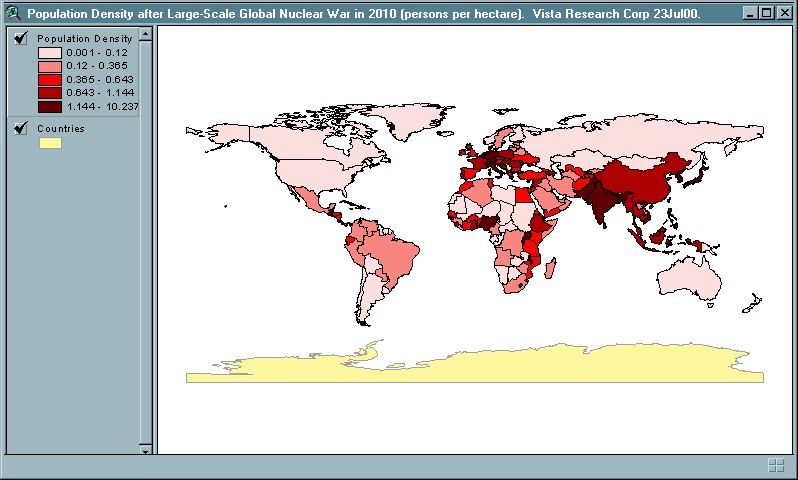
Wizards at War VII - January 10, 2008 - I interpreted the current livestock manangement process now underway through a rather simplistic and brutal lens:
Population cull resulting from large scale thermonuclear war (Joseph George Caldwell)
The thesis of this book is that when fossil-fuel reserves deplete in a few years, the global human population of Earth will drop to about 500 million people or less -- a small fraction of the current six billion. The future is one of global ethnic war and the end of the modern industrialized world. The book examines a "minimal regret" population strategy that shows promise as a sustainable, environmentally sound basis for world population. This population consists of a single industrialized nation of five million people and a hunter-gatherer population of five million.
If I simply compare the level of investment and preparation dedicated to a zero-sum, minimal regret population scenario for resolving the earth's ecological crisis vs. the systematic crash aversion strategy outlined by Lester Brown - it appears that exponentially more has been invested in the former than in the latter......, (and levels of additional investment continue unabated)
Can America Survive -May 9, 2014 - my view/interpretation of the exact same material had shifted somewhat, but still nothing remotely approaching the sophistication with which we observe the intentional and systemic deflation of global human civilization by a small minority of global elites.
foundationwebsite | The answer, quite simply, is no – not in its current form for very long,
and perhaps not in any form at all for very long.This book describes why pending changes in energyavailability, cultural changes brought about by recent massive
immigration, the global populationexplosion, and the proliferation of nuclear weapons, technology and materials
will combine to bring an end to the United Statesas we currently know it – soon.
In the past four centuries, the world human population has
skyrocketed, from about half a billion people to six billion at the present
time.Population projections from
various sources suggest that, barring a major change of some kind, the
population will continue to soar, to nine billion or more by the year
2050.In the past half-century – less
than a lifetime -- the population of the UShas exploded from about 150 million to over
270 million.This explosive growth
occurred despite the fact that fertilityrates in the US dropped to low levels – it is the result of
uncontrolled immigration.
The tremendous global populationincrease has been brought about by the development of technology
to utilize the energystored in fossil fuels, such as petroleum, natural gas, and coal.Petroleum and gas reserves will be
exhausted, however, by about 2050, and coal reserves will not last much beyond
that date if industrial development continues to expand worldwide.
Look around you.If
you live in the USor other economically developed country, every man-made thing you
see or see happening is a product of the expenditure of energy, and most of that energy is
derived from fossil fuels.To establish and maintain our present lifestyle requires
prodigious amounts of energy – an amount equivalent to about 8,000 kilograms of
oilannually
for each man, woman, and child living in the country.Pre-agricultural man lived “off the land,” consuming only the
bounty of nature.Agricultural man
could produce about 10 calories of energy with the expenditure of about one
calorie of energy.Industrial man, it
has been estimated, uses over ten calories of energy to produce a single
calorie of food!The present system is
not only exquisitely wasteful, but it is completely unsustainable.Most of what you see in the industrial world
is a transitory illusion made possible by a one-time windfall supply of energy
from fossil fuels that were accumulated over millions of years.When the fossil fuel reserves deplete in
about 50 years, the modern world will simply disappear along with them.
Whatever age you are, if you were raised in a town or a
small city, go back to where you lived as a child and observe what has happened
to the nearest natural field you played in.Chances are it is now urban sprawl – pavement, concrete, and steel.For each immigrant admitted to the US– legal or illegal – about an acre of natural
land is permanently destroyed, by roads, buildings, parking lots, houses,
schools, and other structures that take the land out of production – both for
wildlife and for agriculture.Last year
the US admitted 1.2 million more immigrants.That represents the complete destruction of another .6 million
acres of farmland, forest, and pastureland.Who cares?Certainly not the people in charge – they want more people
because it makes more money, and they are not particularly concerned with the
concomitant destruction of the environment!
Industrial activity at the massive scale of the present is
causing substantial changes to Earth’s environment. By now, everyone knows that
the atmospheric concentration of carbon dioxide and other gases produced by
industrial activity is increasing substantially every year, and that the
planet’s climate and weather are controlled by these concentrations.Large-scale industrial activity is causing
substantial changes to the planet’s environment – land, air, water, and ecology.In view of the established relationship of the planet’s climate
and ecosystem to these concentrations, it is possible that man’s industrial
activity could cause dramatic changes in the sea level, and trigger another ice
age or create a lifeless “hothouse.”And for what good reason?What
is the good purpose of burning all the planet’s fossil fuelsas fast as possible, when it risks the destruction not only of
mankind but of much other life on the planet as well?The answer is “None.”This activity cannot continue at current levels without risking dire
consequences, even apart from the issue of depletion of fossil fuel reserves
and other nonrenewable resources.To continue to do so is the height of folly.
This book describes the current situation and its predicted
course.For the US– and any other overpopulated, multicultural, high-energy-use country -- the futureis one of war, social fragmentation, and dramatic population
reductions.Power will consolidate in a
single dominant ethnic group; others will be eliminated or reduced to slaveryor serfdom.
This book is not “just another book” on the human population
“problem.”Thousands of books have been
written on the problems of human population, energyand the environment.The real “problem” is that everyone is talking about the problem
and no one is doing anything about it.Proposed solutions to date have either failed or been ignored.Environmentalists and ecologists continue to
wring their hands while the planet croaks.This book identifies a radically new approach to the problem – one that
offers the promise of reducing the risk of ecological destruction to a low
level.It identifies an approach to
population policyanalysis and a course of action that will bring an end to the
massive environmental destruction being caused by human industrial activity and
significantly increase the likelihood of the survivalof the human and other species.
The author of this book has a career that includes both
militarydefenseanalysis and economic development.He worked for about fifteen years in defense applications and
about fifteen years in social and economic applications.His work in military applications includes
ballistic missilewarfare, nuclear weaponseffects, satellite ocean surveillance, naval general-purpose
forces, tactical air warfare, air/land battle tactics, strategy, civil defense, military
communications-electronics, and electronic warfare.His work in social and economic development applications includes
tax policyanalysis, agricultural policy
analysis, trade policy analysis, health, human resource development, demography, development of systems for
planning, monitoring and evaluationof social and economic programs, and educational management
information systems.He has lived and
worked in countries around the world.He holds a PhD degree in mathematical statisticsand is an expert in mathematical gametheory, statistics, operations research, and systems and software
engineering.The analysis presented in
this book is derived from years of experience related to, and years of analysis
of, the population problem.
The organization of this book follows a logical progression,
starting with a description of the current state of the planetand human population.Current trends in human population growth are identified.The relationship of human welfare to energyavailability is described, and the futureavailability of energy is discussed.The role of economicsto population growth is examined.Policies for determining what the human population size should be are
identified.A new approach to population
policyis introduced; it is called the “minimal-regret” approach.The likelihood of nuclear waris considered, and the damage that would result from a limited
nuclear waris
estimated.The impact of this war is
assessed for the United States, Canada, and other countries.An assessment is made of the likelihood that
the United States and various other countries will prevail after a nuclear
war.The relationship of the minimal-regret
approach to nuclear war strategies and the postattackenvironmentis discussed in detail.
The main text of the book is generally nontechnical – as
much as it can be for subjects (population growth, economics, energy, nuclear war) that are technical in
nature.Technical discussions are
presented in appendices.The appendices
include graphs and tables in support of the arguments presented in the text.
The research underlying the population policyapproach introduced in this book was conducted over a four-year
period.During the course of doing the
research, a large number of books and articles were reviewed and analyzed.The bibliography includes a list of about
600 books that were reviewed.To keep
the message of this book as succinct as possible, little description is given
of the content of these books.Instead,
the most relevant publications are simply listed. Little space is allocated to
describing the state of the environmentor other population policies – just enough to provide a context
for the new material presented.
thelocal.se | Published every two years, the WWF Living Planet Report
documents the state of the Earth, including its biodiversity,
ecosystems, the demand on natural resources and what that means for
humans and wildlife.
And the 2016 edition shows that Swedes are currently living lifestyles that would require the equivalent of four Earths to sustain – 4.2 to be precise.
Sweden ranks alongside the likes of the USA, UAE and Canada as one of
the worst countries in the report when it comes to its consumption
footprint, which the WWF defines as the area used to support a defined
population's consumption.
The footprint, measured in global hectares, includes the area needed to
produce the materials a country consumes, and the area needed to absorb
its carbon dioxide emissions.
According to the study, Sweden consumes the equivalent of 7.3 global
hectares per capita. For perspective, nearby Germany consumes 5.3,
Tanzania consumes 1.3, and the USA consumes 8.2.
The WWF highlighted Sweden as being a big importer of consumer goods
produced by fossil fuels, particularly from China. The Nordic nation has
high indirect carbon dioxide emissions as a result.
“Sweden and Swedes are very good at many things and we have come far in
our conversion of energy production even if there is still a lot left
to do. We have advanced technology, knowledge and understanding of
sustainability issues, but we don't speak a lot about the impact of
consumption of items which are produced in an unsustainable way,”
Swedish WWF CEO Håkan Wirtén told news agency TT.
In order to improve its sustainability, the WWF recommended that the
Swedish government should bring in a target to reduce consumption-based
emissions, work out a strategy to halve Sweden's meat consumption, and
ban the sale of newly produced cars which run on fossil fuels by 2025 if
possible.
“A big part of the Swedish footprint comes from transport. The
government should set a target for consumption-based emissions so that
we can actually start to measure the emissions we cause in other ways
through our imports,” the WWF's Wirtén said.
According to the WWF, Sweden's consumption footprint can be broken down
as 32 percent on food, 29 percent on travel, 18 percent on goods, 12
percent on accommodation and nine percent on services.
mises | As soon as it became clear that the Swedish state had no plans to
implement harsh lock downs, global media organizations like the New York Times have implemented what can only be described as an ideological jihad against Sweden.
It is common to read articles stating that Sweden has one of the world's worst death rates for COVID-19.
This, however, remains a matter of perspective.
Sweden's total deaths per million in population as of July 14
is 549. That's considerably lower than the deaths per million rate in
the UK, which is 662, and in Spain, which is 608. In Belgium, the death
rate is 884.
Moreover, the Sweden deaths per million is many times better than the rates found in New Jersey and New York: 1,763 and 1,669.
An astute reader, however, will quickly notice that articles
condemning Sweden's "failure" rarely if ever mention these comparisons.
Instead, anti-Sweden articles are careful to only mention countries with
far lower deaths per million, usually Denmark and Norway. A nonspecific
stock phrase is generally inserted which repeats that Sweden has: "a far higher mortality rate than its neighbours."
Articles about countries with far more deaths per million than Sweden
often make excuses for those governments. In May, for example, the BBC
repeated the Belgian government's talking points, which attempted to
explain that things aren't as bad as they seem in
Belgium. In places where harsh lockdowns were implemented—such as New
York or the UK— the explanation is that these countries implemented
their lockdowns too late.
technologyreview | “The traditional forms of living a good life were going to be
destroyed,” writes Lear. “But there was spiritual backing for the
thought that new good forms of living would arise for the Crow, if only
they would adhere to the virtues of the chickadee.”
Today the
Crow—just like the Sioux, the Navajo, the Potawatomi, and numerous other
native peoples— live in communities that struggle with poverty,
suicide, and unemployment. But these communities are also home to poets,
historians, singers, dancers, and thinkers committed to indigenous
cultural flourishing. The point here is not to glamorize indigenous
closeness to “nature,” or to indulge a naive longing for lost
hunter-warrior values, but to ask what we might learn from courageous
and intelligent people who survived cultural and ecological catastrophe.
Like Plenty Coups, we face the destruction of our conceptual reality.
Catastrophic levels of global warming are practically inevitable at
this point, and one way or another this will bring about the end of life
as we know it.
So we have to confront two distinct challenges.
The first is whether we might curtail the worst possibilities of climate
change and stave off human extinction by limiting greenhouse-gas
emissions and decreasing atmospheric carbon dioxide. The second is
whether we will be able to transition to a new way of life in the world
we’ve made. Meeting the latter challenge demands mourning what we have
already lost, learning from history, finding a realistic way forward,
and committing to an idea of human flourishing beyond any hope of
knowing what form that flourishing will take. “This is a daunting form
of commitment,” Lear writes, for it is a commitment “to a goodness in
the world that transcends one’s current ability to grasp what it is.”
It
is not clear that we moderns possess the psychological and spiritual
resources to meet this challenge. Coming to terms with the situation as
it stands has already proved the struggle of a generation, and the
outcome still remains obscure. Successfully answering this existential
challenge may not even matter at all unless we immediately see
substantial reductions in global carbon emissions: recent research
suggests that at atmospheric carbon dioxide levels around 1,200 parts
per million, which we are on track to hit sometime in the next century,
changes in atmospheric turbulence may dissipate clouds that reflect
sunlight from the subtropics, adding as much as 8 °C warming on top of
the more than 4 °C warming already expected by that point. That much
warming, that quickly—12 °C within a hundred years—would be such an
abrupt and radical environmental shift that it’s difficult to imagine a
large, warm-blooded mammalian apex predator like Homo sapiens
surviving in significant numbers. Such a crisis could create a
population bottleneck like other, prehistoric bottlenecks, as many
billions of people die, or it could mean the end of our species. There’s
no real way to know what will happen except by looking at roughly
similar catastrophes in the past, which have left the Earth a graveyard
of failed species. We burn some of them to drive our cars.
Nevertheless,
the fact that our situation offers no good prospects does not absolve
us of the obligation to find a way forward. Our apocalypse is happening
day by day, and our greatest challenge is learning to live with this
truth while remaining committed to some as-yet-unimaginable form of
future human flourishing—to live with radical hope. Despite decades of
failure, a disheartening track record, ongoing paralysis, a social order
geared toward consumption and distraction, and the strong possibility
that our great-grandchildren may be the last generation of humans ever
to live on planet Earth, we must go on. We have no choice.
charleshughsmith |The lower reaches of the financial food chain are already dying, and every entity that depended on that layer is doomed.
Though
under pressure from climate change, the dinosaurs were still dominant
65 million year ago--until the meteor struck, creating a global "nuclear
winter" that darkened the atmosphere for months, killing off most of the food chain that the dinosaurs depended on. (See chart below.)
The ancestors of modern birds were one of the few dinosaur species to survive the extinction event, which took months to play out.
It
wasn't the impact and shock wave that killed off dinosaurs globally--it
was the "nuclear winter" that doomed them to extinction. As plants withered, the plant-eating dinosaurs expired, depriving the predator dinosaurs of their food supply.
This is a precise analogy for the global economy, which is entering a financial "nuclear winter" extinction event. As I've been discussing for the past few months, costs are sticky but revenues and profits are on a slippery slope.
Businesses still have all the high fixed costs of 2019 but their
revenues are sliding as the "nuclear winter" weakens consumer spending,
investment in new capacity, etc.
Despite all the hoopla about a potential vaccine, no vaccine can change four realities: one,
consumer sentiment has shifted from confidence to caution and from
spending freely to saving. This is the financial equivalent of "nuclear
winter": there is no way to return to the pre-impact environment.
Two, uncertainty cannot be dissipated, either. There are no guarantees a
vaccine will be 99% effective, that it will last more than a few
months, that it won't have side-effects, etc. There are also no
guarantees that consumers will resume their care-free spending ways as
credit tightens, incomes decline, risks emerge and the need for savings
becomes more compelling.
Three, consumer behavior and uncertainty have already changed, and so
businesses that cannot survive on much lower revenues won't last long
enough to emerge from the "nuclear winter" of uncertainty and a shift in
sentiment.
Four, assets based on 2019 revenues, profits and demand are now
horrendously overvalued, and the repricing of all assets will bring down
the predators, i.e. the banks.
As I've noted here before, the top 10% of households account for almost 50% of consumer spending. These
households are older, and own the majority of assets --between 80% and
90% of stocks, bonds, business equity, rental real estate, etc. This is
the demographic with the most to lose in returning to care-free air
travel, jamming into crowded venues and cafes, etc.
The coronavirus pandemic could result in some 28 million Americans being evicted, one expert said.
By comparison, 10 million people lost their homes in the Great Recession.
Here’s what we can expect from this crisis.
Emily Benfer began her career representing homeless families in Washington, D.C.
Her
first case involved a family that had been evicted after complaining to
their landlord about the holes in their roof. One of the times she met
with the family, one of the children, a 4-year-old girl, asked her: “Are
you really going to help us?” Benfer struggled with how to answer.
“I’d
met them too late,” she said. “I couldn’t stop the eviction. They had
already been sleeping on the subway, and in other people’s homes. And
you could see the effects it was taking on them.”
Today, Benfer is
a leading expert on evictions. She is the chair of the American Bar
Association’s Task Force Committee on Eviction and co-creator of the
COVID-19 Housing Policy Scorecard with the Eviction Lab at Princeton
University. Throughout the public health crisis, Benfer has been
investigating how states are dealing with evictions and sharing what she
finds in a public database.
CNBC
spoke with Benfer about the coming eviction crisis and what can be done
to turn it around. The interview has been condensed and edited for
clarity.
variety | “ViacomCBS condemns bigotry of any kind and we categorically denounce
all forms of anti-Semitism. We have spoken with Nick Cannon about an
episode of his podcast ‘Cannon’s Class’ on YouTube, which promoted
hateful speech and spread anti-Semitic conspiracy theories. While we
support ongoing education and dialogue in the fight against bigotry, we
are deeply troubled that Nick has failed to acknowledge or apologize for
perpetuating anti-Semitism, and we are terminating our relationship
with him. We are committed to doing better in our response to incidents
of anti-Semitism, racism, and bigotry. ViacomCBS will have further
announcements on our efforts to combat hate of all kinds,” the company
said.
On Monday, Cannon said on Twitter and Facebook
that he has “no hate in my heart nor malice intentions” and doesn’t
condone hate speech. He also said that he holds himself “accountable for
this moment” and takes full responsibility for his actions.
Late on Tuesday and well into the early hours of Wednesday, the host
began retweeting scores of messages of support from fans, some of whom
condemned ViacomCBS for severing ties with Cannon and expressed concern
for the future of long-running MTV sketch comedy series “Wild ‘N Out,”
which Cannon has hosted since its 2005 debut and recent expansion to
sister network VH1. Cannon also retweeted a number of his critics who
called him the N-word.
I want to clarify
 my now deleted tweet. I was not supporting or condoning what Nick
Cannon specifically said, but I had expressed my support of him owning
the content and brand he helped create 🙏🏾
The host has had a relationship with Viacom since he was an actor on
Nickelodeon in the ’90s, and into the 2000s with “Wild ‘N Out.” More
recently, he’s been known as the host of “The Masked Singer” on Fox and hosted “America’s Got Talent” on NBC from 2009-2016. He’s also launching a syndicated daytime talk show in September with Debmar-Mercury.
Claude's constitution and other matters AI
-
Ross Douthat, Is Claude Coding Us Into Irrelevance? *NYTimes*, 2.12.26.
Are the lords of artificial intelligence on the side of the human race?
That’s t...
Celebrating 113 years of Mama Rosa McCauley Parks
-
*February 4, 1913 -- February 4, 2026*
*Some notes: The life of the courageous activist Mama Rosa McCauley Parks*
Mama Rosa's grandfather Sylvester Ed...
Monsters are people too
-
Comet 3I/Atlas is on its way out on a hyberbolic course to, I don't know
where. I do know that 1I/Oumuamua is heading for the constellation Pegasus,
and ...
Remembering the Spanish Civil War
-
This year marks the 90th anniversary of the launch of the Spanish Civil
War, an epoch-defining event for the international working class, whose
close study...
Return of the Magi
-
Lately, the Holy Spirit is in the air. Emotional energy is swirling out of
the earth.I can feel it bubbling up, effervescing and evaporating around
us, s...
Covid-19 Preys Upon The Elderly And The Obese
-
sciencemag | This spring, after days of flulike symptoms and fever, a man
arrived at the emergency room at the University of Vermont Medical Center.
He ...
-
(Damn, has it been THAT long? I don't even know which prompts to use to
post this)
SeeNew
Can't get on your site because you've gone 'invite only'?
Man, ...
First Member of Chumph Cartel Goes to Jail
-
With the profligate racism of the Chumph Cartel, I don’t imagine any of
them convicted and jailed is going to do too much better than your run of
the mill ...