counterpunch | A new trove of heavily redacted documents provided by the US
Department of Homeland Security (DHS) in response to a Freedom of
Information Act (FOIA) request filed by the Partnership for Civil
Justice Fund (PCJF) on behalf of filmmaker Michael Moore and the
National Lawyers Guild makes it increasingly evident that there was and
is a nationally coordinated campaign to disrupt and crush the Occupy
Movement.
The new documents, which PCJF National Director Mara
Verheyden-Hilliard insists “are likely only a subset of responsive
materials,” in the possession of federal law enforcement agencies, only
“scratch the surface of a mass intelligence network including Fusion
Centers, saturated with ‘anti-terrorism’ funding, that mobilizes
thousands of local and federal officers and agents to investigate and
monitor the social justice movement.”
Nonetheless, blacked-out and limited though they are, she says they
offer clues to the extent of the government’s concern about and focus on
the wave of occupations that spread across the country beginning with
last September’s Occupy Wall Street action in New York City.
The latest documents, reveal “intense involvement” by the DHS’s
so-called National Operations Center (NOC). In its own literature, the
DHS describes the NOC as “the primary national-level hub for domestic
situational awareness,
common operational picture, information fusion, information sharing,
communications, and coordination pertaining to the prevention of
terrorist attacks and domestic incident management.”
The DHS says that the NOC is “the primary conduit for the White House
Situation Room” and that it also “facilitates information sharing and
operational coordination with other federal, state, local, tribal,
non-governmental operation centers and the private sector.”
Remember, this vast yet centralized operation — what
Verheyden-Hilliard describes as “a vast, tentacled, national
intelligence and domestic spying network that the U.S. government
operates against its own people” — was in this case deployed not against
some terrorist organization or even mob or drug cartel, but rather
against a loose-knit band of protesters, all conscientiously and
publicly committed to nonviolence, who were exercising their
Constitutionally-protected right to gather in public places and to speak
out against the crimes and abuses of the corporate elite and the
politicians who are bought and paid by that elite.
BAR |“I was beaten bloody by police officers. But I never hated them. I said, ‘Thank you for your service.’” --Congressman John Lewis
The people who fought against Jim Crow segregation in the 1960s were
quite literally risking their lives. The list of martyrs is a long one.
Activists of that era are rightly respected and their courage must not
be forgotten or taken for granted. But as congressman John Lewis proves,
their actions at that time should not provide dispensation from
critique in the 21st century. Lewis is the latest target of president-elect Donald Trump’s attacks but that shouldn’t give him a pass either.
Despite his early history, Lewis now exemplifies everything that is
wrong with the Congressional Black Caucus, the Democratic Party and the
black misleadership class. The caucus was once known as “the conscience
of the Congress.” Those men and women were always among the most left
leaning members and could be counted on to reliably fight against
domestic injustice and imperialism abroad. They were unafraid of their
party leadership or of presidents either.
“The CBC that is a shell of its former self.”
But all that changed when they were targeted by big money
contributors like the rest of their congressional colleagues. After
years of unsuccessfully attempting to make inroads among black Americans
the right wing realized their error. They began to promote compliant
corporatist candidates for office and to target people like Cynthia
McKinney and Earl Hilliard for defeat. The result is now a CBC that is a
shell of its former self.
Instead of providing inspirational leadership to their constituents
CBC members are now mere lackeys for the corporate wing of the
Democratic Party. They said nothing when Barack Obama made grand
austerity bargains with Republicans, or used sanctions, jihadists and
drone warfare to kill in Somalia and Libya, or when he refused to
prosecute killer cops. Only one of them, Keith Ellison, chose to support
Bernie Sanders instead of Hillary Clinton, and CBC’s lobbying arm gave
her a hearty and undeserved endorsement.
Lewis stood out among all the genuflectors. Having been dubbed a
“civil rights icon” his opinions are given undue weight and he uses them
to uphold the corrupt establishment. Not only did the Congressional
Black Caucus Foundation endorse Clinton but Lewis chose to give the
hapless Sanders a very public beat down. Sanders used his own youthful
movement activism as a political calling card but Lewis dismissed him.
He claimed he knew nothing about Sanders but did know the Clintons who
were great friends of black people. The effort to discredit Sanders was
so obvious and the claims about the Clintons were so outrageous that
Lewis was forced to back track and clarify his comments.
activistpost | A biometric digital identity platform that “evolves just as you evolve” is set to be introduced in
“low-income, remote communities” in West Africa thanks to a
public-private partnership between the Bill Gates-backed GAVI vaccine
alliance, Mastercard and the AI-powered “identity authentication”
company, Trust Stamp.
The program, which was first launched in
late 2018, will see Trust Stamp’s digital identity platform integrated
into the GAVI-Mastercard “Wellness Pass,” a digital vaccination record
and identity system that is also linked to Mastercard’s click-to-play system that powered by its AI and machine learning technology called NuData. Mastercard, in addition to professing its commitment to promoting “centralized record keeping of childhood immunization” also describes itself as
a leader toward a “World Beyond Cash,” and its partnership with GAVI
marks a novel approach towards linking a biometric digital identity
system, vaccination records, and a payment system into a single cohesive
platform. The effort, since its launch nearly two years ago, has been funded via
$3.8 million in GAVI donor funds in addition to a matched donation of
the same amount by the Bill and Melinda Gates Foundation.
In early June, GAVI reported that Mastercard’s
Wellness Pass program would be adapted in response to the coronavirus
(COVID-19) pandemic. Around a month later, Mastercard announced that
Trust Stamp’s biometric identity platform would be integrated into
Wellness Pass as Trust Stamp’s system is capable of providing biometric
identity in areas of the world lacking internet access or cellular
connectivity and also does not require knowledge of an individual’s
legal name or identity to function. The Wellness Program involving GAVI,
Mastercard, and Trust Stamp will soon be launched in West Africa and
will be coupled with a COVID-19 vaccination program once a vaccine
becomes available.
The push to implement biometrics as part of national ID registration
systems has been ongoing for many years on the continent and has become a
highly politicized issue in
several African countries. Opposition to similar projects in Africa
often revolves around the costs surrounding them, such as the biometric
voter management system that the Electoral Commission of Ghana has been
trying to implement ahead of their 2020 general election in December.
Bright Simons, honorary VP of the IMANI policy think tank, has
questioned the “budgetary allocation” for the new system, claiming that
the “unnecessary registration of 17 million people all over again”
represents millions of dollars “being blown for reasons that nobody can
explain in this country.”
iatp |Fourteen years ago, the Bill and Melinda Gates and
Rockefeller foundations launched the Alliance for a Green Revolution in
Africa (AGRA) with the goal of bringing Africa its own Green Revolution
in agricultural productivity. Armed with high-yield commercial seeds,
fertilizers and pesticides, AGRA eventually set the goal to double
productivity and incomes by 2020 for 30 million small-scale farming
households while reducing food insecurity by half in 20 countries.
According to a new report from a broad-based civil
society alliance, based partly on my new background paper, AGRA is
“failing on its own terms.” There has been no productivity surge. Many
climate-resilient, nutritious crops have been displaced by the expansion
in supported crops such as maize. Even where maize production has
increased, incomes and food security have scarcely improved for AGRA’s
supposed beneficiaries, small-scale farming households. The number of
undernourished in AGRA’s 13 focus countries has increased 30% during the
organization’s well-funded Green Revolution campaign.
"The results of the study are devastating for AGRA and
the prophets of the Green Revolution," says Jan Urhahn, agricultural
expert at the Rosa Luxemburg Stiftung, which funded the research and on
July 10 published “False Promises: The Alliance for a Green Revolution in Africa (AGRA).”
A Record of Failure
As I document in my background paper, “Failing Africa’s Farmers: An Impact Assessment of the Alliance for a Green Revolution in Africa,” AGRA
has received nearly $1 billion in contributions, the vast majority from
the Gates Foundation but with significant contributions from donor
governments, including from the United States, United Kingdom, Germany
and other countries. AGRA has made over $500 million in grants to
promote its vision of a “modernized” African agriculture freed from its
limited technology and low yields. The campaign has been fortified with
large financial outlays by African governments, much of it in the form
of subsidies to farmers to buy the seeds and fertilizers AGRA promotes.
These subsidy programs have been estimated to provide as much as $1
billion per year in direct support for such technology adoption.
AGRA has been controversial from the start. Many farmers’
groups on the continent actively opposed the initiative, pointing to
negative environmental and social impacts of the first Green Revolution
in Asia and Latin America. Since AGRA’s founding, scientists and world
leaders have gained growing awareness of the limitations of
input-intensive agricultural systems, particularly to mitigate and adapt
to climate change. The U.N. Intergovernmental Panel on Climate Change
in 2019 documented the many ways industrialized agriculture contributes
to climate change, calling for profound changes to both mitigate and
help farmers adapt to climate disruptions.
Surprisingly, as AGRA reaches its self-declared deadline
of 2020, the organization has published no overall evaluation of the
impacts of its programs on the number of smallholder households reached,
the improvements in their yields and household incomes or their food
security, nor does it make reference to its goals or progress in
achieving them. Neither has the Bill and Melinda Gates Foundation, which
has provided two-thirds of AGRA’s funding. This lack of accountability
represents a serious oversight problem for a program that has both
consumed so much in the way of resources and driven the region’s
agricultural development policies with its narrative of
technology-driven, input-intensive agricultural development.
ourfiniteworld | It seems like a reset of an economy should work like a reset of your
computer: Turn it off and turn it back on again; most problems should be
fixed. However, it doesn’t really work that way. Let’s look at a few of
the misunderstandings that lead people to believe that the world
economy can move to a Green Energy future.
[1] The economy isn’t really like a computer that can be
switched on and off; it is more comparable to a human body that is dead,
once it is switched off.
A computer is something that is made by humans. There is a beginning
and an end to the process of making it. The computer works because
energy in the form of electrical current flows through it. We can turn
the electricity off and back on again. Somehow, almost like magic,
software issues are resolved, and the system works better after the
reset than before.
Even though the economy looks like something made by humans, it really is extremely different. In physics terms, it is a “dissipative structure.” It is able to “grow” only because of energy consumption, such as oil to power trucks and electricity to power machines.
The system is self-organizing in the sense that new businesses are
formed based on the resources available and the apparent market for
products made using these resources. Old businesses disappear when their
products are no longer needed. Customers make decisions regarding what
to buy based on their incomes, the amount of debt available to them, and
the choice of goods available in the marketplace.
There are many other dissipative structures. Hurricanes and tornadoes
are dissipative structures. So are stars. Plants and animals are
dissipative structures. Ecosystems of all kinds are dissipative
structures. All of these things grow for a time and eventually collapse.
If their energy source is taken away, they fail quite quickly. The
energy source for humans is food of various types; for plants it is
generally sunlight.
Thinking that we can switch the economy off and on again comes close
to assuming that we can resurrect human beings after they die. Perhaps
this is possible in a religious sense. But assuming that we can do this
with an economy requires a huge leap of faith.
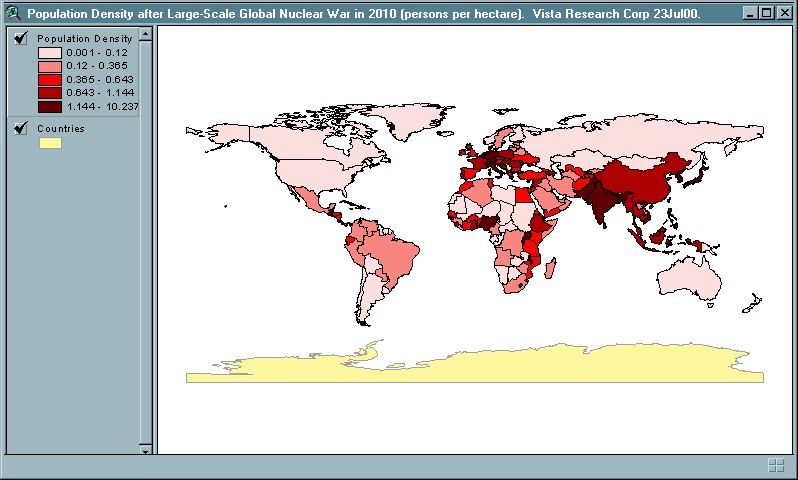
Wizards at War VII - January 10, 2008 - I interpreted the current livestock manangement process now underway through a rather simplistic and brutal lens:
Population cull resulting from large scale thermonuclear war (Joseph George Caldwell)
The thesis of this book is that when fossil-fuel reserves deplete in a few years, the global human population of Earth will drop to about 500 million people or less -- a small fraction of the current six billion. The future is one of global ethnic war and the end of the modern industrialized world. The book examines a "minimal regret" population strategy that shows promise as a sustainable, environmentally sound basis for world population. This population consists of a single industrialized nation of five million people and a hunter-gatherer population of five million.
If I simply compare the level of investment and preparation dedicated to a zero-sum, minimal regret population scenario for resolving the earth's ecological crisis vs. the systematic crash aversion strategy outlined by Lester Brown - it appears that exponentially more has been invested in the former than in the latter......, (and levels of additional investment continue unabated)
Can America Survive -May 9, 2014 - my view/interpretation of the exact same material had shifted somewhat, but still nothing remotely approaching the sophistication with which we observe the intentional and systemic deflation of global human civilization by a small minority of global elites.
foundationwebsite | The answer, quite simply, is no – not in its current form for very long,
and perhaps not in any form at all for very long.This book describes why pending changes in energyavailability, cultural changes brought about by recent massive
immigration, the global populationexplosion, and the proliferation of nuclear weapons, technology and materials
will combine to bring an end to the United Statesas we currently know it – soon.
In the past four centuries, the world human population has
skyrocketed, from about half a billion people to six billion at the present
time.Population projections from
various sources suggest that, barring a major change of some kind, the
population will continue to soar, to nine billion or more by the year
2050.In the past half-century – less
than a lifetime -- the population of the UShas exploded from about 150 million to over
270 million.This explosive growth
occurred despite the fact that fertilityrates in the US dropped to low levels – it is the result of
uncontrolled immigration.
The tremendous global populationincrease has been brought about by the development of technology
to utilize the energystored in fossil fuels, such as petroleum, natural gas, and coal.Petroleum and gas reserves will be
exhausted, however, by about 2050, and coal reserves will not last much beyond
that date if industrial development continues to expand worldwide.
Look around you.If
you live in the USor other economically developed country, every man-made thing you
see or see happening is a product of the expenditure of energy, and most of that energy is
derived from fossil fuels.To establish and maintain our present lifestyle requires
prodigious amounts of energy – an amount equivalent to about 8,000 kilograms of
oilannually
for each man, woman, and child living in the country.Pre-agricultural man lived “off the land,” consuming only the
bounty of nature.Agricultural man
could produce about 10 calories of energy with the expenditure of about one
calorie of energy.Industrial man, it
has been estimated, uses over ten calories of energy to produce a single
calorie of food!The present system is
not only exquisitely wasteful, but it is completely unsustainable.Most of what you see in the industrial world
is a transitory illusion made possible by a one-time windfall supply of energy
from fossil fuels that were accumulated over millions of years.When the fossil fuel reserves deplete in
about 50 years, the modern world will simply disappear along with them.
Whatever age you are, if you were raised in a town or a
small city, go back to where you lived as a child and observe what has happened
to the nearest natural field you played in.Chances are it is now urban sprawl – pavement, concrete, and steel.For each immigrant admitted to the US– legal or illegal – about an acre of natural
land is permanently destroyed, by roads, buildings, parking lots, houses,
schools, and other structures that take the land out of production – both for
wildlife and for agriculture.Last year
the US admitted 1.2 million more immigrants.That represents the complete destruction of another .6 million
acres of farmland, forest, and pastureland.Who cares?Certainly not the people in charge – they want more people
because it makes more money, and they are not particularly concerned with the
concomitant destruction of the environment!
Industrial activity at the massive scale of the present is
causing substantial changes to Earth’s environment. By now, everyone knows that
the atmospheric concentration of carbon dioxide and other gases produced by
industrial activity is increasing substantially every year, and that the
planet’s climate and weather are controlled by these concentrations.Large-scale industrial activity is causing
substantial changes to the planet’s environment – land, air, water, and ecology.In view of the established relationship of the planet’s climate
and ecosystem to these concentrations, it is possible that man’s industrial
activity could cause dramatic changes in the sea level, and trigger another ice
age or create a lifeless “hothouse.”And for what good reason?What
is the good purpose of burning all the planet’s fossil fuelsas fast as possible, when it risks the destruction not only of
mankind but of much other life on the planet as well?The answer is “None.”This activity cannot continue at current levels without risking dire
consequences, even apart from the issue of depletion of fossil fuel reserves
and other nonrenewable resources.To continue to do so is the height of folly.
This book describes the current situation and its predicted
course.For the US– and any other overpopulated, multicultural, high-energy-use country -- the futureis one of war, social fragmentation, and dramatic population
reductions.Power will consolidate in a
single dominant ethnic group; others will be eliminated or reduced to slaveryor serfdom.
This book is not “just another book” on the human population
“problem.”Thousands of books have been
written on the problems of human population, energyand the environment.The real “problem” is that everyone is talking about the problem
and no one is doing anything about it.Proposed solutions to date have either failed or been ignored.Environmentalists and ecologists continue to
wring their hands while the planet croaks.This book identifies a radically new approach to the problem – one that
offers the promise of reducing the risk of ecological destruction to a low
level.It identifies an approach to
population policyanalysis and a course of action that will bring an end to the
massive environmental destruction being caused by human industrial activity and
significantly increase the likelihood of the survivalof the human and other species.
The author of this book has a career that includes both
militarydefenseanalysis and economic development.He worked for about fifteen years in defense applications and
about fifteen years in social and economic applications.His work in military applications includes
ballistic missilewarfare, nuclear weaponseffects, satellite ocean surveillance, naval general-purpose
forces, tactical air warfare, air/land battle tactics, strategy, civil defense, military
communications-electronics, and electronic warfare.His work in social and economic development applications includes
tax policyanalysis, agricultural policy
analysis, trade policy analysis, health, human resource development, demography, development of systems for
planning, monitoring and evaluationof social and economic programs, and educational management
information systems.He has lived and
worked in countries around the world.He holds a PhD degree in mathematical statisticsand is an expert in mathematical gametheory, statistics, operations research, and systems and software
engineering.The analysis presented in
this book is derived from years of experience related to, and years of analysis
of, the population problem.
The organization of this book follows a logical progression,
starting with a description of the current state of the planetand human population.Current trends in human population growth are identified.The relationship of human welfare to energyavailability is described, and the futureavailability of energy is discussed.The role of economicsto population growth is examined.Policies for determining what the human population size should be are
identified.A new approach to population
policyis introduced; it is called the “minimal-regret” approach.The likelihood of nuclear waris considered, and the damage that would result from a limited
nuclear waris
estimated.The impact of this war is
assessed for the United States, Canada, and other countries.An assessment is made of the likelihood that
the United States and various other countries will prevail after a nuclear
war.The relationship of the minimal-regret
approach to nuclear war strategies and the postattackenvironmentis discussed in detail.
The main text of the book is generally nontechnical – as
much as it can be for subjects (population growth, economics, energy, nuclear war) that are technical in
nature.Technical discussions are
presented in appendices.The appendices
include graphs and tables in support of the arguments presented in the text.
The research underlying the population policyapproach introduced in this book was conducted over a four-year
period.During the course of doing the
research, a large number of books and articles were reviewed and analyzed.The bibliography includes a list of about
600 books that were reviewed.To keep
the message of this book as succinct as possible, little description is given
of the content of these books.Instead,
the most relevant publications are simply listed. Little space is allocated to
describing the state of the environmentor other population policies – just enough to provide a context
for the new material presented.
thelocal.se | Published every two years, the WWF Living Planet Report
documents the state of the Earth, including its biodiversity,
ecosystems, the demand on natural resources and what that means for
humans and wildlife.
And the 2016 edition shows that Swedes are currently living lifestyles that would require the equivalent of four Earths to sustain – 4.2 to be precise.
Sweden ranks alongside the likes of the USA, UAE and Canada as one of
the worst countries in the report when it comes to its consumption
footprint, which the WWF defines as the area used to support a defined
population's consumption.
The footprint, measured in global hectares, includes the area needed to
produce the materials a country consumes, and the area needed to absorb
its carbon dioxide emissions.
According to the study, Sweden consumes the equivalent of 7.3 global
hectares per capita. For perspective, nearby Germany consumes 5.3,
Tanzania consumes 1.3, and the USA consumes 8.2.
The WWF highlighted Sweden as being a big importer of consumer goods
produced by fossil fuels, particularly from China. The Nordic nation has
high indirect carbon dioxide emissions as a result.
“Sweden and Swedes are very good at many things and we have come far in
our conversion of energy production even if there is still a lot left
to do. We have advanced technology, knowledge and understanding of
sustainability issues, but we don't speak a lot about the impact of
consumption of items which are produced in an unsustainable way,”
Swedish WWF CEO Håkan Wirtén told news agency TT.
In order to improve its sustainability, the WWF recommended that the
Swedish government should bring in a target to reduce consumption-based
emissions, work out a strategy to halve Sweden's meat consumption, and
ban the sale of newly produced cars which run on fossil fuels by 2025 if
possible.
“A big part of the Swedish footprint comes from transport. The
government should set a target for consumption-based emissions so that
we can actually start to measure the emissions we cause in other ways
through our imports,” the WWF's Wirtén said.
According to the WWF, Sweden's consumption footprint can be broken down
as 32 percent on food, 29 percent on travel, 18 percent on goods, 12
percent on accommodation and nine percent on services.
mises | As soon as it became clear that the Swedish state had no plans to
implement harsh lock downs, global media organizations like the New York Times have implemented what can only be described as an ideological jihad against Sweden.
It is common to read articles stating that Sweden has one of the world's worst death rates for COVID-19.
This, however, remains a matter of perspective.
Sweden's total deaths per million in population as of July 14
is 549. That's considerably lower than the deaths per million rate in
the UK, which is 662, and in Spain, which is 608. In Belgium, the death
rate is 884.
Moreover, the Sweden deaths per million is many times better than the rates found in New Jersey and New York: 1,763 and 1,669.
An astute reader, however, will quickly notice that articles
condemning Sweden's "failure" rarely if ever mention these comparisons.
Instead, anti-Sweden articles are careful to only mention countries with
far lower deaths per million, usually Denmark and Norway. A nonspecific
stock phrase is generally inserted which repeats that Sweden has: "a far higher mortality rate than its neighbours."
Articles about countries with far more deaths per million than Sweden
often make excuses for those governments. In May, for example, the BBC
repeated the Belgian government's talking points, which attempted to
explain that things aren't as bad as they seem in
Belgium. In places where harsh lockdowns were implemented—such as New
York or the UK— the explanation is that these countries implemented
their lockdowns too late.
technologyreview | “The traditional forms of living a good life were going to be
destroyed,” writes Lear. “But there was spiritual backing for the
thought that new good forms of living would arise for the Crow, if only
they would adhere to the virtues of the chickadee.”
Today the
Crow—just like the Sioux, the Navajo, the Potawatomi, and numerous other
native peoples— live in communities that struggle with poverty,
suicide, and unemployment. But these communities are also home to poets,
historians, singers, dancers, and thinkers committed to indigenous
cultural flourishing. The point here is not to glamorize indigenous
closeness to “nature,” or to indulge a naive longing for lost
hunter-warrior values, but to ask what we might learn from courageous
and intelligent people who survived cultural and ecological catastrophe.
Like Plenty Coups, we face the destruction of our conceptual reality.
Catastrophic levels of global warming are practically inevitable at
this point, and one way or another this will bring about the end of life
as we know it.
So we have to confront two distinct challenges.
The first is whether we might curtail the worst possibilities of climate
change and stave off human extinction by limiting greenhouse-gas
emissions and decreasing atmospheric carbon dioxide. The second is
whether we will be able to transition to a new way of life in the world
we’ve made. Meeting the latter challenge demands mourning what we have
already lost, learning from history, finding a realistic way forward,
and committing to an idea of human flourishing beyond any hope of
knowing what form that flourishing will take. “This is a daunting form
of commitment,” Lear writes, for it is a commitment “to a goodness in
the world that transcends one’s current ability to grasp what it is.”
It
is not clear that we moderns possess the psychological and spiritual
resources to meet this challenge. Coming to terms with the situation as
it stands has already proved the struggle of a generation, and the
outcome still remains obscure. Successfully answering this existential
challenge may not even matter at all unless we immediately see
substantial reductions in global carbon emissions: recent research
suggests that at atmospheric carbon dioxide levels around 1,200 parts
per million, which we are on track to hit sometime in the next century,
changes in atmospheric turbulence may dissipate clouds that reflect
sunlight from the subtropics, adding as much as 8 °C warming on top of
the more than 4 °C warming already expected by that point. That much
warming, that quickly—12 °C within a hundred years—would be such an
abrupt and radical environmental shift that it’s difficult to imagine a
large, warm-blooded mammalian apex predator like Homo sapiens
surviving in significant numbers. Such a crisis could create a
population bottleneck like other, prehistoric bottlenecks, as many
billions of people die, or it could mean the end of our species. There’s
no real way to know what will happen except by looking at roughly
similar catastrophes in the past, which have left the Earth a graveyard
of failed species. We burn some of them to drive our cars.
Nevertheless,
the fact that our situation offers no good prospects does not absolve
us of the obligation to find a way forward. Our apocalypse is happening
day by day, and our greatest challenge is learning to live with this
truth while remaining committed to some as-yet-unimaginable form of
future human flourishing—to live with radical hope. Despite decades of
failure, a disheartening track record, ongoing paralysis, a social order
geared toward consumption and distraction, and the strong possibility
that our great-grandchildren may be the last generation of humans ever
to live on planet Earth, we must go on. We have no choice.
charleshughsmith |The lower reaches of the financial food chain are already dying, and every entity that depended on that layer is doomed.
Though
under pressure from climate change, the dinosaurs were still dominant
65 million year ago--until the meteor struck, creating a global "nuclear
winter" that darkened the atmosphere for months, killing off most of the food chain that the dinosaurs depended on. (See chart below.)
The ancestors of modern birds were one of the few dinosaur species to survive the extinction event, which took months to play out.
It
wasn't the impact and shock wave that killed off dinosaurs globally--it
was the "nuclear winter" that doomed them to extinction. As plants withered, the plant-eating dinosaurs expired, depriving the predator dinosaurs of their food supply.
This is a precise analogy for the global economy, which is entering a financial "nuclear winter" extinction event. As I've been discussing for the past few months, costs are sticky but revenues and profits are on a slippery slope.
Businesses still have all the high fixed costs of 2019 but their
revenues are sliding as the "nuclear winter" weakens consumer spending,
investment in new capacity, etc.
Despite all the hoopla about a potential vaccine, no vaccine can change four realities: one,
consumer sentiment has shifted from confidence to caution and from
spending freely to saving. This is the financial equivalent of "nuclear
winter": there is no way to return to the pre-impact environment.
Two, uncertainty cannot be dissipated, either. There are no guarantees a
vaccine will be 99% effective, that it will last more than a few
months, that it won't have side-effects, etc. There are also no
guarantees that consumers will resume their care-free spending ways as
credit tightens, incomes decline, risks emerge and the need for savings
becomes more compelling.
Three, consumer behavior and uncertainty have already changed, and so
businesses that cannot survive on much lower revenues won't last long
enough to emerge from the "nuclear winter" of uncertainty and a shift in
sentiment.
Four, assets based on 2019 revenues, profits and demand are now
horrendously overvalued, and the repricing of all assets will bring down
the predators, i.e. the banks.
As I've noted here before, the top 10% of households account for almost 50% of consumer spending. These
households are older, and own the majority of assets --between 80% and
90% of stocks, bonds, business equity, rental real estate, etc. This is
the demographic with the most to lose in returning to care-free air
travel, jamming into crowded venues and cafes, etc.
The coronavirus pandemic could result in some 28 million Americans being evicted, one expert said.
By comparison, 10 million people lost their homes in the Great Recession.
Here’s what we can expect from this crisis.
Emily Benfer began her career representing homeless families in Washington, D.C.
Her
first case involved a family that had been evicted after complaining to
their landlord about the holes in their roof. One of the times she met
with the family, one of the children, a 4-year-old girl, asked her: “Are
you really going to help us?” Benfer struggled with how to answer.
“I’d
met them too late,” she said. “I couldn’t stop the eviction. They had
already been sleeping on the subway, and in other people’s homes. And
you could see the effects it was taking on them.”
Today, Benfer is
a leading expert on evictions. She is the chair of the American Bar
Association’s Task Force Committee on Eviction and co-creator of the
COVID-19 Housing Policy Scorecard with the Eviction Lab at Princeton
University. Throughout the public health crisis, Benfer has been
investigating how states are dealing with evictions and sharing what she
finds in a public database.
CNBC
spoke with Benfer about the coming eviction crisis and what can be done
to turn it around. The interview has been condensed and edited for
clarity.
variety | “ViacomCBS condemns bigotry of any kind and we categorically denounce
all forms of anti-Semitism. We have spoken with Nick Cannon about an
episode of his podcast ‘Cannon’s Class’ on YouTube, which promoted
hateful speech and spread anti-Semitic conspiracy theories. While we
support ongoing education and dialogue in the fight against bigotry, we
are deeply troubled that Nick has failed to acknowledge or apologize for
perpetuating anti-Semitism, and we are terminating our relationship
with him. We are committed to doing better in our response to incidents
of anti-Semitism, racism, and bigotry. ViacomCBS will have further
announcements on our efforts to combat hate of all kinds,” the company
said.
On Monday, Cannon said on Twitter and Facebook
that he has “no hate in my heart nor malice intentions” and doesn’t
condone hate speech. He also said that he holds himself “accountable for
this moment” and takes full responsibility for his actions.
Late on Tuesday and well into the early hours of Wednesday, the host
began retweeting scores of messages of support from fans, some of whom
condemned ViacomCBS for severing ties with Cannon and expressed concern
for the future of long-running MTV sketch comedy series “Wild ‘N Out,”
which Cannon has hosted since its 2005 debut and recent expansion to
sister network VH1. Cannon also retweeted a number of his critics who
called him the N-word.
I want to clarify
 my now deleted tweet. I was not supporting or condoning what Nick
Cannon specifically said, but I had expressed my support of him owning
the content and brand he helped create 🙏🏾
The host has had a relationship with Viacom since he was an actor on
Nickelodeon in the ’90s, and into the 2000s with “Wild ‘N Out.” More
recently, he’s been known as the host of “The Masked Singer” on Fox and hosted “America’s Got Talent” on NBC from 2009-2016. He’s also launching a syndicated daytime talk show in September with Debmar-Mercury.
thegrayzone | Did neocon cancel queen Bari Weiss stage her NY Times resignation to fuel her career?
A closer look at the events surrounding Bari Weiss’ resignation
suggests she omitted some critical details about her toxic presence
inside the paper, and may have staged her resignation to drum up
publicity for her next move.
Back on June 3, neoconservative Sen. Tom Cotton published an op-ed in
the New York Times calling for the US military to crack down on
Americans protesting lethal police violence. The decision to publish the
editorial touched off outrage among Times staff, with many demanding to
know how such a fascistic piece made it into print.
It turned out that the staffer who edited the piece, Adam Rubenstein,
was a card-carrying neocon hired by the Times in early 2019. Rubenstein
was a former editor for the now-defunct Weekly Standard founded by
William Kristol – the neocon leader responsible for rustling up pro-Israel money to support Cotton’s electoral ambitions.
New York Times staff claimed
that the Cotton op-ed “was edited” by Rubenstein and other staffers
“had not been aware of the article before it was published.”
The editorial disaster prompted the dismissal of op-ed page editor
James Bennet, who had initially defended running Cotton’s screed.
Before joining the Weekly Standard, Rubenstein was a pro-Israel activist at Kenyon College who once attempted to cancel an appearance by the Palestian poet Remi Kanazi on the grounds that Kanazi was “part of a focus-grouped and incubated hatred.”
Rubenstein’s hiring by the Times complimented its hiring of Bari Weiss and fellow anti-Palestinian bigot Bret Stephens
in 2017. In her resignation letter, Weiss acknowledged, “I was hired
with the goal of bringing in voices that would not otherwise appear in
[the Times’] pages: first-time writers, centrists, conservatives.”
In 2018, Weiss and Stephens responded to a critic who had called them “Zionist fanatics
of near-unhinged proportions.” The two retorted: “The word ‘near’
should not have been a part of the sentence. Otherwise, we happily plead
guilty as charged.”
When Rubenstein joined them at the paper, he became Weiss’s personal
editor. Both Weiss and Stephens had risen to prominence at the op-ed
page of the Wall Street Journal, where Rubenstein had also worked as a Robert Bartley Fellow.
When the Cotton column calling for a military crackdown on Black
Lives Matter ran less than a year later, the Times’ neocon problem
finally came to a head.
This June 5, as 300 non-editorial staffers planned a virtual walkout,
Times publisher A.G. Sulzberger convened an all-hands meeting. During
the question-and-answer session, according to a report by Vice, employees demanded to know “whether Opinion staff editor and writer Bari Weiss would be fired for ‘openly bad mouth[ing]
younger news colleagues on a platform where they, because of strict
company policy, could not defend themselves’; whether the opinion
section had suggested the topic of the op-ed to Cotton; and what the Times would do to help retain and support Black employees.”
Times staff seemed to be pointing a finger at Weiss and her neocon network for soliciting the Cotton op-ed.
When Weiss resigned on July 14, she complained
that colleagues “have called me a Nazi and a racist… Several colleagues
perceived to be friendly with me were badgered by coworkers.” Yet she
failed to acknowledge her apparent role in the Cotton op-ed affair,
which was clearly the source of her colleagues’ outrage, painting
herself instead as a blameless victim of “illiberal” cancel culture.
bariweiss | It took the paper two days and two jobs to say that the Tom Cotton op-ed
“fell short of our standards.” We attached an editor’s note on a travel
story about Jaffa shortly after it was published because it “failed to
touch on important aspects of Jaffa’s makeup and its history.” But there
is still none appended to Cheryl Strayed’s fawning interview with the
writer Alice Walker, a proud anti-Semite who believes in lizard
Illuminati.
NYTimes | Today, I’m going to call Alice Walker. She won the Pulitzer Prize in
fiction for her novel, The Color Purple. She was the first black woman
to win that prize. She also won the National Book Award that year. She’s
published many books, novels, poetry collections, essay collections.
And she really for many decades now has been telling the truth about who
we are and how we struggle and how we persist. Her most recent book is a
collection of poetry called Taking the Arrow Out of the Heart. I’ve
been reading it the past few days. It’s terrific.
tabletmag | Alice
Walker was given another uncritical platform at a premier outlet which
proffered no mention or questions about her anti-Semitic history. That
outlet? A popular New York Times podcast.
For Wednesday’s episode of Sugar Calling,
Walker was interviewed about her life under lockdown by host and author
Cheryl Strayed. Remarkably, in her questions, Strayed quoted verbatim
from the very Times interview where Walker promoted David Icke,
asking her about the “kinship” with Jane Eyre she’d expressed there,
but not about the anti-Semitism she’d voiced.
If it seems unbelievable that the Times
would knowingly repeat its mistake of feting Walker without
foregrounding her bigotry, that’s because it is: The episode was made in
error, not malice. When I raised the issue with Strayed and detailed
Walker’s prejudicial past to her, she was shocked and explained that
neither she nor her producers were aware of the author’s anti-Semitic
backstory. “I had no idea and neither did the producers who make the
show,” she said. “You’re correct that I read that interview and asked
her about Jane Eyre, but I didn't know anything about the Icke book
until yesterday. If I’d known, I wouldn't have asked Alice Walker to be
on the show.” Saying she was “mortified,” Strayed promptly deleted her
posts promoting the episode on social media. It was a rare expression of
genuine contrition and accountability that is all too rare in my
experience reporting on these matters.
The problem here is not Cheryl Strayed, who responded admirably to a difficult situation. The problem is TheNew York Times,
which in 2018 did not respond admirably to the same situation, and left
their original interview with Walker untouched, with no annotations to
indicate to subsequent readers that Walker was promoting anti-Semitism
in it.
At the time, after it became a national scandal, the Times book editor did not apologize and told
reporters that in such an interview, “we would never add that a book is
factually inaccurate, or that the author is a serial predator, or any
kind of judgment on the work or the writer. We do not issue a verdict on
people’s opinions.” Asked if “in retrospect, would you have done
anything differently with the column by Ms. Walker?” the editor
answered, “No.” Thus, even after the controversy, the Times did
not amend the piece to inform future readers that one of the books that
Walker recommended in it was a vicious anti-Semitic screed.
nonsite |In light of recent events we thought to republish Adolph Reed’s
2016 essay on racial disparity and police violence. We include a new
introduction to the piece by Cedric Johnson, “The Triumph of Black Lives Matter and Neoliberal Redemption,” that considers the essay in view of the contemporary situation.
Some readers will know that I’ve contended that, despite its
proponents’ assertions, antiracism is not a different sort of
egalitarian alternative to a class politics but is a class
politics itself: the politics of a strain of the professional-managerial
class whose worldview and material interests are rooted within a
political economy of race and ascriptive identity-group relations.
Moreover, although it often comes with a garnish of disparaging but
empty references to neoliberalism as a generic sign of bad things,
antiracist politics is in fact the left wing of neoliberalism in that
its sole metric of social justice is opposition to disparity in the
distribution of goods and bads in the society, an ideal that naturalizes
the outcomes of capitalist market forces so long as they are equitable
along racial (and other identitarian) lines. As I and my colleague
Walter Benn Michaels have insisted repeatedly over the last decade, the
burden of that ideal of social justice is that the society would be fair
if 1% of the population controlled 90% of the resources so long as the
dominant 1% were 13% black, 17% Latino, 50% female, 4% or whatever
LGBTQ, etc. That is the neoliberal gospel of economic justice,
articulated more than a half-century ago by Chicago neoclassical
economist Gary Becker, as nondiscriminatory markets that reward
individual “human capital” without regard to race or other invidious
distinctions.
We intend to make a longer and more elaborate statement of this
argument and its implications, which antiracist ideologues have
consistently either ignored or attempted to dismiss through
mischaracterization of the argument or ad hominem attack.1
For now, however, I want simply to draw attention to how insistence on
reducing discussion of killings of civilians by police to a matter of
racism clouds understanding of and possibilities for effective response
to the deep sources of the phenomenon.
Available data (see https://www.washingtonpost.com/graphics/national/police-shootings/?tid=a_inl)
indicate, to the surprise of no one who isn’t in willful denial, that
in this country black people make up a percentage of those killed by
police that is nearly double their share of the general American
population. Latinos are killed by police, apparently, at a rate roughly
equivalent to their incidence in the general population. Whites are
killed by police at a rate between just under three-fourths (through the
first half of 2016) and just under four-fifths (2015) of their share of
the general population. That picture is a bit ambiguous because seven
percent of those killed in 2015 and fourteen percent of those killed
through June of 2016 were classified racially as either other or
unknown. Nevertheless, the evidence of gross racial disparity is clear:
among victims of homicide by police blacks are represented at twice
their rate of the population; whites are killed at somewhat less than
theirs. This disparity is the founding rationale for the branding
exercise2
called #Black Lives Matter and endless contentions that imminent danger
of death at the hands of arbitrary white authority has been a
fundamental, definitive condition of blacks’ status in the United States
since slavery or, for those who, like the Nation’s Kai Wright,
prefer their derivative patter laced with the seeming heft of obscure
dates, since 1793. In Wright’s assessment “From passage of the 1793
Fugitive Slave Act forward, public-safety officers have been empowered
to harass black bodies [sic] in the defense of private capital and the
pursuit of public revenue.”3
This line of argument and complaint, as well as the demand for ritual
declarations that “black lives matter,” rest on insistence that
“racism”—structural, systemic, institutional, post-racial or however
modified—must be understood as the cause and name of the injustice
manifest in that disparity, which is thus by implication the singular or
paramount injustice of the pattern of police killings.
But, when we step away from focus on racial disproportions, the
glaring fact is that whites are roughly half or nearly half of all those
killed annually by police. And the demand that we focus on the racial
disparity is simultaneously a demand that we disattend from other
possibly causal disparities. Zaid Jilani found, for example, that
ninety-five percent of police killings occurred in neighborhoods with
median family income of less than $100,00 and that the median family
income in neighborhoods where police killed was $52,907.4 And, according to the Washington Post data,
the states with the highest rates of police homicide per million of
population are among the whitest in the country: New Mexico averages
6.71 police killings per million; Alaska 5.3 per million; South Dakota
4.69; Arizona and Wyoming 4.2, and Colorado 3.36. It could be possible
that the high rates of police killings in those states are concentrated
among their very small black populations—New Mexico 2.5%; Alaska 3.9%;
South Dakota 1.9%; Arizona 4.6%, Wyoming 1.7%, and Colorado 4.5%.
However, with the exception of Colorado—where blacks were 17% of the 29
people killed by police—that does not seem to be the case. Granted, in
several of those states the total numbers of people killed by police
were very small, in the low single digits. Still, no black people were
among those killed by police in South Dakota, Wyoming, or Alaska. In New
Mexico, there were no blacks among the 20 people killed by police in
2015, and in Arizona blacks made up just over 2% of the 42 victims of
police killing.
What is clear in those states, however, is that the great
disproportion of those killed by police have been Latinos, Native
Americans, and poor whites. So someone should tell Kai Wright et al to
find another iconic date to pontificate about; that 1793 yarn has
nothing to do with anything except feeding the narrative of endless
collective racial suffering and triumphalist individual
overcoming—“resilience”—popular among the black professional-managerial
strata and their white friends (or are they just allies?) these days.
WEF | In the US, COVID-19 has taken a disproportionate toll on
African-American communities, low-income people and vulnerable
populations such as the homeless. In Los Angeles, the death rate for black citizens is nearly three times that of its wealthiest residents.
The fact that the pandemic affected so disproportionately black
communities is a reflection not just of historic racism but also their
continuation in existing systemic inequalities. In America, as in many
other countries, people who face racial discrimination and
marginalization are more likely to be unemployed or underemployed and
have poor housing and living conditions. As a result, their access to
health care is more limited and they suffer more from pre-existing
health conditions that make COVID-19 particularly deadly.
The great challenge for all those who share leadership
responsibilities is to respond to the crisis in a way that integrates
the hopes of the future. While reflecting on the aspects that a future
social contract might follow, the opinions of the younger generation
must be integrated, as they are the ones who will be asked to live with
it – the same generation that is now so engaged at the vanguard of the
fight against racism. They have taken to heart the words of Archbishop
Desmond Tutu: “If you are neutral in situations of injustice, you have
chosen the side of the oppressor.”
Their adherence is decisive, and therefore to better understand
what they want, it is necessary for them to be heard. This is made all
the more significant by the fact that the younger generation is likely
to be more radical than the older one in redefining the social contract.
The pandemic has tragically ended lives but it has also upended
them. A whole generation across the globe will be defined by economic
and often social insecurity, with millions due to enter the work force
in the midst of a profound recession. Even for the most advantaged
amongst them, starting off in deficit – many students have educational
debts – is likely to have long-term effects. Already the millennials (at
least in the Western world) are worse off than their parents in terms
of earnings, assets and wealth. They are less likely to own a home or
have children than their parents were.
Now, another generation (Gen Z) is entering a system that it sees
as failing and that will be beset by longstanding problems exacerbated
by the pandemic. As a young student told The New York Times: “Young people have a deep desire for radical change because we see the broken path ahead”.
The worst response the world can have in this situation is
further polarization, narrow thinking and the search for simplistic
solutions – a terrain favourable for propagating rumours,
misinformation and hatred. The COVID-19 pandemic has unequivocally shown
that the world is deeply interconnected and yet also largely bereft of
solidarity between nations, and often even within nations.
WEF | We could try to go back to the world we had before the pandemic,
he said, but that risked "the amplification of many of the trends we see
today: polarisation, nationalism, racism and ultimately social unrest
and conflicts."
A great reset of how the economy and society run would do the opposite, he said.
It was also a time to support those who had been left behind.
Juliana Rotich, Venture Partner at Atlantica Ventures in Nairobi, said
we were at an inflection point.
"There’s an opportunity to centre the reset on those who are most
vulnerable, those on the edge where it only takes something like a
pandemic to slide into poverty."
Other speakers at the launch echoed Schwab's concerns about inequality and racism.
Microsoft President Brad Smith made a direct reference to the
racial conflict in his own country, and how the Great Reset could be
part of the solution.
"Data, and technology more broadly, are indispensable tools to solving almost any of the problems that we confront," he said.
"And so when it comes to protecting people’s fundamental rights,
as we are seeing in the United States today, we have been focused for
several years on using data to shine a light on disparities, for
example, between the practices of police on African-Americans and blacks
in the United States in comparison with other populations - that is a
slice of what we’ll need to address around the world."
In a passionate address, Kristalina Georgieva, the head of the
International Monetary Fund said the Great Reset would result in a
"greener, smarter, fairer world".
"We know this pandemic, if left to its own devices, will deepen inequality," she said.
"But if we were to concentrate in investing in people, in the
social fabric of our societies, in access to opportunities and education
for all, in expansion of social programmes - then we can have a world
that is a better world for all."
off-guardian | In early 2020, Neil Ferguson of the UK’s Imperial College used a
scare tactic to predict that 80% of Americans would be infected and that
there would be 2.2 million American deaths – neither of which
materialized. Yet Ferguson’s extremism accomplished its intended purpose
in establishing the basis for draconian Lockdown requirements. Ferguson
later retracted his earlier prediction down to 20,000 fatalities.
Just a few examples come to mind, such as liquor stores and big chains
are considered ‘essential’ and remain open but stand-alone, independent,
mom ‘n pops are not. Barbers may be open but hair salons may not. While
it is advised to get tested for Covid19, a colonoscopy or other
elective surgery are not allowed. While vitamins C and D and Sunshine
strengthen the immune system, all outdoor sport programs have been
canceled.
In an unexpected development, a recent JP Morgan study asserted that the Lockdowns failed to “alter the course of the pandemic” as it “destroyed millions of livelihoods” and that as infection rates ‘unrelated to often inconsistent lockdown’ measures decreased, fewer outbreaks were reported as the quarantines were lifted.
As the official narrative of the Covid19 as an existential threat has collapsed, it is interesting to follow how ‘hot spots’ occur just as a particular State, like Florida, announces re-opening.
Those new hot spots encourage a reinvigorated debate over mandatory
face masks and social distancing with its success depending on a
duplicitous media instilling panic and a naive public still believing
Covid19 to be more dangerous than seasonal flu.
voxeu | One great unknown about COVID-19 is whether individuals who recover from
it can be reinfected. At the emergence of any new virus, it is
impossible to know whether immunity is permanent or wanes, until enough
time has passed for longitudinal studies to take place. At the moment,
and with limited available data, medical scientists and epidemiologists
are instead comparing SARS-CoV-2 to related coronaviruses, such as
HCoV-HKU1 and HCoV-OC43, which are known to exhibit waning immunity. An
early contribution by Kissler et al. (2020) assumed that immunity to
SARS-CoV-2 wanes in approximately 45 weeks. A recent medical study (Long
et al. 2020) found a significant drop in specific antibody levels after
three months. Nevertheless, the duration of immunity in general is
still far from understood.
In Giannitsarou et al. (2020), we explicitly consider a setting in
which immunity is temporary. We derive a stylised optimal containment
policy and contrast it to policies assuming that once recovered,
individuals are forever immune.
We work with a flexible epidemic model known as SEIRS
(Susceptible-Exposed-Infected-Recovered-Susceptible). The model allows
for natural births and deaths, disease induced deaths, a pre-symptomatic
state in which individuals are exposed to the virus and can be
infectious without exhibiting symptoms, and importantly, waning
immunity. In such a framework, because immunity may slowly disappear
from recovered people, there is the potential for a second (and even
third) wave of infection.
In summary, we find that if immunity to SARS-CoV-2 is temporary, the
disease will become endemic. The optimal policy will make an initial
effort to reduce the first great infection wave and then engage in a
permanent low level management of the persistent infection in the
population in order to keep it under control. In practice, this means
that partial lockdown or social distancing measures may become the norm
for some years to come.
Our analysis assumed that, currently, the only policies at our
disposal are broad-based non-medical interventions such as social
distancing and lockdown measures. At the initial stages of the COVID-19
pandemic, such policies proved to be extremely costly from social,
economic, and health care perspectives. But going forward, we expect
that individuals, businesses, and governments are likely to adapt how
they do things and operate to mitigate the costs of this initial
dramatic shock. People may become more cautious in everyday dealings,
businesses may come to depend less on third parties or off-shoring,
while other organisations such as schools, transport, intermediate goods
producers, and local governments may find innovative ways to become
more flexible and resilient in the ways they deliver services and
products. We hope that with creativity and resourcefulness, humanity
will learn to navigate and live with the disease, should it turn out to
be here for the long term.
Toward a Biophysics of Poetry
-
My long-term interest in Coleridge’s “Kubla Khan” (KK) is shadowed by an
interest in “This Line-Tree Bower My Prison,” (LTB) which is one of the
so-calle...
Celebrating 113 years of Mama Rosa McCauley Parks
-
*February 4, 1913 -- February 4, 2026*
*Some notes: The life of the courageous activist Mama Rosa McCauley Parks*
Mama Rosa's grandfather Sylvester Ed...
Monsters are people too
-
Comet 3I/Atlas is on its way out on a hyberbolic course to, I don't know
where. I do know that 1I/Oumuamua is heading for the constellation Pegasus,
and ...
Remembering the Spanish Civil War
-
This year marks the 90th anniversary of the launch of the Spanish Civil
War, an epoch-defining event for the international working class, whose
close study...
Return of the Magi
-
Lately, the Holy Spirit is in the air. Emotional energy is swirling out of
the earth.I can feel it bubbling up, effervescing and evaporating around
us, s...
Covid-19 Preys Upon The Elderly And The Obese
-
sciencemag | This spring, after days of flulike symptoms and fever, a man
arrived at the emergency room at the University of Vermont Medical Center.
He ...
-
(Damn, has it been THAT long? I don't even know which prompts to use to
post this)
SeeNew
Can't get on your site because you've gone 'invite only'?
Man, ...
First Member of Chumph Cartel Goes to Jail
-
With the profligate racism of the Chumph Cartel, I don’t imagine any of
them convicted and jailed is going to do too much better than your run of
the mill ...