Tuesday, May 08, 2012

media silent when administration targets whistleblowers

miamiherald | Obama took office pledging tolerance and even support for whistleblowers, but instead is prosecuting them with a zeal that’s historically unprecedented. His Justice Department has conducted six prosecutions over leaks of classified information to reporters. Five involve the Espionage Act, a powerful law that had previously been used only four times since it was enacted in 1917 to prosecute spies.

Some spies. We’re no longer in the era of Aldrich Ames, Robert Hanssen or Kim Philby, infamous Cold War turncoats.

Instead, there’s Thomas Drake, a career official of the National Security Agency, who faced 35 years in prison for telling a Baltimore Sun reporter about what The New York Times called “a potential billion-dollar computer boondoggle.” At stake was bureaucratic embarrassment, not national security. (The case against Drake collapsed last summer.)

Then there’s Shamai Leibowitz, a translator for the FBI, who believed he had intercepted evidence of illegal influence-peddling by the Israeli embassy. When his boss wouldn’t act, he leaked transcripts to a blogger. He got 20 months.

Ex-CIA agent John Kiriakou was indicted in January for allegedly identifying a Guantánamo interrogator (who was not working undercover;) Stephen Kim, a State Department analyst, allegedly told a reporter for Fox News — wait for it — that the U.S. was worried North Korea might respond to new U.N. sanctions by testing another A-bomb; and Jeffrey Sterling, who allegedly disclosed a botched CIA operation in Iran that was described in a 2006 book by a Times reporter.

And there’s the biggest case, the court martial of Bradley Manning, the Army private accused of engineering the mammoth dumps of U.S. military and diplomatic data that Wikileaks, the online whistleblower network, turned over to leading newspapers in 2010 and 2011.

The administration seems undeterred by the scanty evidence that any of these defendants was out to hurt the country, a mainstay ingredient of espionage, and the Manning judge has even warned prosecutors they must show he believed he was “aiding the enemy” or she would toss the most serious charge against him.

The public is generally unaware of how essential nominally classified information is to coverage of diplomatic and strategic news. As Steven Aftergood, director of the Federation of American Scientists’ government secrecy project, put it: “The administration’s aggressive pursuit of leaks represents a challenge to the practice of national security reporting, which depends on the availability of unauthorized sources if it is to produce something more than ‘authorized’ news.”

What’s behind the administration’s fervor isn’t clear, but the news media have largely rolled over and yawned. A big reason is that prosecutors aren’t hassling reporters as they once did. Thanks to the post-9/11 explosion in government intercepts, electronic surveillance, and data capture of all imaginable kinds — the NSA is estimated to have intercepted 15-20 trillion communications in the past decade — the secrecy police have vast new ways to identify leakers.

So they no longer have to force journalists to expose confidential sources. As a national security representative told Lucy Dalglish, director of the Reporters Committee for Freedom of the Press, “We’re not going to subpoena reporters in the future. We don’t need to. We know who you’re talking to.”


Read more here: http://www.miamiherald.com/2012/05/07/2783978/media-silent-when-administration.html#storylink=cpy

Monday, May 07, 2012

well, that didn't take long, did it?


wikipedia | Golden Dawn (Greek: Χρυσή Αυγή, Chrysi Avgi, Greek pronunciation: [xriˈsi avˈʝi]) is a Greek nationalist far-right political organization led by Nikolaos Michaloliakos. It expresses anti-immigrant views and is known for its militancy. It also expresses sympathy with the totalitarian regime of Ioannis Metaxas.

Golden Dawn describes itself as a "People's Nationalist Movement" and "uncompromising Nationalists."[9] Michaloliakos described Golden Dawn as opposing the "so-called Enlightenment" and the Industrial Revolution.[9][10] Religiously, they currently support the Eastern Orthodox Church.

Michaloliakos began the foundations of what would become Golden Dawn in 1980. In 1991 it became a notable movement, and in 1993 was registered as a political party. It temporarily ceased political operations in 2005, and was absorbed by the Patriotic Alliance. The Alliance in turn ceased operations after Michaloliakos withdrew support. In March 2007, Golden Dawn held its sixth congress, where Party officials announced the resumption of their political activism. At local elections on November 7, 2010 Golden Dawn got 5.3% of the vote in the municipality of Athens, winning a seat at the City Council. In some neighbourhoods with big immigrant communities it even reached 20%.[11] In the Greek legislative election, 2012, it achieved 7% of the popular vote, enough to enter the Hellenic Parliament for the first time.

icelandic anger brings debt forgiveness

bloomberg | Icelanders who pelted parliament with rocks in 2009 demanding their leaders and bankers answer for the country’s economic and financial collapse are reaping the benefits of their anger.

Since the end of 2008, the island’s banks have forgiven loans equivalent to 13 percent of gross domestic product, easing the debt burdens of more than a quarter of the population, according to a report published this month by the Icelandic Financial Services Association.

“You could safely say that Iceland holds the world record in household debt relief,” said Lars Christensen, chief emerging markets economist at Danske Bank A/S in Copenhagen. “Iceland followed the textbook example of what is required in a crisis. Any economist would agree with that.”

The island’s steps to resurrect itself since 2008, when its banks defaulted on $85 billion, are proving effective. Iceland’s economy will this year outgrow the euro area and the developed world on average, the Organization for Economic Cooperation and Development estimates. It costs about the same to insure against an Icelandic default as it does to guard against a credit event in Belgium. Most polls now show Icelanders don’t want to join the European Union, where the debt crisis is in its third year.

The island’s households were helped by an agreement between the government and the banks, which are still partly controlled by the state, to forgive debt exceeding 110 percent of home values. On top of that, a Supreme Court ruling in June 2010 found loans indexed to foreign currencies were illegal, meaning households no longer need to cover krona losses.

Crisis Lessons

“The lesson to be learned from Iceland’s crisis is that if other countries think it’s necessary to write down debts, they should look at how successful the 110 percent agreement was here,” said Thorolfur Matthiasson, an economics professor at the University of Iceland in Reykjavik, in an interview. “It’s the broadest agreement that’s been undertaken.”

Without the relief, homeowners would have buckled under the weight of their loans after the ratio of debt to incomes surged to 240 percent in 2008, Matthiasson said. Fist tap Dale.

how hitler defied the bankers...,

wakeupfromyourslumber | When Hitler came to power, Germany was hopelessly broke. The Treaty of Versailles had imposed crushing reparations on the German people, demanding that Germans repay every nation’s costs of the war. These costs totaled three times the value of all the property in Germany.

Private currency speculators caused the German mark to plummet, precipitating one of the worst runaway inflations in modern times. A wheelbarrow full of 100 billion-mark banknotes could not buy a loaf of bread. The national treasury was empty. Countless homes and farms were lost to speculators and to private (Jewish controlled) banks. Germans lived in hovels. They were starving.

Nothing like this had ever happened before - the total destruction of the national currency, plus the wiping out of people's savings and businesses. On top of this came a global depression. Germany had no choice but to succumb to debt slavery under international (mainly Jewish) bankers until 1933, when the National Socialists came to power. At that point the German government thwarted the international banking cartels by issuing its own money. World Jewry responded by declaring a global boycott against Germany.

Hitler began a national credit program by devising a plan of public works that included flood control, repair of public buildings and private residences, and construction of new roads, bridges, canals, and port facilities. All these were paid for with money that no longer came from the private international bankers.

The projected cost of these various programs was fixed at one billion units of the national currency. To pay for this, the German government (not the international bankers) issued bills of exchange, called Labor Treasury Certificates. In this way the National Socialists put millions of people to work, and paid them with Treasury Certificates.

Under the National Socialists, Germany’s money wasn't backed by gold (which was owned by the international bankers). It was essentially a receipt for labor and materials delivered to the government. Hitler said, "For every mark issued, we required the equivalent of a mark's worth of work done, or goods produced." The government paid workers in Certificates. Workers spent those Certificates on other goods and services, thus creating more jobs for more people. In this way the German people climbed out of the crushing debt imposed on them by the international bankers.

Within two years, the unemployment problem had been solved, and Germany was back on its feet. It had a solid, stable currency, with no debt, and no inflation, at a time when millions of people in the United States and other Western countries (controlled by international bankers) were still out of work. Within five years, Germany went from the poorest nation in Europe to the richest.

Germany even managed to restore foreign trade, despite the international bankers’ denial of foreign credit to Germany, and despite the global boycott by Jewish-owned industries. Germany succeeded in this by exchanging equipment and commodities directly with other countries, using a barter system that cut the bankers out of the picture. Germany flourished, since barter eliminates national debt and trade deficits. (Venezuela does the same thing today when it trades oil for commodities, plus medical help, and so on. Hence the bankers are trying to squeeze Venezuela.)

Germany's economic freedom was short-lived; but it left several monuments, including the famous Autobahn, the world's first extensive superhighway.

Hjalmar Schacht, a Rothschild agent who was temporarily head of the German central bank, summed it up thus… An American banker had commented, "Dr. Schacht, you should come to America. We've lots of money and that's real banking." Schacht replied, "You should come to Berlin. We don't have money. That's real banking."

(Schact, the Rothschild agent, actually supported the private international bankers against Germany, and was rewarded by having all charges against him dropped at the Nuremberg trials.)

This economic freedom made Hitler extremely popular with the German people. Germany was rescued from English economic theory, which says that all currency must be borrowed against the gold owned by a private and secretive banking cartel -- such as the Federal Reserve, or the Central Bank of Europe -- rather than issued by the government for the benefit of the people.

Canadian researcher Dr. Henry Makow (who is Jewish himself) says the main reason why the bankers arranged for a world war against Germany was that Hitler sidestepped the bankers by creating his own money, thereby freeing the German people. Worse, this freedom and prosperity threatened to spread to other nations. Hitler had to be stopped!

Makow quotes from the 1938 interrogation of C. G. Rakovsky, one of the founders of Soviet Bolsevism and a Trotsky intimate. Rakovsky was tried in show trials in the USSR under Stalin. According to Rakovsky, Hitler was at first funded by the international bankers, through the bankers’ agent Hjalmar Schacht. The bankers financed Hitler in order to control Stalin, who had usurped power from their agent Trotsky. Then Hitler became an even bigger threat than Stalin when Hitler started printing his own money.

(Stalin came to power in 1922, which was eleven years before Hitler came to power.)

Rakovsky said:

“Hitler took over the privilege of manufacturing money, and not only physical moneys, but also financial ones. He took over the machinery of falsification and put it to work for the benefit of the people. Can you possibly imagine what would have come if this had infected a number of other states?” (Henry Makow, "Hitler Did Not Want War," www.savethemales.com March 21, 2004).

Sunday, May 06, 2012

the technical and economic magnitude of an ultra-deep oil well project

lifeitself | In the summer of 1858, Edwin Drake punched 33 ft of cast iron pipe into the earth to prevent near surface water from collapsing the hole. He then lowered drilling equipment into the cased hole and used a steam engine to drill a successful, 69 ft deep well. On August 27th, shallow oil flowed almost to the surface and was recovered with a sump pump. Edwin Drake made absolutely no money on developing modern drilling technology and died a poor man.

Let us go back to Colonel Drake and his technology. Do you see the fundamental difference between producing 20,000 barrels per day of shallow oil from 5 simple wells that may cost 0.04 million dollars each, versus 20,000 barrels of ultradeep oil and gas from one well that will cost 200-300 million dollars?

In the first case, the initial and ongoing expenditures of energy were nothing compared with the heating value of the oil. In the second case, in addition to the well hardware, we need to throw in two hundred miles of a seafloor steel pipeline or a bunch of tankers, seafloor facilities, ships, and other energy-intensive means of assuring production from our well for a few years.

Net energy gain from the ultradeep wells can be much, much less than producing the old East Texas oilfields. Net energy gain from the various oil and gas shale projects can be less yet. And this is the main energy problem the twenty first century Earthlings face. Most are ignorant, others are in denial. The current state of affairs is not a prescription for a meaningful social discourse on what to do next, when the current global economy is strangled by the lack of cheap reliable crude oil. For those in chronic denial, please note that I said "when," not "if."

P.S. What I just showed you is translated into the official business language as follows:
Our analysis of the 50 largest publicly traded oil and gas companies (ex-FSU) shows that cost inflation continues to increase sharply within the global upstream oil and gas industry. In 2011, production costs increased by 26% while the unit cost of production increased by 21%, which was higher than longer term trends. In 2011, the marginal cost of production the same companies increased 10.8% to US$92.26/bbl.
"Era of Cheap Oil Over As Secular Growth in Upstream Cost Inflation Underpins Triple Digit Oil Prices," Bernstein Research, May 2, 2012.

Do not feel guilty if you can't understand this quote, but it surely is scary when you superimpose it on top of the actual declines of production by most major oil companies.

how the federal reserve bought the economics profession...,

HuffPo | The Federal Reserve, through its extensive network of consultants, visiting scholars, alumni and staff economists, so thoroughly dominates the field of economics that real criticism of the central bank has become a career liability for members of the profession, an investigation by the Huffington Post has found.

This dominance helps explain how, even after the Fed failed to foresee the greatest economic collapse since the Great Depression, the central bank has largely escaped criticism from academic economists. In the Fed's thrall, the economists missed it, too.

"The Fed has a lock on the economics world," says Joshua Rosner, a Wall Street analyst who correctly called the meltdown. "There is no room for other views, which I guess is why economists got it so wrong."

One critical way the Fed exerts control on academic economists is through its relationships with the field's gatekeepers. For instance, at the Journal of Monetary Economics, a must-publish venue for rising economists, more than half of the editorial board members are currently on the Fed payroll -- and the rest have been in the past.

The Fed failed to see the housing bubble as it happened, insisting that the rise in housing prices was normal. In 2004, after "flipping" had become a term cops and janitors were using to describe the way to get rich in real estate, then-Federal Reserve Chairman Alan Greenspan said that "a national severe price distortion [is] most unlikely." A year later, current Chairman Ben Bernanke said that the boom "largely reflect strong economic fundamentals."

The Fed also failed to sufficiently regulate major financial institutions, with Greenspan -- and the dominant economists -- believing that the banks would regulate themselves in their own self-interest.

Despite all this, Bernanke has been nominated for a second term by President Obama. Fist tap Dale.

more warnings to the fed about the economy

epj | I ask, is the Chairman using the United States economy as a lab with Americans as the lab rats to test his intellectual curiosity about such things as Operation Twist?

Further, I am very confused by the response of Chairman Bernanke to questioning by Congressman Ron Paul. To a seemingly near off the cuff question by Congressman Paul on Federal Reserve money provided to the Watergate burglars, Chairman Bernanke contacted the Inspector General’s Office of the Federal Reserve and requested an investigation [12]. Yet, the congressman has regularly asked about the gold certificates held by the Federal Reserve [13] and whether the gold at Fort Knox backing up the certificates will be audited. Yet there have been no requests by the Chairman to the Treasury for an audit of the gold.This I find very odd. The Chairman calls for a major investigation of what can only be an historical point of interest but fails to seek out any confirmation on a point that would be of vital interest to many present day Americans.

In this very building, deep in the underground vaults, sits billions of dollars of gold, held by the Federal Reserve for foreign governments. The Federal Reserve gives regular tours of these vaults, even to school children. [14] Yet, America’s gold is off limits to seemingly everyone and has never been properly audited. Doesn’t that seem odd to you? If nothing else, does anyone at the Fed know the quality and fineness of the gold at Fort Knox?

In conclusion, it is my belief that from start to finish the Fed is a failure. I believe faulty methodology is used, I believe that the justification for the Fed, to bring price and economic stability, has never been a success. I repeat, prices since the start of the Fed have climbed by 2,241% and there have been over the same period 18 recessions. No one seems to care at the Fed about the gold supposedly backing up the gold certificates on the Fed balance sheet. The emperor has no clothes. Austrian Business cycle theorists are regularly ignored by the Fed, yet they have the best records with regard to spotting overall downturns, and further they specifically recognized the developing housing bubble. Let it not be forgotten that in 2004, two economists here at the New York Fed wrote a paper [15] denying there was a housing bubble. I responded to the paper [16] and wrote:

The faulty analysis by [these] Federal Reserve economists... may go down in financial history as the greatest forecasting error since Irving Fisher declared in 1929, just prior to the stock market crash, that stocks prices looked to be at a permanently high plateau.

Data released just yesterday, now show housing prices have crashed to 2002 levels. [17]

I will now give you more warnings about the economy.

The noose is tightening on your organization, vast amounts of money printing are now required to keep your manipulated economy afloat. It will ultimately result in huge price inflation, or, if you stop printing, another massive economic crash will occur. There is no other way out.

Again, thank you for inviting me. You have prepared food, so I will not be rude, I will stay and eat.

Let’s have one good meal here. Let’s make it a feast. Then I ask you, I plead with you, I beg you all, walk out of here with me, never to come back. It’s the moral and ethical thing to do. Nothing good goes on in this place. Let’s lock the doors and leave the building to the spiders, moths and four-legged rats. Fist tap Dale.

Saturday, May 05, 2012

why your overlords hate the gold standard...,

whiskey&gunpowder | Ben Bernanke journeyed across town to give a 4-part seminar to 30 undergraduates at George Washington University.

This was clearly a public relations stunt. Why would the head of the world’s most powerful central bank lecture to 30 undergraduates? This was not quite the equivalent of George W. Bush reading “My Pet Goat” to third graders, but it was close. Think of it as “My Pet Peeve.” His first speech was an overview of central banking. He used PowerPoint to create slides. The presentation had 49 slides.

Any experienced lecture listener, had he known of this in advance, would have headed toward the exit. Here is the man whose verbal skills produce narcolepsy in normal people who have slept at least 10 hours. To this he added 49 slides. This violated Guy Kawasaki’s 10-20-30 rule: 10 slides, 20 minutes, 30-point font. The slides are here.

UNDERGROUND GOLD

In his speech, he introduced some of the classic arguments of the fiat money advocates. Warren Buffett has invoked it:

Gold gets dug out of the ground in Africa, or someplace. “Then we melt it down, dig another hole, bury it again and pay people to stand around guarding it. It has no utility. Anyone watching from Mars would be scratching their head.”

This was Buffett’s reply to his father’s policy of defending the gold standard in Congress in the late 1940s. His father had far greater understanding of the gold standard than he does.

The thought of all those itching Martian heads apparently bothers Bernanke, too. So, he repeated the argument.

“Now, unfortunately, gold standards are far from perfect monetary systems. One small problem which is not on the slides but I’ll just mention is that there’s an awful big waste of resources. I mean, what you have to do to have a gold standard is you have to go to South Africa or some place and dig up tons of gold and move it to New York and put it in the basement of the Federal Reserve Bank in New York, and, that’s a lot of effort and work and it’s a, you know, it’s a – Milton Friedman used to emphasize that that was a very serious cost of a gold standard that all this gold was being dug up and then put back into another hole. So there is some cost to having a gold standard.”

There is “some cost” to having a gold standard. This means that we must pay for services rendered. Will wonders never cease! There are costs in this life! I’m telling you, this fellow Bernanke is on the cutting edge of economic science.

It’s a shame that he did not have a slide for this, even though that would have meant 50 slides.
Back in 1969, I dealt with this argument. Bernanke was 15 at the time. He must have missed it.

I begin with his first statement: “Now, unfortunately, gold standards are far from perfect monetary systems.” So, let me assure you, is central banking.

Friday, May 04, 2012

paul vs. paul


waste unrivalled by anything short of uranium production...,


central bankers are intellectually bankrupt...,

zerohedge | Likely glowing from his glorious victory (h/t Trish Regan) over Krugman in Bloomberg's recent Paul vs Paul debate, Rep. Ron Paul destroys the central-planning arrogance of Bernanke and his ilk in an Op-Ed released by the FT today.

Control of the world’s economy has been placed in the hands of a banking cartel, which holds great danger for all of us. True prosperity requires sound money, increased productivity, and increased savings and investment. The world is awash in US dollars, and a currency crisis involving the world’s reserve currency would be an unprecedented catastrophe. No amount of monetary expansion can solve our current financial problems, but it can make those problems much worse.

Our Central Bankers Are Intellectually Bankrupt

by Ron Paul

The financial crisis has fully exposed the intellectual bankruptcy of the world’s central bankers.

Why? Central bankers neglect the fact that interest rates are prices. Manipulating those prices through credit expansion or contraction has real and deleterious effects on the economy. Yet while socialism and centralised economic planning have largely been rejected by free-market economists, the myth persists that central banks are a necessary component of market economies.

These economists understand that having wages or commodity prices established by government fiat would cause shortages, misallocations of capital and hardship. Yet they accept at face value the notion that central banks must determine not only the supply of one particular commodity – money – but also the cost of that commodity via the setting of interest rates.

Printing unlimited amounts of money does not lead to unlimited prosperity. This is readily apparent from observing the Fed’s monetary policy over the past two decades. It has pumped trillions of dollars into the economy, providing money to banks with the hope that this new money will spur lending and, in turn, consumption. These interventions are intended to raise stock prices, lower borrowing costs for companies and individuals, and maintain high housing prices.

But like their predecessors in the 1930s, today’s Fed governors behave as if the height of the credit bubble is the status quo to which we need to return. This confuses money with wealth, and reflects the idea that prosperity stems from high asset prices and large amounts of money and credit.

The push for easy money is not new. Central banking was supposed to have ended the types of periodic financial crises the US experienced throughout the 19th century. Yet US financial panics have only got worse since the centralisation of monetary policy via the creation of the Fed in 1913. The Depression in the 1930s; the haemorrhaging of gold reserves during the 1960s; the stagflation of the 1970s; the dotcom bubble of the early 2000s; and the current recession all have their root in the Fed’s loose monetary policy.

Each of these crises began with an inflationary monetary policy that led to bubbles, and the solution to the busts that inevitably followed has always been to reflate the bubble.

This only sows the seeds for the next crisis. Lowering interest rates in an attempt to forestall a recession in the aftermath of the dotcom bubble required massive credit creation that led to the housing bubble, the collapse of which we still have not recovered from today. Failing to learn the lesson of the bursting of both the dotcom bubble and the housing bubble, the Fed has pumped trillions of dollars into the economy and has promised to leave interest rates at zero through to at least 2014. This will only ensure that the next crisis will be even more destructive than the current one.

Not content with its failed attempts to prop up the US economy, the Fed has set its sights on bailing out Europe, too. Through currency swaps, it has committed to offering potentially hundreds of billions of US dollars to the European Central Bank and we cannot rule out the possibility of direct intervention.

The Fed’s response to the crisis suggests that it believes the current crisis is a problem of liquidity. In fact it is a problem of poorly allocated investments caused by improper pricing of money and credit, pricing which is distorted by the Fed’s inflationary actions.

The Fed has made banks and corporations dependent on cheap money. Instead of looking for opportunities to invest in real products that will serve the needs of consumers, Wall Street awaits the minutes of each Federal Open Market Committee meeting with bated breath, hoping that QE3 and QE4 are just around the corner. It is no wonder that long-term investment and business planning are stagnant.

We live in a world that seems to have abandoned the concept of savings and investment as the source of real wealth and economic growth. Financial markets clamour for more cheap money creation on the part of central banks. Hopes of further quantitative easing from the Fed, the Bank of England, or the Bank of Japan – or further longer-term refinancing operations from the ECB – buoy markets, while decisions not to intervene can cause stocks to plummet. Policy makers focus on spurring consumption, while ignoring production. The so-called capitalists have forgotten that capital cannot be created by government fiat.

Control of the world’s economy has been placed in the hands of a banking cartel, which holds great danger for all of us. True prosperity requires sound money, increased productivity, and increased savings and investment. The world is awash in US dollars, and a currency crisis involving the world’s reserve currency would be an unprecedented catastrophe. No amount of monetary expansion can solve our current financial problems, but it can make those problems much worse.

Thursday, May 03, 2012

europe's scariest chart just got scarier...,

zerohedge | We were the first to note the dire state of youth unemployment in Europe here, and reiterated here, as this terrible social situation just goes from bad to worse this month. Whether youth unemployment is a proxy for sales of PlayStations or for the much more critical likelihood of widespread social unrest and eventually the dissolution of Europe's political compact is unclear but one thing is for sure - Europe's leaders will be watching this chart and quaking as nation after nation breaks to all-time high levels of joblessness for the critical tinder-box of Under-25 year-olds. The Euro-zone youth unemployment rate is back over 22% for the first time since September 1994. With Spain and Greece over 50% (and rising) and Italy now joining Ireland over 35% at the same time as Germany's youth unemployment falls below 8% for the first time since May 1993 - one can only surmise the rising tensions between the haves and the have-nots (even as Germany's PMI disappoints).

who's in charge - you or your brain?

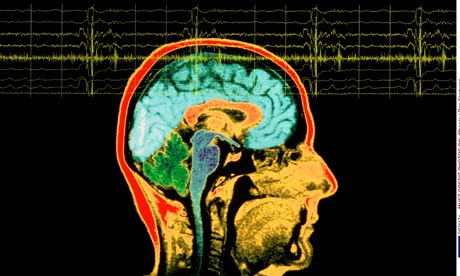
Guardian | It is clear at this point that we are irrevocably tied to the 3lb of strange computational material found within our skulls. The brain is utterly alien to us, and yet our personalities, hopes, fears and aspirations all depend on the integrity of this biological tissue. How do we know this? Because when the brain changes, we change. Our personality, decision-making, risk-aversion, the capacity to see colours or name animals – all these can change, in very specific ways, when the brain is altered by tumours, strokes, drugs, disease or trauma. As much as we like to think about the body and mind living separate existences, the mental is not separable from the physical.

This clarifies some aspects of our existence while deepening the mystery and the awe of others.

For example, take the vast, unconscious, automated processes that run under the hood of conscious awareness. We have discovered that the large majority of the brain's activity takes place at this low level: the conscious part – the "me" that flickers to life when you wake up in the morning – is only a tiny bit of the operations. This understanding has given us a better understanding of the complex multiplicity that makes a person. A person is not a single entity of a single mind: a human is built of several parts, all of which compete to steer the ship of state. As a consequence, people are nuanced, complicated, contradictory. We act in ways that are sometimes difficult to detect by simple introspection. To know ourselves increasingly requires careful studies of the neural substrate of which we are composed.

Wednesday, May 02, 2012

the end of pax americana; how western decline became inevitable

TheAtlantic | When great powers begin to experience erosion in their global standing, their leaders inevitably strike a pose of denial. At the dawn of the twentieth century, as British leaders dimly discerned such an erosion in their country's global dominance, the great diplomat Lord Salisbury issued a gloomy rumination that captured at once both the inevitability of decline and the denial of it. "Whatever happens will be for the worse," he declared. "Therefore it is our interest that as little should happen as possible." Of course, one element of decline was the country's diminishing ability to influence how much or how little actually happened.

We are seeing a similar phenomenon today in America, where the topic of decline stirs discomfort in national leaders. In September 2010, Secretary of State Hillary Clinton proclaimed a "new American Moment" that would "lay the foundations for lasting American leadership for decades to come." A year and a half later, President Obama declared in his State of the Union speech: "Anyone who tells you that America is in decline . . . doesn't know what they're talking about." A position paper from Republican presidential candidate Mitt Romney stated flatly that he "rejects the philosophy of decline in all of its variants." And former U.S. ambassador to China and one-time GOP presidential candidate Jon Huntsman pronounced decline to be simply "un-American."

Such protestations, however, cannot forestall real-world developments that collectively are challenging the post-1945 international order, often called Pax Americana, in which the United States employed its overwhelming power to shape and direct global events. That era of American dominance is drawing to a close as the country's relative power declines, along with its ability to manage global economics and security.

This does not mean the United States will go the way of Great Britain during the first half of the twentieth century. As Harvard's Stephen Walt wrote in this magazine last year, it is more accurate to say the "American Era" is nearing its end. For now, and for some time to come, the United States will remain primus inter pares--the strongest of the major world powers--though it is uncertain whether it can maintain that position over the next twenty years. Regardless, America's power and influence over the international political system will diminish markedly from what it was at the apogee of Pax Americana. That was the Old Order, forged through the momentous events of World War I, the Great Depression and World War II. Now that Old Order of nearly seven decades' duration is fading from the scene. It is natural that U.S. leaders would want to deny it--or feel they must finesse it when talking to the American people. But the real questions for America and its leaders are: What will replace the Old Order? How can Washington protect its interests in the new global era? And how much international disruption will attend the transition from the old to the new?

history of the banking cartels and the federal reserve


Tuesday, May 01, 2012

private prison corporations are slave traders

bar | Crime has been going down for nearly a generation, and the states have finally put the brakes on prison growth in response to the fiscal crunch. But Wall Street prison profiteers see the crisis as an opportunity. The Corrections Corporation of America has offered to buy nearly all the nation’s state prisons. “To ensure their profitability, the corporation insists that it be guaranteed that the prisons be kept at least 90 percent full.”
The Corrections Corporation of America believes the economic crisis has created an historic opportunity to become the landlord, as well as the manager, of a big chunk of the American prison gulag.”
The nation’s largest private prison company, the Corrections Corporation of America, is on a buying spree. With a war chest of $250 million, the corporation, which is listed on the New York Stock Exchange, this month sent letters to 48 states, offering to buy their prisons outright. To ensure their profitability, the corporation insists that it be guaranteed that the prisons be kept at least 90 percent full. Plus, the corporate jailers demand a 20-year management contract, on top of the profits they expect to extract by spending less money per prisoner.

For the last two years, the number of inmates held in state prisons has declined slightly, largely because the states are short on money. Crime, of course, has declined dramatically in the last 20 years, but that has never dampened the states’ appetites for warehousing ever more Black and brown bodies, and the federal prison system is still growing. However, the Corrections Corporation of America believes the economic crisis has created an historic opportunity to become the landlord, as well as the manager, of a big chunk of the American prison gulag. The attempted prison grab is also defensive in nature. If private companies can gain both ownership and management of enough prisons, they can set the prices without open-bid competition for prison services, creating a guaranteed cost-plus monopoly like that which exists between the Pentagon and the military-industrial complex.

If private companies are allowed to own the deeds to prisons, they are a big step closer to owning the people inside them.”

But, for a better analogy, we must go back to the American slave system, a thoroughly capitalist enterprise that reduced human beings to units of labor and sale. The Corrections Corporation of America’s filings with the U.S. Securities and Exchange Commission read very much like the documents of a slave-trader. Investors are warned that profits would go down if the demand for prisoners declines. That is, if the world’s largest police state shrinks, so does the corporate bottom line. Dangers to profitability include “relaxation of enforcement efforts, leniency in conviction or parole standards and sentencing practices or through the decriminalization of certain activities that are currently proscribed by our criminal laws." The corporation spells it out: “any changes with respect to drugs and controlled substances or illegal immigration could affect the number of persons arrested, convicted, and sentenced, thereby potentially reducing demand for correctional facilities to house them." At the Corrections Corporation of America, human freedom is a dirty word. Fist tap Arnach.

breaking the addiction to incarceration?

aclu | Today, the U.S. has the highest incarceration rate of any country in the world. With over 2.3 million men and women living behind bars, our imprisonment rate is the highest it's ever been in U.S. history. And yet, our criminal justice system has failed on every count: public safety, fairness and cost-effectiveness. Across the country, the criminal justice reform conversation is heating up. Each week, we feature our some of the most exciting and relevant news in overincarceration discourse that we've spotted from the previous week. Check back weekly for our top picks.

U.S. Jail Population Declines for Third Consecutive Year, Reports Justice Dept.
From June 2010 to June 2011, the jail inmate population declined 1.8 percent, dropping to 735,601 from 748,728. Jails were operating at 84 percent of their rated capacity at mid-year 2011, the lowest percentage since 1984.

House Funding Bill Includes $70 million for Second Chance Act
The House and Senate Appropriations Subcommittees on Commerce, Justice, and Science proposed $70 million for the Second Chance Act, an increase of $7 million from the FY12 funding level. The Second Chance Act was passed by Congress in 2008 and supports evidence-based strategies proven to reduce recidivism.

California Group Collects Enough Signatures to Place Three-Strikes on Nov. Ballot
A coalition of law enforcement officials, civil rights organizations and taxpayer groups reported recently that it has submitted enough signatures to local election officials to qualify a November ballot initiative to change California's three-strikes law. The controversial statute, which deals out long sentences for any third felony, has been linked to the precipitous growth of California's bloated prison population. The measure, which received 830,000 signatures, also would allow prisoners currently serving life behind bars for nonviolent third strikes to appeal their sentences.

Vermont Reduces Prison Population Growth with Smart Reforms
In 2007, it looked like Vermont's prison population, which had doubled between 1997 and 2007, would continue its upward trend. In the five years since then, the state has reduced its prison population by changing the way it sentences offenders and rehabilitates inmates. Vermont Gov. Peter Shumlin credits a mix of measures that includes risk-based assessments at sentencing and drug treatment and job training for parolees with his state's success.

George Will Comments on Life without Parole for Juveniles
In the wake of the oral arguments in Miller v. Alabama and Jackson v. Hobbs, in which the Supreme Court considered whether sentencing minors to life without parole constitutes cruel and unusual punishment under the Eighth Amendment, George Will calls on the court to consider modern understandings of adolescent psychology when making its decision. Writes Mr. Will, "The court must consider not only what is society's sense of cruelty but also how that sense should be shaped by what some new technologies reveal about adolescent brain biology."

prohibition costs billions, legalization would earn billions - but what about its effect on dopamine hegemony?

aclu | Over 300 economists, including three Nobel Laureates, recently signed a petition that encourages the president, Congress, governors and state legislatures to carefully consider marijuana legalization in America. The petition draws attention to an article by Harvard economist Jeffrey Miron, whose findings highlight the substantial cost-savings our government could incur if it were to tax and regulate marijuana, rather than needlessly spending billions of dollars enforcing its prohibition.

Miron predicts that legalizing marijuana would save $7.7 billion per year in government expenditure on enforcement, in addition to generating $2.4 billion annually if taxed like most consumer goods, or $6 billion per year if taxed similarly to alcohol and tobacco. The economists signing the petition note that the budgetary implications of marijuana prohibition are just one of many factors to be considered, but declare it essential that these findings become a serious part of the national decriminalization discussion.

The advantages of marijuana legalization extend far beyond an opportunity to make a dent in our federal deficit. The criminalization of marijuana is one of the many fights in the War on Drugs that has failed miserably. And while it's tempting to associate only the harder, "scarier" drugs with this botched crusade, the fact remains that marijuana prohibition is very much a part of the battle. The federal government has even classified marijuana as a Schedule 1 substance (its most serious category of substances), placing it in a more dangerous category than cocaine. More than 800,000 people are arrested for marijuana use and possession each year, and 46 percent of all drug prosecutions across the country are for marijuana possession. Yet this costly and time-consuming targeting of marijuana users by law enforcement and lawmakers has done little to quell use of the drug.

The criminalization of marijuana has not only resulted in a startlingly high number of arrests, it also reflects the devastating disparate racial impact of the War on Drugs. Despite ample evidence that marijuana is used more frequently by white people, Blacks and Latinos account for a grossly disproportionate percentage of the 800,000 people arrested annually for marijuana use and possession. These convictions hinder one's ability to find or keep employment, vote or gain access to affordable housing. The fact that these hard-to-shake consequences – bad enough as they are — are suffered more frequently by a demographic that uses marijuana less makes our current policies toward marijuana all the more unfair, unwise and unacceptable.

Monday, April 30, 2012

the invisible borders that define american culture

TheAtlantic | When we think about borders, we tend to think of administrative boundaries. Those demarcating lines, often grown out of rivers and mountain ranges or diplomatic quirks, govern our daily lives, and that’s doubly so if we live near a neighboring country or state.

We know that these boundaries are on some level unnatural. Driving around Kansas City, where I live, makes this abundantly clear. Gas price differences aside, it can be difficult to tell which state you’re in, Missouri or Kansas, and the small street of State Line Road does nothing to make it clearer.

But are there more organic borders, brought to life by our own actions and activities? I recently set out, along with a team from MIT and AT&T, to see if I could find an answer. Previously, members of our group had collaborated to use mobile phone call and text message records to determine how tightly connected different counties are to each other. But communication is far from the only way in which we are connected or separated. We can be connected based on where we move, how we speak, and even what sports teams we root for.

So our research team, consisting of DeDe Paul of AT&T, Vincent Blondel of Belgium’s Université catholique de Louvain, IBM's Dominik Dahlem*, and myself, set out to understand how a variety of cultural and social properties create borders, and whether or not these borders actually overlap. Are there in fact natural boundaries to the borders that we create as social creatures? Fist tap Prof. Geo.

mental-egoic tools for mental egoic connectivity


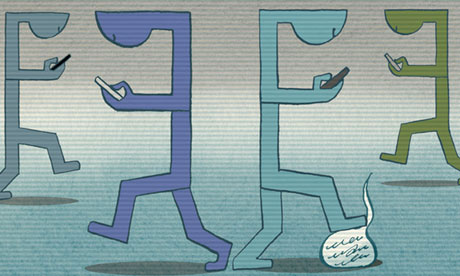
Guardian | I first noticed it in a restaurant. The place was strangely quiet, and at one table a group seemed deep in prayer. Their heads were bowed, their eyes hooded and their hands in their laps. I then realised that every one, young and old, was gazing at a handheld phone. People strolled the street outside likewise, with arms crooked at right angles, necks bent and heads in potentially crippling postures. Mothers with babies were doing it. Students in groups were doing it. They were like zombies on call. There was no conversation.

Every visit to California convinces me that the digital revolution is over, by which I mean it is won. Everyone is connected. The New York Times last week declared the death of conversation. While mobile phones may at last be falling victim to etiquette, this is largely because even talk is considered too intimate a contact. No such bar applies to emailing, texting, messaging, posting and tweeting. It is ubiquitous, the ultimate connectivity, the brain wired full-time to infinity.

The MIT professor and psychologist Sherry Turkle claims that her students are close to mastering the art of sustaining eye contact with a person while texting someone else. It is like an organist playing different tunes with hands and feet. To Turkle, these people are "alone together … a tribe of one". Anyone with 3,000 Facebook friends has none.

The audience in a New York theatre now sit, row on row, with lit machines in their laps, looking to the stage occasionally but mostly scrolling and tapping away. The same happens at meetings and lectures, in coffee bars and on jogging tracks. Children are apparently developing a dexterity in their thumbs unknown since the evolution of the giant sloth. Talk is reduced to the muttered, heads-down expletives brilliantly satirised in the BBC's Twenty Twelve.

Psychologists have identified this as "fear of conversation". People wear headphones as "conversational avoidance devices". The internet connects us to the entire world, but it is a world bespoke, edited, deleted, sanitised. Doubt and debate become trivial because every statement can be instantly verified or denied by Google. There is no time for the thesis, antithesis, synthesis of Socratic dialogue, the skeleton of true conversation.

Sunday, April 29, 2012

neurobiological sickness...,


Romanity | From Roman racism to Orthodox equality.

All humans suffer from this short-circuit "since all have sinned and fall short of the glory of God." (Rom. 3:23) The difference among humans is not equality or inequality of race, but whether one is being cured or not. Within this context we have a complete reversal of the above foundation of the Hellenic paganism of the Roman Empire. The great struggle between paganism and Christianity in the time of Emperor Constantine the Great (306-337) is reflected in the difference between Roman Greeks (meaning Pagans) and Roman Christians. All Pagan Romans were defending their aristocratic ancient Hellenic identity and traditions which was being torn apart by the aristocratic identity of the cure of glorification which was open to all Romans, both gentis and non-gentis, and to all non-Romans.[ 66 ] The "Aristocracy" of Glorification is no respector of the aristocracy of birth. [ Return ](b) Examples of racism even in the theology of Pan-Germanism and Pan-Slavism.

Having conquered the West Romans the Franco-Latins called themselves the "gentis" and their Roman slaves "serfs" and "villains". Pan-German ideology was clearly expressed to an extreme degree by the followers of Hitler who were out to enslave at least the Slavs. But a theological expression of this Germanic racism is found in Albert Schweitzer's book, "The Quest Of The Historical Jesus." For example, on the first page of Chapter I he claims that,

"When, at some future day, our civilization shall lie, closed and completed, before the eyes of later generations, German theology will stand out as a great, a unique phenomenon in the mental and spiritual life of our time. For nowhere save in the German temperament can there be found in the same perfection in the living complex of conditions and factors — of philosophic thought, critical acumen, historic insight, and religious feeling — without which no deep theology is possible."

"And the greatest achievement of German theology is the critical investigation of the life of Jesus. What it has accomplished here has laid down the conditions and determined the course of the religious thinking of the future.."

"In the history of doctrine its work has been negative; it so to speak, cleared the site for the new edifice of religious thought. In describing how the ideas of Jesus were taken possession of by the Greek spirit, it was tracing the growth of what must necessarily become strange to us, and, as a matter of fact, has become strange to us."[ 67 ]

All this has been done without the slightest knowledge of what glorification in the Lord (Yahweh) of Glory is (in both Old and New Testaments). This is ignored equally by both Germans and their Protestant and or 'Catholic' colleagues. Because of Augustine's Neo-Platonism, both Protestants and Latins have always imagined that the Fathers of the Ecumenical Councils accepted both the analogia entis between God and His creation and analogia fidei between God and the Bible. This created not only their Biblical fundamentalism, but also made Greek philosophy the foundation of their understanding of the History of Dogma which is certainly not that of the reality of the Roman Ecumenical Councils. The reason for this is that Western Biblical and doctrinal scholars are ignorant of the Four Patristic Keys to the Bible and the Dogmas of the Roman Ecumenical Councils explained earlier. But even many "Orthodox" scholars follow either the Protestant or 'Catholic' scholars by "sniffing."

Albert Schweitzer and his students saw clearly where their quest for the "historical Jesus" was leading, i.e. to the dissolution of the doctrinal fabric of what passes off as Christian Tradition in the Franco-Latin West. One typical Orthodox reaction has been to become proud that the Fathers of the Church had supposedly Hellenized Christianity thereby making it acceptable to the Hellenic mind of the Roman Empire.

The Slavophil branch of Pan-Slavism also believed that the Slavs understood the Bible better than other races. But the supposed reason for this is that among the Orthodox the Greco-Roman Fathers of the Church belong to the historical manifestation of the Kouchite movement in history, whereas the Slavs belong to the Iranian movement in history.[ 68 ] In other words the Slavic Orthodox are a superior brand of Christians than the Roman Fathers of the Church, not because they may have reached glorification, but simply because they are Slavs.[ 69 ]

with the dopamine flowing like this, you knew the booty popping couldn't be far behind...,


CNN | After focusing on "green cars" in recent years, carmakers are wowing visitors at the Auto China 2012 car show with vehicles that are big, bad and gas-guzzling.

"I would definitely be interested if the price was right," says Wang Xizhen as he ogled a deep purple Aston Martin DBS.

Aston Martin launched its Dragon 88 China-only limited edition this week. With gold dragon emblems embroidered onto its leather seats, the car also carries a hefty price tag - more than 5 million yuan (nearly $800,000).

Jeep also launched a China-inspired car -- a flashy Wrangler concept car emblazoned with a long silvery dragon across the hood.

"Jeep brand sales in China in 2011 increased 81% over the prior year and China," said Mike Manley, CEO of Jeep Brand, Chrysler group, at the unveiling on Monday. "Last year, more Jeep vehicles were sold in China than in any other country besides the U.S. and Canada."

Manley said because the brand is committed to China, it's important to design and tailor vehicles specifically to Chinese tastes. But some consumers, like Wang, disagreed.

"Just because it has a dragon on it, doesn't mean Chinese people will love it. After all, we're after going after a western brand," said Wang. "I like the subtlety of Aston Martin's dragon design, but to put a huge dragon across the entire car is going overboard."

Jeep and Aston Martin are among many foreign automakers hoping to woo hundreds of thousands of Chinese consumers visiting the show this week, especially as China has become the world's largest auto market amid a sales slump in Europe and tepid growth in the United States.

Despite the push in green cars in previous years following government subsidies for cleaner vehicles, this year's focus turned to gas-guzzling SUVs. Crowds swooned over the new Lamborghini Urus SUV concept car -- a potential competitor to the popular Porsche Cayenne.

Ford also unveiled three SUVs at the show, including the EcoSport, which is expected to be manufactured at the company's China factory in Chongqing.

"SUVs are a strength for Ford globally and here in China, the SUV segment is one of the fastest growing segments in the industry," said Joe Hinrichs, president of Ford's Asia Pacific and Africa region. "So you put the two together...it's a very exciting time."

Automakers have turned their attention to bigger cars and flashier cars to attract consumers since there are fewer government-backed incentives to pursue green technology, analysts say.


Friday, April 27, 2012

left in the dark: plant/human symbiosis and the fall of humanity

realitysandwich | “I believe that the lost secret of human emergence . . . the undefined catalyst that took a very bright monkey and turned that species into a self-reflecting dreamer . . . that catalyst has to be sought in these alkaloids in the food chain that were catalyzing higher states of intellectual activity.”
--Terence McKenna

Tony Wright and Graham Gynn are authors of Left In The Dark--the book that presents Tony’s research outlining a radical re-interpretation of the current data regarding human evolution and, they contend, our recent degenerated state we call “civilization”. You can read the book for free here. Despite such a young and extreme proposal positive reactions are growing and include such minds as Dennis McKenna, Stanislav Grof, Colin Groves, Michael Winkelman and many There are many mysterious anomalies about human evolution yet to be adequately explained. These include the human brains rapid expansion in size and complexity, why this accelerating expansion suddenly stalled roughly 200,000 years ago and our brains have been shrinking ever since, and why our rare glimpses of genius goes hand in hand with our species wide insanity.

The following is a discussion with Tony Wright on these anomalies and more, followed by some further information on his theory.

TS: After two decades of research and radical self-experimentation you’ve come to a synthesis between the ancient data and information coming out of modern science. Paradoxically this all seems to indicate a humongous problem, and simultaneously explains why we would be oblivious to it in the first place: we are all suffering from species wide neural retardation, and are now too deluded to even realize when faced with the mountain of evidence. Is this the general idea?

TW: Yes. It should be virtually impossible to find any supporting evidence for such a profound theory if there was no real problem with the development and structural integrity of our neural system in the first place. If there were only ancient accounts of the diagnosis, or any supporting biological data, or initial support from some of society’s sharpest minds, then it should at least ring alarm bells. That all those elements exist and in addition our collective behavior has long been thought by many to be insane indicates something really serious just doesn’t add up. If everything is fine then the theory would be a no-brainer to refute, and we should at least have no fear in thoroughly checking it out.

So during millions of years of evolution in the African tropical forest we developed a symbiosis with fruit, and your proposing that it is no coincidence the most complex tissue in the known universe evolved during a symbiosis with perhaps dozens of species of the most complex chemical factories on the planet. How did this occur?

I’m proposing that the accelerating expansion of the neo-cortex was due to a runaway feedback mechanism driven by our own hormone system in combination with the complex plant bio-chemistry provided by our diet. What has been overlooked is the profound effects of flooding our brains 24/7 for thousands of generations with this highly advanced molecular engineering formula. Fruit is essentially a womb-like developmental environment for the seeds and has very unique, highly complex hormonally active chemistry. Our early development is dictated by the transcription process whereby changes in how the DNA is read dictate the type of structures that develop. Steroids like testosterone are the key players here, but by incorporating more and more of these DNA-reading plant chemicals into our diet we basically shifted from a typical mammalian developmental environment to more of a plant developmental environment.

Along with regulating gene transcription many of these molecules increase brain activity, modulate the endocrine system including the pineal gland, inhibit mono amine oxidase (MAO inhibitors), are antioxidants and also inhibit the activity of our own hormones such as testosterone and oestrogens. Just altering the activity of these two hormones has a dramatic affect on many aspects of our development, physiology and neural structure. For example, decreasing they’re activity extends juvenility and the window for brain development by delaying the onset of sexual maturity.

All this coming together would have many interconnected affects and, being that this bio-chemistry would be present in the developmental environment it would dramatically impact what develops at this most sensitive and rapid stage of brain/endocrine system growth in the uterus.

This carried on after birth through breastfeeding, and then afterwards through directly ingesting this highly advanced molecular engineering cocktail we call fruit. Each generation would pass down a progressively modified neuro-endocrine system as a result. So after millions of years of ever more entangled co-evolution nearly all of the transcription chemicals present during our early development and on through life that were essential to our optimal design/functioning were lost and replaced by progressively worse substitutes irrelevant to our evolution . . . all the way until we reach today’s ‘junk’ food. Ironically much of this actually has the opposite effect of fruit bio-chemistry on our hormones, causing the unique process to reverse.

All of this sounds complex but at its foundation it’s just really basic engineering principles: If you change the design (transcription) and construction materials that a system or technology is built from and fueled by, then the structure and functionality of that system will inevitably change as a result. This logic is obvious when applied to any of our technologies but paradoxically we haven’t applied it to the thing involved in generating our perception, which just happens to be the most complex piece of kit we know. Our perception is directly correlated with and ‘effectively’ a product of the extremely sensitive structure and bio-chemistry of our brain and this has changed out of all recognition in a very short time. (more on this symbiosis)

scenes from internet rising...,


Thursday, April 26, 2012

from fracking to water rights: how foreign interests are cleaning out africa

treehugger | There are a lot of misconceptions about Africa, including that the continent needs help from the rest of the world in order to overcome the economic challenges it faces. It doesn't need help, though, so much as to be on equal footing with the rest of the world. Yet it continues to be seen not only as the 'dark' continent, but also a resource-rich one whose wealth is there for the taking. Foreign countries and companies are racing to claim not only the continent's mineral resources, which often fuel conflict and environmental disasters, but also arable land to grow water-intensive crops for export. That's no small problem, considering the droughts that African countries already face and how vulnerable the region is to climate change.

These resource grabs often proceed in the name of development, but all they develop are gains for foreign countries. In the process, they make every problem that the continent already faces a lot worse. Fist tap Dale.

huge water resource exists under africa


BBCNews | Scientists say the notoriously dry continent of Africa is sitting on a vast reservoir of groundwater.

They argue that the total volume of water in aquifers underground is 100 times the amount found on the surface.

The team have produced the most detailed map yet of the scale and potential of this hidden resource.

Writing in the journal Environmental Research Letters, they stress that large scale drilling might not be the best way of increasing water supplies.

Across Africa more than 300 million people are said not to have access to safe drinking water.

Demand for water is set to grow markedly in coming decades due to population growth and the need for irrigation to grow crops.

Freshwater rivers and lakes are subject to seasonal floods and droughts that can limit their availability for people and for agriculture. At present only 5% of arable land is irrigated.

Now scientists have for the first time been able to carry out a continent-wide analysis of the water that is hidden under the surface in aquifers. Researchers from the British Geological Survey and University College London (UCL) have mapped in detail the amount and potential yield of this groundwater resource across the continent.

Helen Bonsor from the BGS is one of the authors of the paper. She says that up until now groundwater was out of sight and out of mind. She hopes the new maps will open people's eyes to the potential.

"Where there's greatest ground water storage is in northern Africa, in the large sedimentary basins, in Libya, Algeria and Chad," she said.

"The amount of storage in those basins is equivalent to 75m thickness of water across that area - it's a huge amount." Fist tap Dale.

Wednesday, April 25, 2012

e.o.wilson; what is art?

HarvardMagazine | The utilitarian theory of cave art, that the paintings and scratchings depict ordinary life, is almost certainly partly correct, but not entirely so. Few experts have taken into account that there also occurred, in another wholly different domain, the origin and use of music. This event provides independent evidence that at least some of the paintings and sculptures did have a magical content in the lives of the cave dwellers. A few writers have argued that music had no Darwinian significance, that it sprang from language as a pleasant “auditory cheesecake,” as one author once put it. It is true that scant evidence exists of the content of the music itself—just as, remarkably, we have no score and therefore no record of Greek and Roman music, only the instruments. But musical instruments also existed from an early period of the creative explosion. “Flutes,” technically better classified as pipes, fashioned from bird bones, have been found that date to 30,000 years or more before the present. At Isturitz in France and other localities some 225 reputed pipes have been so classified, some of which are of certain authenticity. The best among them have finger holes set in an oblique alignment and rotated clockwise to a degree seemingly meant to line up with the fingers of a human hand. The holes are also beveled in a way that allows the tips of the fingers to be sealed against them. A modern flutist, Graeme Lawson, has played a replica made from one of them, albeit of course without a Paleolithic score in hand.

Other artifacts have been found that can plausibly be interpreted as musical instruments. They include thin flint blades that, when hung together and struck, produce pleasant sounds like those from wind chimes. Further, although perhaps just a coincidence, the sections of walls on which cave paintings were made tend to emit arresting echoes of sound in their vicinity.

Was music Darwinian? Did it have survival value for the Paleolithic tribes that practiced it? Examining the customs of contemporary hunter-gatherer cultures from around the world, one can hardly come to any other conclusion. Songs, usually accompanied by dances, are all but universal. And because Australian aboriginals have been isolated since the arrival of their forebears about 45,000 years ago, and their songs and dances are similar in genre to those of other hunter-gatherer cultures, it is reasonable to suppose that they resemble the ones practiced by their Paleolithic ancestors.

what is money?

BBCRadio | We dream about it, argue about it, worry about it, celebrate it, spend it, save it, we transfer it from one emotion to another. But what exactly is money? And why do we trust it? Frances Stonor Saunders takes a journey through some of the fundamentals of money. During her journey she dips her toe into the world of quantitative easing. How is that money invented? Is it as real as the pieces of paper in our wallets? And she explores some of the reasons for the calls to return to a gold standard. Essentially, she tries to gain a better understanding of what this stuff which we call money is really about; how and why do we maintain our faith in it, or has it just become too complicated? Read the transcript.

Tuesday, April 24, 2012

a separative lesion in consciousness...,


The process which we are considering may be regarded as the development of individual personality and it was only during the first millenium B.C. that this degree of self-consciousness became widespread. It is to this new mental-egoic substitute self to which we must turn our attention because there is one common characteristic that underlies the overwhelming majority of mental-egoic activity. It is a very simple characteristic. Most mental-egoic activity refers to and is based on the past. That is to say, mental-egoic activity is based on the memory of past actions, past experiences, past events. As you are now thinking about all this, you are working largely with and from memories - because it is from memories that you draw words, names, and concepts. (why I said "lying" is harsh word for it, but often useful)

The nature of mental-egoic processes are not bad in-and-of themselves, it is through this attentive use of memory that you humans have been able to pull yourselves up out of the archaic cameral state. Odd as it sounds, memory and the mental-egoic attention to the same is a form of transcendence inasmuch as it has allowed you humans to escape the panoramic fluctuations of the moment. As the human "self" began to shift away from the cameral sympathos toward mental-egoic thought and language - it likewise began an inevitable shift away from the present moment and toward memory. The mental-egoic self is a memory self, and that is what allows it to rise above cameral sympathetic fluctuation.

What you humans refer to as "consciousness" is before everything else just memory.

There are three basic problems with that.

First, after the mental-egoic self is formed, it is very difficult to escape. Attending to word/name/concept memory becomes all that you have, and all that are. Short of chemically induced submergence into the cameral sympathos, i.e. forced attention to otherwise subliminal fluctuations of the moment, you are sound asleep to what is present and real. The mental-egoic attention to memory becomes so stable and strong that it not only escapes the subconscious cameral sympathos.

Second, the mental-egoic also begins to deny or even destroy access to the superconscious, i.e., conscience or the memory of emotion, the all important recollection and experiencing of the cameral sympathos or feeling "all at once" that is the next step in possible human evolution. The mental-egoic has to be very badly shocked in order to open itself to momentary glimpses or experiences of conscience or "feeling all at once".

Finally, as if the above wasn't bad enough, the mental-egoic has one other fundamental disability derived from working with memory, it tends to be static and to deal most effectively with unreal, unnatural static constructs. As these humans began forming static Euclidean notions about fundamental reality - and paying attention principally to the recording, thinking, and remembering aspects of mind, it began to separate from the spontaneous, impulsive, moving world from which it emerged.

Mental-egoic human awareness followed a path of developing thought based on static concepts of nature and of the self which long ago ceased to conform to the underlying living matrix from which it arose. The mental-egoic "self" is a separative lesion in consciousness.

alone together


alonetogetherbook | Facebook. Twitter. SecondLife. “Smart” phones. Robotic pets. Robotic lovers. Thirty years ago we asked what we would use computers for. Now the question is what don’t we use them for. Now, through technology, we create, navigate, and perform our emotional lives.

We shape our buildings, Winston Churchill argued, then they shape us. The same is true of our digital technologies. Technology has become the architect of our intimacies. Online, we face a moment of temptation. Drawn by the illusion of companionship without the demands of intimacy, we conduct “risk free” affairs on Second Life and confuse the scattershot postings on a Facebook wall with authentic communication. And now, we are promised “sociable robots” that will marry companionship with convenience.

Technology promises to let us do anything from anywhere with anyone. But it also drains us as we try to do everything everywhere. We begin to feel overwhelmed and depleted by the lives technology makes possible. We may be free to work from anywhere, but we are also prone to being lonely everywhere. In a surprising twist, relentless connection leads to a new solitude. We turn to new technology to fill the void,but as technology ramps up, our emotional lives ramp down.

Alone Together is the result of MIT technology and society specialist Sherry Turkle’s nearly fifteen-year exploration of our lives on the digital terrain. Based on interviews with hundreds of children and adults, it describes new, unsettling relationships between friends, lovers, parents, and children, and new instabilities in how we understand privacy and community, intimacy and solitude. It is a story of emotional dislocation, of risks taken unknowingly. But it is also a story of hope, for even in the places where digital saturation is greatest,there are people—especially the young—who are asking the hard questions about costs, about checks and balances, about returning to what is most sustaining about direct human connection. At the threshold of what Turkle calls “the robotic moment,” our devices prompt us to recall that we have human purposes and,perhaps, to rediscover what they are.

Chipocalypse Now - I Love The Smell Of Deportations In The Morning

sky |   Donald Trump has signalled his intention to send troops to Chicago to ramp up the deportation of illegal immigrants - by posting a...