Cato | Michael Gerson, former speechwriter for President George W. Bush and now a columnist for the Washington Post, has denounced libertarianism as "morally empty," "anti-government," "a scandal," "an idealism that strangles mercy," guilty of "selfishness," "rigid ideology," and "rigorous ideological coldness." (He's starting to repeat himself.)
In his May 9 column, "Ron Paul's Land of Second-Rate Values," he went after Rep. Paul for his endorsement of drug legalization in the Republican presidential debate. "Dotty uncle," he fumed, alleging that Paul has "contempt for the vulnerable and suffering." Paul holds "second-rate values," he added.
What did Paul do to set him off? He said that adult Americans ought to have the freedom to make their own decisions about their personal lives — from how they worship, to what they eat and drink, to what drugs they use. And he mocked the paternalist mindset: "How many people here would use heroin if it were legal? I bet nobody would say, 'Oh yeah, I need the government to take care of me. I don't want to use heroin, so I need these laws.'"
Gerson accused Paul of mocking not paternalists but addicts: "Paul is not content to condemn a portion of his fellow citizens to self-destruction; he must mock them in their decline." Gerson wants to treat them with compassion. But let's be clear: He thinks the compassionate way to treat suffering people is to put them in jail. And in the California case Brown v. Plata, the Supreme Court just reminded us what it means to hold people in prison:
California's prisons are designed to house a population just under 80,000, but ... the population was almost double that. The State's prisons had operated at around 200% of design capacity for at least 11 years. Prisoners are crammed into spaces neither designed nor intended to house inmates. As many as 200 prisoners may live in a gymnasium, monitored by as few as two or three correctional officers. As many as 54 prisoners may share a single toilet. Because of a shortage of treatment beds, suicidal inmates may be held for prolonged periods in telephone-booth-sized cages without toilets.
Gerson knows this. His May 27 column quoted this very passage and concluded, "[I]t is absurd and outrageous to treat [prisoners] like animals while hoping they return to us as responsible citizens."
Gerson contrasted the "arrogance" of Paul's libertarian approach to the approach of "a Republican presidential candidate [who] visited a rural drug treatment center outside Des Moines. Moved by the stories of recovering young addicts, Texas Gov. George W. Bush talked of his own struggles with alcohol. 'I'm on a walk. And it's a never-ending walk as far as I'm concerned... . I want you to know that your life's walk is shared by a lot of other people, even some who wear suits.'"
Gerson seems to have missed the point of his anecdote. Neither Bush nor the teenagers in a Christian rehab center were sent to jail. They overcame their substance problems through faith and personal responsibility. But Gerson and Bush support the drug laws under which more than 1.5 million people a year are arrested and some 500,000 people are currently in jail.
Our last three presidents have all acknowledged they used illegal drugs in their youth. Yet they don't seem to think — nor does Gerson suggest — that their lives would have been made better by arrest, conviction, and incarceration. If libertarianism is a second-rate value, where does hypocrisy rank?
Gerson seems to have a fantastical view of our world today. He writes, "[D]rug legalization fails. The de facto decriminalization of drugs in some neighborhoods — say, in Washington, D.C. — has encouraged widespread addiction."
This is mind-boggling. What has failed in Washington, D.C., is drug prohibition. As Mike Riggs of Reason magazine wrote, "I want to know where in D.C. one can get away with slinging or using in front of a cop. The 2,874 people arrested by the MPD for narcotics violations between Jan. 1 and April 9 of this year would probably like to know, too."
Michelle Alexander, author of The New Jim Crow, writes, "Crime rates have fluctuated over the past few decades — and currently are at historical lows — but imprisonment rates have soared. Quintupled. And the vast majority of that increase is due to the War on Drugs, a war waged almost exclusively in poor communities of color." Michael Gerson should ask Professor Alexander for a tour of these neighborhoods where he thinks drugs are de facto decriminalized.
In a recent Cato Institute report, Jeffrey Miron of Harvard University estimated that governments could save $41.3 billion a year if they decriminalized drugs, an indication of the resources we're putting into police, prosecutions, and prisons to enforce the war on drugs.
Tuesday, August 30, 2011
drug decriminalization has failed?
By
CNu
at
August 30, 2011
0
comments
Labels: dopamine , hegemony , states rights
Monday, August 29, 2011
mexican elites fleeing their failing civil war...,
Video - Michelle Obama declares it safe to travel to Mexico.
Tens of thousands of well-off Mexicans have moved north of the border in a quiet exodus over the past few years, according to local officials, border experts and demographers. Unlike the much larger population of illegal immigrants, they are being warmly welcomed.
“It goes counter to the conventional wisdom about the Mexican presence in the United States,” San Antonio Mayor Julian Castro said. The influx “is positive, it is entrepreneurial . . . and one of the keys to a very successful growing city like San Antonio.”
Castro estimates that Mexicans own at least 50,000 of the approximately 500,000 homes and apartments in his city of 1.3 million, which has a vibrant Hispanic culture. Many are in gated communities that have sprung up in the city’s sun-baked northern hills. One neighborhood built around a country club has so many residents from the Mexican city of Monterrey that it has been dubbed “Sonterrey.”
“I’ve never seen so many Maseratis and Porsches in my neighborhood,” said Carl Bohn, a businessman who lives in what is formally called Sonterra, a tranquil development of homes with red-tiled roofs, palm trees, colonnaded entrances and backyard pools.
Affluent Mexicans have long visited the United States for business and shopping. What’s different now is that they are coming to stay, fleeing cartel wars that have left more than 37,000 Mexicans dead in four years, according to U.S. and Mexican officials and analysts. The number of investment visas granted to Mexicans has risen sharply over the past five years.
“It’s a very substantial flow; I would say probably the largest since the 1920s, the last great period of upheaval in Mexico,” said Henry Cisneros, a former mayor of San Antonio who served in President Clinton’s Cabinet. “We have whole areas of San Antonio that are being transformed.”
The size of the new wave is difficult to measure, since some of the new arrivals hold dual citizenship or U.S. work visas or already had American vacation homes. One Mexican think tank, the Security and Civic Culture Observatory, estimated last year that 230,000 people had fled the violence-wracked border city of Juarez, with half going across Mexico’s northern border.
By
CNu
at
August 29, 2011
0
comments
Labels: agenda , elite , establishment , unintended consequences
and now onto the collapse war on our southern border...,
Video - Casino Royale arson attack in Monterrey
Security forces had so far confiscated about 1,500 slot machines at 11 casinos in Monterrey and its surroundings and arrested three people, Mexico’s tax agency said. It said the continuing operation was meant to verify whether casinos had paid taxes or introduced slot machines illegally.
Thursday’s arson attack by gunmen was a macabre milestone in a conflict that the government says has claimed more than 35,000 lives since President Felipe Calderon launched an offensive against drug cartels in late 2006. Others put the death toll near 40,000.
The torching of the Casino Royale has raised questions over Mexico’s regulatory controls for fast-spreading gambling houses.
Authorities have not been able to reach the owners of two companies pointed out as titleholders of the casino. Jorge Domene, security spokesman for Nuevo Leon state, said an order to appear before state police has been issued for owners of the two companies, CYMSA Corp. and Vallarta Attractions and Emotions.
Casino Royale’s legal representative, Juan Gomez, told reporters that the shareholders of the business were Jorge Alberto and Raul Rocha Cantu. They will meet with police when authorities set the time, Gomez said.
Their family members have been prohibited from leaving the city, he said without offering details.
During the raids, which began Friday, about 700 soldiers, federal police and Treasury Department agents seized slot machines and put them in moving trucks.
Authorities did not say the raids were related to the arson. But one of the casinos searched was also registered under Vallarta Attractions and Emotions, according to the gaming unit of Mexico’s Interior Department. Information of the other locations was not immediately available.
Federal police deployed 1,500 offiers and sent Black Hawk helicopters to the state to step up security in this industrial metropolis of more than 4 million people. The Mexican army said it was sending in 1,500 soldiers.
Mayor Fernando Larrazabal said the Casino Royale and other 12 casinos violated municipal laws and were allowed to remain open after obtaining federal court injunctions.
The casino had been attacked twice before, including an incident in May when gunmen strafed it from the outside. Last month, gunmen killed 20 people at a bar in Monterrey.
Cartels often extort casinos and other businesses, threatening to attack them or burn them to the ground if they refuse to pay. But Gomez, the owners’ representative, said the Casino Royale had not received extortion threats.
Speaking at a news conference, he also said the casino had the appropriate permits and met safety standards.
Authorities have not blamed a specific drug-trafficking organization for the casino attack. But the city has been ensnared in a turf battle between the Gulf cartel and its offshoot, the Zetas, and is on track for record levels of killings this year.
By
CNu
at
August 29, 2011
0
comments
Labels: Collapse Crime , unintended consequences
chinese military clowns a lot like the u.s. military...,
Video - 1l33t chinese h@x0rs putting in work rotflmbao...,
The documentary itself was otherwise meant as praise to the wisdom and judgment of Chinese military strategists, and a typical condemnation of the United States as an implacable aggressor in the cyber-realm. But the fleeting shots of an apparent China-based cyber-attack somehow made their way into the final cut.
The screenshots appear as B-roll footage in the documentary for six seconds—between 11:04 and 11:10 minutes—showing custom-built Chinese software apparently launching a cyber-attack against the main website of the Falun Gong spiritual practice, by using a compromised IP address belonging to a United States university. As of Aug. 22 at 1:30pm EDT, in addition to Youtube, the whole documentary is available on the CCTV website. But by Aug. 25, multiple media noted that the video had been removed.
The screenshots show the name of the software and the Chinese university that built it, the Electrical Engineering University of China's People's Liberation Army—direct evidence that the PLA is involved in coding cyber-attack software directed against a Chinese dissident group.
The software window says "Choose Attack Target." The computer operator selects an IP address from a list—it happens to be 138.26.72.17—and then selects a target. Encoded in the software are the words "Falun Gong website list," showing that attacking Falun Gong websites was built into the software.
A drop-down list of dozens of Falun Gong websites appears. The computer operator chooses Minghui.org, the main website of the Falun Gong spiritual practice.
The IP address 138.26.72.17 belongs to the University of Alabama in Birmingham (UAB), according to an online trace.
The shots then show a big "Attack" button on the bottom left being pushed, before the camera cuts away.
"The CCP has leaked its top secret here," says Jason Ma, a commentator for New Tang Dynasty Television. "This is the first time we see clearly that one of the top Chinese military universities is doing this research and developing software for cyber-attacks. There's solid proof of it in this video," he said.
The Chinese Communist Party has consistently denied that it is involved in cyber-attacks, but experts have long suspected that the Chinese military engages in them.
"Now we've got proof," Ma says. "They're also extending their persecution of Falun Gong overseas, attacking a civil website in the U.S. These are the clear messages revealed in these six seconds of video."
By
CNu
at
August 29, 2011
0
comments
Labels: Ass Clownery , count zero
dhs funds these babies for the local constabulary...,
Video - Shadowhawk UAV - coming soon to a disaster near you.
These aircraft offer not only extended ISR capabilities but all four variants can be weaponized with select payloads to include but not limited to 40mm grenade launchers, full and semi-automatic small arms, as well as a multitude of SIGINT collection units.
By
CNu
at
August 29, 2011
0
comments
Labels: Peak Capitalism , predatory militarism
Sunday, August 28, 2011
murray rothbard's 1972 dissection of the cult of ayn rand..,
Video - sendup of ayn rand from the virtue of selfishness
The goals of the cult leadership are money and power. Power is achieved over the minds of the disciples through inducing them to accept without question the guru and his creed. This devotion is enforced through psychological sanctions. For once the acolyte is imbued with the view that approval of, and communication with, the guru are essential to his life, then the implicit and explicit threat of excommunication – of removal from the direct or indirect presence of the guru – creates a powerful psychological sanction for the "enforcement" of loyalty and obedience. Money flows upward from the members through the hierarchy, either in the form of volunteer labor service contributed by the members, or through cash payments.
It should be clear at this point in history that an ideological cult can adopt the same features as the more overtly religious cult, even when the ideology is explicitly atheistic and anti-religious. That the cults of Hitler, Mussolini, Stalin, Trotsky, and Mao are religious in nature, despite the explicit atheism of the latter, is by now common knowledge. The adoration of the cult founder and leader, the hierarchical structure, the unswerving loyalty, the psychological (and when in command of State power, the physical) sanctions are all too evident.
The Exoteric and the Esoteric
Every religious cult has two sets of differing and distinctive creeds: the exoteric and the esoteric. The exoteric creed is the official, public doctrine, the creed which attracts the acolyte in the first place and brings him into the movement as a rank-and-file member. The quite different creed is the unknown, hidden agenda, a creed which is only known to its full extent by the top leadership, the "high priests" of the cult. The latter are the keepers of the Mysteries of the cult.
But cults become particularly fascinating when the esoteric and exoteric creeds are not only different, but totally and glaringly in mutual contradiction. The havoc that this fundamental contradiction plays in the minds and lives of the disciples may readily be imagined. Thus, the various Marxist-Leninists cults officially and publicly extol Reason and Science, and denounce all religion, and yet the members are mystically attracted to the cult and its alleged infallibility.
Thus, Alfred G. Meyer writes of Leninist views on party infallibility:
Lenin seems to have believed that the party, as organized consciousness, consciousness as a decision-making machinery, had superior reasoning power. Indeed, in time this collective body took on an aura of infallibility, which was later elevated to a dogma, and a member’s loyalty was tested, in part, by his acceptance of it. It became part of the communist confession of faith to proclaim that the party was never wrong.... The party itself never makes mistakes.1
If the glaring inner contradictions of the Leninist cults make them intriguing objects of study, still more so is the Ayn Rand cult, which, while in some sense is still faintly alive, flourished for just ten years in the 1960s; more specifically, from the founding of the Nathaniel Branden lecture series in early 1958 to the Rand-Branden split ten years later. For not only was the Rand cult explicitly atheist, anti-religious, and an extoller of Reason; it also promoted slavish dependence on the guru in the name of independence; adoration and obedience to the leader in the name of every person’s individuality; and blind emotion and faith in the guru in the name of Reason.
Virtually every one of its members entered the cult through reading Rand’s lengthy novel Atlas Shrugged, which appeared in late 1957, a few months before the organized cult came into being. Entering the movement through a novel meant that despite repeated obeisances to Reason, febrile emotion was the driving force behind the acolyte’s conversion. Soon, he found that the Randian ideology sketched out in Atlas was supplemented by a few non-fiction essays, and, in particular, by a regular monthly magazine, The Objectivist Newsletter (later, The Objectivist).
By
CNu
at
August 28, 2011
3
comments
Labels: A Kneegrow Said It
mike wallace 1959 ayn rand interview
Second, the questions that Wallace raises with Rand illustrate how much social values have changed in 50 years.
Video - Part one of three part interview
By
CNu
at
August 28, 2011
0
comments
Labels: psychopathocracy
stetson kennedy rip...,
Video - Audio overview of the late great Stetson Kennedy.
Author and folklorist Stetson Kennedy, who infiltrated the Ku Klux Klan six decades ago and exposed its secrets but decades later was criticized for appearing to exaggerate his exploits, died Saturday at a medical center near St. Augustine, Fla. He was 94.
The death was announced on his website.
In his 1954 book "I Rode With the Ku Klux Klan," Kennedy wrote that he gained entrance to the Klan by posing as an encyclopedia salesman and using the name of an uncle who was a Klan member. The book was rereleased in 1990 as "The Klan Unmasked."
"Exposing their folklore — all their secret handshakes, passwords and how silly they were, dressing up in white sheets" was one of the strongest blows delivered to the Klan, Peggy Bulger, director of the American Folklife Center at the Library of Congress, told the Associated Press in 2007.
"If they weren't so violent, they would be silly," said Bulger, who wrote her doctoral thesis on Kennedy's work as a folklorist.
After a back injury kept him out of the military during World War II, Kennedy began crusading against what he called "homegrown racial terrorists." He served as director of fact-finding for the southeastern office of the Anti-Defamation League and as director of the Anti-Nazi League of New York.
With evidence salvaged from the grand dragon's wastebasket, he enabled the Internal Revenue Service to press for collection of an outstanding $685,000 tax lien from the Klan in 1944 and he helped draft the brief used by the state of Georgia to revoke the Klan's national corporate charter in 1947. He also testified in other Klan-related cases.
In the late 1940s, Kennedy exposed the Klan's secrets on the national stage through the "Superman" radio series, which used information he provided in episodes titled "Clan of the Fiery Cross."
By
CNu
at
August 28, 2011
0
comments
Labels: cognitive infiltration , common sense , truth
remembering King's thoughts...,
Video - MLK at Riverside Church
King's alarm — what he described as “the evil of militarism” — is ringing loud; our military adventures are so difficult to explain in terms of rationale, that few try or are even asked.
The doctrinal system equates patriotism synonymous with militarism; this is a far cry from the intellect of a King or even James Madison, who stated that a people cannot exist both ignorant and free.
In an Iowa classroom, I was brought to tears last week by a white woman who cut through the clutter and said in front of everybody that we have buried Dr. King.
As I thought about it, I decided citizens have not had the last word, yet.
— Jeffrey J. Weiss, Catholic Peace Ministry, director, Des Moines
By
CNu
at
August 28, 2011
2
comments
Labels: unspeakable
Saturday, August 27, 2011
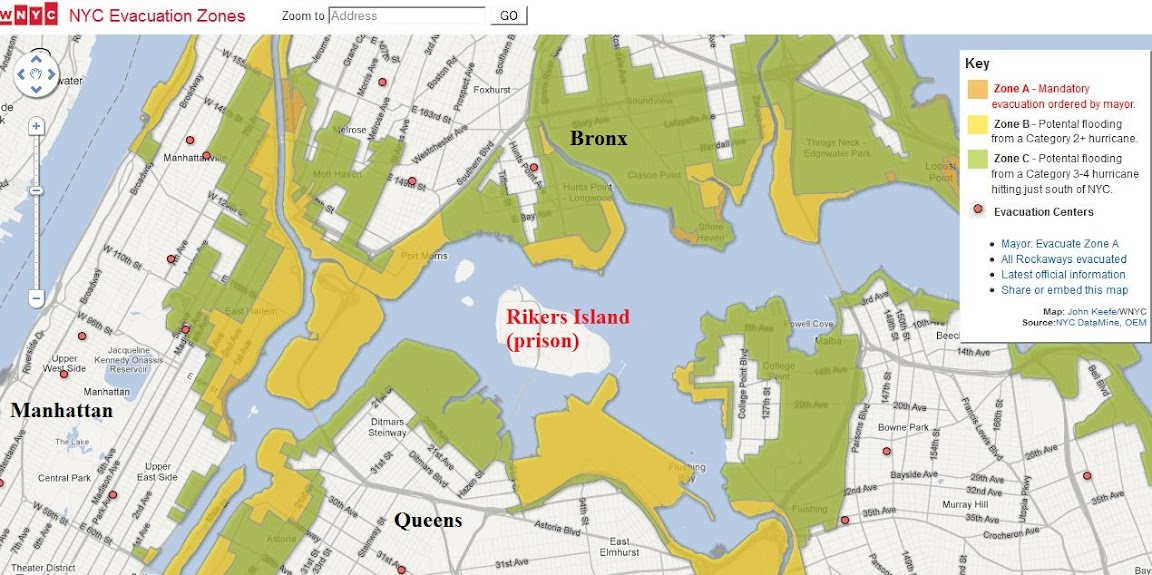
riker's prisoners locked up and on their own...,
By
CNu
at
August 27, 2011
5
comments
Labels: Livestock Management , The Hardline
you.are.on.your.own....,
Video - Leonard Cohen First We Take Manhattan
Whether we’re talking about earthquakes, snow storms, hurricanes, floods, electrical outages or terrorist attacks, government officials, as well as individuals, have demonstrated time and again that we have a psychological inability to cope with high stress situations, a lack of foresight to stock emergency reserves, and have failed to prepare effective emergency response plans.
Though we hardly felt any movement here in the city of New York as a result of the earthquake, panic seemed to overtake a lot of people, as indicated by various news programs and social networking sites.Once cell phone service went out following high volumes of calls across the eastern seaboard, local police, fire and medical response was effectively shut down. Add congestion and confusion on roadways and you have a recipe for disaster.
A single tremor was enough to cause mass confusion, building evacuations and cell phone service outages across the city.
So, I ask, are we ready for this possibility [Hurricane Irene], New York?
Consider: This region, more than any other, relies on electrical power. From high rise apartment buildings, to business computers, to the subway system, a massive power outage caused by a hurricane will have a significant impact on people’s lives.
Imagine if you were sick or paralyzed, and stuck on a building’s 35th floor without elevator service for days. Or, simply picture the isolation caused by television and cell phone outages. Ask yourself, where are your flashlights? Your radio? How will you keep up to date with important emergency information if the storm knocks out electrical services?
In order to prepare for this hurricane, ultimately we have to think not of the earthquake, which caused no lasting damage, but rather everything that went wrong during this past winter’s big snowstorm.
People were unable to leave their apartments, and emergency buildings were essentially unable to move around on the streets. We were woefully under-prepared, and most city workers had to play catch up to fix the significant problems that resulted from the storm.
Source: Fox News
The earthquakes this week were minor events in terms of severity and damage. But consider what might happen in a prolonged regional-disaster. Hurricane Katrina was such an incident, albeit still a short-term event, and luckily the rest of the country was unaffected. Emergency response took a week or more in some instances, and it reportedly took some three days to get bottled water into New Orleans. Bottled Water! And this is with a completely intact national infrastructure around the disaster zone.
Images of the looting, violence, preventable deaths and confiscatory martial law sweeps were beamed to millions of Americans. No one was paying attention, save a few individuals willing to think outside the box of complaceny and the status quo.
We realize the government has spent billions of our tax dollars making preparations. But how that money has been directed and managed is anybody’s guess. When it comes down to it, whatever preparations are being made by emergency preparedness experts at DHS, FEMA and other agencies, they will likely not benefit you all that much. If the time ever came that the infrastructure of the entire United States, not just an isolated region, experienced a far-from-equilibrium event we need to assume help is not coming. No ambulances. No police. No grocery delivery trucks. And no electricians to fix the power.
By
CNu
at
August 27, 2011
5
comments
Labels: weather report , What Now?
put your ID in your left shoe...,
Video - Gov. Christie 'Irene a 'Serious, Significant Event'
Though this news is not directly related to the coming economic depression, we thought we’d publish it to alert our readers in the area to take cover and precautions.
The Philadelphia Inquirer said officials in Cape May county have told people to leave from 8am local time tomorrow.
The hurricane is expected to hit the north eastern seaboard of America this weekend.
It is predicted to hit North Carolina before working its way up the coast.
More than 50m people could be in the path of the storm.
The mayor of New York, Michael Bloomberg, warned residents to expect tropical storm conditions.
Washington is also on alert for heavy storms.
Train services in the capital have been cancelled and workers are trying to protect power lines.
Mayor Vincent Gray took to his Twitter account to ask residents to study emergency evacuation routes.
Irene, a category three storm with winds of up to 120mph (195km) has already caused damage in the Bahamas.
Those who choose to ignore the mandatory evacuation order have been asked to place an ID card in their left shoe so they may be identified if necessary.
By
CNu
at
August 27, 2011
0
comments
Labels: weather report
does the fbi organize almost all the terror plots in the u.s.?
If you think that’s a few spies too many — spies earning as much as $100,000 per assignment — one doesn’t have to go too deep into their track record to see their accomplishments. Those agents are responsible for an overwhelming amount of terrorist stings that have stopped major domestic catastrophes in the vein of 9/11 from happening on American soil.
Another thing those agents are responsible for, however, is plotting those very schemes.
The FBI has in recent years used trained informants not just to snitch on suspected terrorists, but to set them up from the get-go. A recent report put together by Mother Jones and the Investigative Reporting Program at the University of California-Berkley analyses some striking statistics about the role of FBI informants in terrorism cases that the Bureau has targeted in the decade since the September 11 attacks.
The report reveals that the FBI regularly infiltrates communities where they suspect terrorist-minded individuals to be engaging with others. Regardless of their intentions, agents are sent in to converse within the community, find suspects that could potentially carry out “lone wolf” attacks and then, more or less, encourage them to do so. By providing weaponry, funds and a plan, FBI-directed agents will encourage otherwise-unwilling participants to plot out terrorist attacks, only to bust them before any events fully materialize.
Additionally, one former high-level FBI officials speaking to Mother Jones says that, for every informant officially employed by the bureau, up to three unofficial agents are working undercover.
The FBI has used those informants to set-up and thus shut-down several of the more high profile would-be attacks in recent years. The report reveals that the Washington DC Metro bombing plot, the New York City subway plot, the attempt to blow up Chicago’s Sears Tower and dozens more were all orchestrated by FBI agents. In fact, reads the report, only three of the more well-known terror plots of the last decade weren’t orchestrated by FBI-involved agents.
The report reveals that in many of the stings, important meetings between informants and the unknowing participants are left purposely unrecorded, as to avoid any entrapment charges that could cause the case to be dismissed. Perhaps the most high-profile of the FBI-proposed plots was the case of the Newburgh 4. Around an hour outside of New York City, an informant infiltrated a Muslim community and engaged four local men to carry out a series of attacks. Those men may have never actually carried out an attack, but once the informant offered them a plot and a pair of missiles, they agreed. Defense attorneys cried “entrapment,” but the men still were sentenced to 25 years apiece.
"The problem with the cases we're talking about is that defendants would not have done anything if not kicked in the ass by government agents," Martin Stolar tells Mother Jones. Stolar represented the suspect involved in a New York City bombing plot that was set-up by FBI agents. "They're creating crimes to solve crimes so they can claim a victory in the war on terror." For their part, the FBI says this method is a plan for "preemption," "prevention" and "disruption."
The report also reveals that, of the 500-plus prosecutions of terrorism-related cases they analyzed, nearly half of them involved the use of informants, many of whom worked for the FBI in exchange for money or to work off criminal charges. Of the 158 prosecutions carried out, 49 defendants participated in plots that agent provocateurs arranged on behalf of the FBI.
By
CNu
at
August 27, 2011
0
comments
Labels: Collapse Crime
Friday, August 26, 2011
subrealists on the eastside - ACHTUNG!
By
CNu
at
August 26, 2011
2
comments
Labels: weather report
the psychological roots of resource overconsumption
Humans have an innate need for status and for novelty in their lives. Unfortunately, the modern world has adopted very energy- and resource-intensive ways of meeting those needs. Other ways are going to have to be found as part of the move to a more sustainable world.
Most people associate the word “sustainability” with changes to the supply side of our modern way of life such as using energy from solar flows rather than fossil fuels, recycling, green tech and greater efficiency. In this essay, however, I will focus on the demand-side drivers that explain why we continue to seek and consume more stuff.
When addressing ‘demand-side drivers’, we must begin at the source: the human brain. The various layers and mechanisms of our brain have been built on top of each other via millions and millions of iterations, keeping intact what ‘worked’ and adding via changes and mutations what helped the pre-human, pre-mammal organism to incrementally advance. Brain structures that functioned poorly in ancient environments are no longer around. Everyone reading this page is descended from the best of the best at both surviving and procreating which, in an environment of privation and danger where most ‘iterations’ of our evolution happened, meant acquiring necessary resources, achieving status and possessing brains finely tuned to natural dangers and opportunities.
This essay outlines two fundamental ways in which the evolutionarily derived reward pathways of our brains are influencing our modern overconsumption. First, financial wealth accumulation and the accompanying conspicuous consumption are generally regarded as the signals of modern success for our species. This gives the rest of us environmental cues to compete for more and more stuff as a proxy of our status and achievement. A second and more subtle driver is that we are easily hijacked by and habituated to novel stimuli. As we shall see, the prevalence of novelty today eventually demands higher and higher levels of neural stimulation, which often need increased consumption to satisfy. Thus it is this combination of pursuit of social status and the plethora of novel activities that underlies our large appetite for resource throughput.
By
CNu
at
August 26, 2011
0
comments
Labels: Great Filters , Hanson's Peak Capitalism
double-O quashes state investigations of wall st. banks
Video - Don Corleone had all the judges and the politicians in New York, and he must share them.
By
CNu
at
August 26, 2011
11
comments
Labels: Collapse Crime , Obamamandian Imperative
Thursday, August 25, 2011
cars set ablaze all across berlin...,
NYTimes | At night all over the city, cars are burning on the streets of the German capital.
The federal police have been called in to help. Helicopters with infrared cameras can be heard buzzing overhead, and citizens are talking about forming watch groups. About 90 cars have been set on fire in the past two weeks alone.
In light of the recent outbreak of rioting in London, it might seem as though Berlin was the site of the Continent’s latest unrest. Yet incongruously, the city is otherwise peaceful.
Burning cars as a political statement dates back a decade here; hundreds go up in flames every year. Add copycats, insurance fraud and petty acts of revenge to the mix and a chronic illness has flared into an epidemic — with the burned-out chassis of BMWs, Mercedes-Benzes and even a backhoe and a garbage truck filling the news. The record up to this point came in 2009, when 401 automobiles were set on fire. Already this year, however, 364 cars have been set ablaze.
Fanning the fires, at least figuratively, is the Berlin mayoral race, now heading into the home stretch for next month’s election. Photographs of burned-out cars have been splashed across newspaper front pages and featured in campaign advertisements criticizing cuts in the police force — attention that experts say may be encouraging publicity-seeking perpetrators.
Burkard Dregger, a candidate for the city Parliament from Chancellor Angela Merkel’s Christian Democratic Union, seized on the outcry from would-be neighborhood watchers and came out in favor of forming a volunteer police force to bolster the regulars, though one that is unarmed.
“When the state fails in its core competency of providing public safety, then some people begin to have the idea that they have to prevent these acts themselves,” Mr. Dregger said in an interview.
According to the German Insurance Association, 15,000 cars are burned in Germany each year, an overwhelming majority through accidents or mechanical malfunctions. Christian Lübke, a spokesman for the association, said that the political debate driven by the mayoral race had increased the attention paid to the arson, making it more attractive in the process.
“The more feedback the people doing this get in the media, the more they see their handiwork displayed, the more encouraged they are,” Mr. Lübke said.
Of particular concern is the possibility that the arson attacks, which are also a problem in Hamburg, could signify the stirrings of a militant domestic movement, just as the Red Army Faction made its presence known in 1968 with two department store fires in Frankfurt.
“This is not terrorism, but we also shouldn’t downplay it,” said Dieter Wiefelspütz, a member of Parliament for the left-leaning Social Democrats. “When perpetrators believe that they will not be held accountable, that is dangerous for the constitutional state.”
In past years, the arson emerged in predictable patterns. There was an obvious emphasis on luxury sedans and SUVs, and fast-gentrifying neighborhoods like Friedrichshain, a former punk holdout, were hit particularly hard. But now, the attacks seem to have spread to every corner of the city and to include passenger cars of every sort.
By
CNu
at
August 25, 2011
2
comments
Labels: Collapse Crime , micro-insurgencies
all arrested rioters locked up until trial - guilty or not
Guardian | Riots: Metropolitan police planned to hold all suspects in custody, leaked strategy amounts to a blanket policy of mass imprisonments and could lead to legal challenge, say lawyers. Read Operation Withern's prisoner processing strategy Senior Metropolitan police officers devised a policy of holding all people arrested on riot-related offences in custody and recommending that the courts also refuse bail after they were charged, according to a leaked "prisoner processing strategy" that lawyers argue could pave the way for a mass legal challenge.
The document, seen by the Guardian, was circulated to all investigating officers at the height of the violence two weeks ago by Operation Withern, the codename for Scotland Yard's emergency response to the outbreak of violence in the capital. It suggested that no one arrested in or after the riots should be let off with a caution – regardless of the offence – and that everyone arrested should be held in custody, with a recommendation that bail should also be denied when the case first goes to court.
Lawyers began proceedings on Monday for the first judicial review of the custody procedures, which resulted in 62% of those arrested for involvement in the riots remanded in custody compared with a normal rate of around 10% for more serious offences. They claimed the document amounted to a blanket policy of mass imprisonment of people.
The police document argues that the policy was necessary to prevent further public disorder as violence spread through the capital. But it also acknowledges that the force was so stretched at the height of the riots that it was "impractical" to bail people while they conducted "protracted" investigations, suggesting that investigating officers use special rules to fast-track cases to the courts with less evidence than is normally required. The recommendation could expose the Metropolitan police to accusations that it adopted a policy of "conveyer belt" justice in order to deal with its unprecedented workload.
The document, titled Operation Withern: prisoner processing strategy, includes a suggested statement for investigating officers to use in the prosecuting reports of individual cases, which are then passed to the Crown Prosecution Service. It says: "A strategic decision has been made by the MPS [Metropolitan Police Service] that in all cases an application will be made for remand in custody both at the police station, and later at court. This decision has been made in the interest of public safety and the prevention of further cases of disorder. The spontaneous nature of these offences and the significant burden it has placed on police resources has meant that not all inquiries have yet been completed. Some inquiries, such as gathering of CCTV, are not capable of being progressed at present due to the ongoing public disorder in and around London.
"As a result this case requires the application of a 'threshold test' for a charging decision based on the evidence present and the expectation that further evidence may be forthcoming."
By
CNu
at
August 25, 2011
8
comments
Labels: clampdown , The Hardline
the people running britain had no idea how desperate things had become..,
PennyRed | There are communities all over the country that nobody paid attention to unless there had recently been a riot or a murdered child. Well, they’re paying attention now.
Tonight in London, social order and the rule of law have broken down entirely. The city has been brought to a standstill; it is not safe to go out onto the streets, and where I am in Holloway, the violence is coming closer. As I write, the looting and arson attacks have spread to at least fifty different areas across the UK, including dozens in London, and communities are now turning on each other, with the Guardian reporting on rival gangs forming battle lines. It has become clear to the disenfranchised young people of Britain, who feel that they have no stake in society and nothing to lose, that they can do what they like tonight, and the police are utterly unable to stop them. That is what riots are all about.
Riots are about power, and they are about catharsis. They are not about poor parenting, or youth services being cut, or any of the other snap explanations that media pundits have been trotting out: structural inequalities, as a friend of mine remarked today, are not solved by a few pool tables. People riot because it makes them feel powerful, even if only for a night. People riot because they have spent their whole lives being told that they are good for nothing, and they realise that together they can do anything – literally, anything at all. People to whom respect has never been shown riot because they feel they have little reason to show respect themselves, and it spreads like fire on a warm summer night. And now people have lost their homes, and the country is tearing itself apart.
Noone expected this. The so-called leaders who have taken three solid days to return from their foreign holidays to a country in flames did not anticipate this. The people running Britain had absolutely no clue how desperate things had become. They thought that after thirty years of soaring inequality, in the middle of a recession, they could take away the last little things that gave people hope, the benefits, the jobs, the possibility of higher education, the support structures, and nothing would happen. They were wrong. And now my city is burning, and it will continue to burn until we stop the blanket condemnations and blind conjecture and try to understand just what has brought viral civil unrest to Britain. Let me give you a hint: it ain’t Twitter.
I’m stuck in the house, now, with rioting going on just down the road in Chalk Farm. Ealing and Clapham and Dalston are being trashed. Journalists are being mugged and beaten in the streets, and the riot cops are in retreat where they have appeared at all. Police stations are being set alight all over the country. This morning, as the smoke begins to clear, those of us who can sleep will wake up to a country in chaos. We will wake up to fear, and to racism, and to condemnation on left and right, none of which will stop this happening again, as the prospect of a second stock market clash teeters terrifyingly at the bottom of the news reports. Now is the time when we make our choices. Now is the time when we decide whether to descend into hate, or to put prejudice aside and work together. Now is the time when we decide what sort of country it is that we want to live in. Follow the #riotcleanup hashtag on Twitter. And take care of one another.
By
CNu
at
August 25, 2011
0
comments
Labels: complications , governance
Wednesday, August 24, 2011
guild politics - proprietary or open source?
CAISO | New market participants - California’s changing energy landscape is creating new opportunities to participate in the ISO market. Renewable energy providers, transmission developers, demand response entities and cogeneration (combined-heat-and power) firms are finding our wholesale market is robust and accommodating.
The California ISO welcomes participation by new market participants. We are committed to making it easy for new customers to understand their participation options, which helps them make informed business decisions.
Scheduling coordinator
To participate in the ISO market you must be a certified scheduling coordinator (SC) or retain the services of a certified SC to act on your behalf.
Generation
The ISO provides open and non-discriminatory access to the transmission grid, which is supported by a competitive energy market for resources generating one megawatt or more.
Load
ISO market rules allow load and aggregation of loads capable of reducing their electric demand to participate as price responsive demand in the ancillary services market and as curtailable demand in real-time.
Metered subsystems
Electric utilities in existence prior to the start of ISO operations and inside its balancing authority can become metered subsystems and balance loads and resources within their territories.
Transmission
Transmission owners can elect to turn operational control of their facilities over to the ISO and collect access charges from users.
Utility distribution company
Utilities own the local distribution systems that take energy from the high voltage transmission system managed by the ISO to provide retail electric service to end-use customers.
Metering and telemetry
Settlement quality meter data collection and direct telemetry of participating resources are mandatory requirements for accurate revenue accounting and ISO operational visibility.
Market products
Participants seeking to provide ancillary services and participate in the congestion revenue rights and convergence bidding processes must meet specific requirements and complete the registration processes.
Application access
The ISO and its market participants must adhere to rigorous requirements to help ensure the integrity and confidentiality of commercially sensitive or proprietary information and data, as well as to protect the ISO grid and its assets.
Training
The ISO designs and offers training programs and courses to its customers that help them understand our market and processes. Fist tap and double dap to Brotherbrown and Arnach.
By
CNu
at
August 24, 2011
1 comments
Labels: open source culture , Possibilities
cuba of the north
Video - Gil Scott Heron explains "the revolution will not be televised"
As one European country after another fails or risks failing, imperiling the Euro, with repercussions for the entire world, the last thing the powers that be want is for Iceland to become an example. Here's why:
Five years of a pure neo-liberal regime had made Iceland, (population 320 thousand, no army), one of the richest countries in the world. In 2003 all the country’s banks were privatized, and in an effort to attract foreign investors, they offered on-line banking whose minimal costs allowed them to offer relatively high rates of return. The accounts, called IceSave, attracted many English and Dutch small investors. But as investments grew, so did the banks’ foreign debt. In 2003 Iceland’s debt was equal to 200 times its GNP, but in 2007, it was 900 percent. The 2008 world financial crisis was the coup de grace. The three main Icelandic banks, Landbanki, Kapthing and Glitnir, went belly up and were nationalized, while the Kroner lost 85% of its value with respect to the Euro. At the end of the year Iceland declared bankruptcy.
Contrary to what could be expected, the crisis resulted in Icelanders recovering their sovereign rights, through a process of direct participatory democracy that eventually led to a new Constitution. But only after much pain.
Geir Haarde, the Prime Minister of a Social Democratic coalition government, negotiated a two million one hundred thousand dollar loan, to which the Nordic countries added another two and a half million. But the foreign financial community pressured Iceland to impose drastic measures. The FMI and the European Union wanted to take over its debt, claiming this was the only way for the country to pay back Holland and Great Britain, who had promised to reimburse their citizens.
Protests and riots continued, eventually forcing the government to resign. Elections were brought forward to April 2009, resulting in a left-wing coalition which condemned the neoliberal economic system, but immediately gave in to its demands that Iceland pay off a total of three and a half million Euros. This required each Icelandic citizen to pay 100 Euros a month (or about $130) for fifteen years, at 5.5% interest, to pay off a debt incurred by private parties vis a vis other private parties. It was the straw that broke the reindeer’s back.
What happened next was extraordinary. The belief that citizens had to pay for the mistakes of a financial monopoly, that an entire nation must be taxed to pay off private debts was shattered, transforming the relationship between citizens and their political institutions and eventually driving Iceland’s leaders to the side of their constituents. The Head of State, Olafur Ragnar Grimsson, refused to ratify the law that would have made Iceland’s citizens responsible for its bankers’ debts, and accepted calls for a referendum.
Of course the international community only increased the pressure on Iceland. Great Britain and Holland threatened dire reprisals that would isolate the country. As Icelanders went to vote, foreign bankers threatened to block any aid from the IMF. The British government threatened to freeze Icelander savings and checking accounts. As Grimsson said: “We were told that if we refused the international community’s conditions, we would become the Cuba of the North. But if we had accepted, we would have become the Haiti of the North.” (How many times have I written that when Cubans see the dire state of their neighbor, Haiti, they count themselves lucky.)
By
CNu
at
August 24, 2011
0
comments
Labels: states rights , The Straight and Narrow
community considers shedding its parasite

By
CNu
at
August 24, 2011
2
comments
Labels: open source culture , People Centric Leadership
Tuesday, August 23, 2011
empathy and the science of evil
Time | Cambridge psychology professor and leading autism expert Simon Baron-Cohen is best known for studying the theory that a key problem in autistic disorders is "mind blindness," difficulty understanding the thoughts, feelings and intentions of others. He's also known for positing the "extreme male brain" concept of autism, which suggests that exposure to high levels of testosterone in the womb can cause the brain to focus on systematic knowledge and patterns more than on emotions and connection with others. (Oh, and yes, he's also the cousin of British comedian Sacha "Borat" Baron Cohen.)
Baron-Cohen's new book, The Science of Evil: On Empathy and the Origins of Cruelty, examines the role of empathy, the ability to understand and care about the emotions of others, not only in autism but in conditions like psychopathy in which lack of care for others leads to antisocial and destructive behavior.
What do you mean when you write about "zero negative" empathy?
Zero empathy refers to people at the extremely low end of the scale. They tend to be people with personality disorders, particularly antisocial personality disorder (ASPD). I focus quite a lot on psychopathy [the extreme form of ASPD] and also on two other personality disorders, borderline personality disorder and narcissistic personality disorder.
The 'negative' is meant to be shorthand for this being negative for the individual but also for the people around them. It's meant to contrast with what I call 'zero positive' empathy, which effectively describes the autistic spectrum.
[Autistic people] struggle with empathy just like zero negatives but it seems to be for very different reasons. I'm arguing that their low empathy is a result of a particular cognitive style, which is attentive to details and patterns or rules, which in shorthand, I call systemizing.
If we think about the autism spectrum as involving a very strong drive to systemize, that can have very positive consequences for the individual and for society. The downside is that when you try to systemize certain parts of the world like people and emotions, those sorts of phenomena are less lawful and harder to systemize. That can lead to having low empathy, almost like a byproduct of strong systemizing.
How do you account for people who are both highly empathetic and highly systematic, such as some of those with Asperger's who are actually oversensitive to the emotions of others?
I've certainly come across subgroups like that. There are people with Asperger's whom I've met who certainly would be very upset to learn they'd hurt another person's feelings. They often have very strong moral consciences and moral codes. They care about not hurting people. They may not always be aware [that they've said something rude or hurtful], but if it's pointed out, they would want to do something about it.
The other side of their moral sense is that they often have a strong sense of justice or fairness. They may have arrived at it through looking for logical patterns rather than necessarily because they can easily identify with someone, however.
People often think that autistic people are dangerous, like psychopaths, when they hear this idea that they have "no empathy."
In a way, that was one of my motivations for writing the book. Low empathy is a characteristic of many different conditions or disorders. Often books are written where they either focus on psychopathy or autism but [not both].
We have to look at them side by side, and when we do that, we see that they are very different and it's important to bring that out.
Is it the case, then, that autistic people are not good at the "mind reading" part of empathy, in terms of predicting people's behavior and feelings, while psychopaths are able to do that but are not able to care?
I think the contrast between these two conditions provides some evidence for that dissociation within empathy. People with psychopathy are very good at reading the minds of their victims. That's probably most clearly seen in deception. You have to be good at mind reading before it would even occur to you want [to deceive someone]. So you can see the cognitive part of empathy as functioning very well, but the fact that they don't have the appropriate emotional response to someone else's state of mind, the feeling of wanting to alleviate distress if someone's in pain, [that suggests that] the affective part of empathy is not functioning normally.
By
CNu
at
August 23, 2011
9
comments
Labels: killer-ape , knowledge , What IT DO Shawty...
ideology attached to psychopathology
Guardian | Seumas Milne claims that it might be "comforting, perhaps, to dismiss Anders Behring Breivik as nothing more than a psychotic loner" (In his rage against Muslims, Norway's killer was no loner, 28 July). He thinks that this would have "the advantage of meaning no wider conclusions need to be drawn about the social context of the atrocity" – and therefore should be avoided.
Milne seems to be using an either/or grid under which a consideration of the impact of Breivik's personality prevents considerations from other perspectives.
We think that, to the contrary, the necessary conclusions can only be drawn if the assessment of Breivik's personality is not restricted along the usual and apparently comforting lines of "mad or bad". Even though we have not assessed Breivik, from the information available one could assume that he may have a severe personality disorder and that his psychopathology "attached" itself to extreme political ideology.
This manifest politicisation of his likely psychopathology seems to have facilitated a general collusion with his "delusion of sanity" (as first described by Dr Leslie Sohn, psychiatrist and psychoanalyst). This is a commonly seen phenomenon in forensic psychiatry among individuals who have committed terribly violent acts.
The equally frequent collusion is promoted by the ubiquitous wish for a rational explanation for such terrible deeds. Such an explanation can serve as a means to avoid the anxiety of imagining the state of mind of a person who reportedly laughed while shooting his victims.
In our view the assumption of a clear divide between psychosis and personality disorders in the current manuals is an unhelpful restriction. Considering psychosis and personality disorders as a single diagnostic entity enables us to opine that Breivik may well have had an undiagnosed severe personality disorder which, for years, managed to contain his conscious and likely unconscious violent fantasies.
At the time of the killings this containment might have broken down, and losing contact with reality in a psychotic state could have enabled the violent fantasies to be enacted and the catastrophic events to unfold. Later on, a more personality-disordered presentation might have become apparent once more when Breivik appeared "normal" and sane.
Going along with this appearance can cause errors in reporting such cases as predominantly political, which in turn can inhibit the chance of understanding such individuals. And at the institutional level it can lead to poor subsequent long-term management of the individual, and also to unjustified limitations on the freedom of holding political views, abhorrent though some of these might be.
Ultimately, failing to challenge but rather gratify the probable grandiose part of Breivik's disturbed mind can be of little comfort to surviving victims or relatives and friends of those killed.
By
CNu
at
August 23, 2011
0
comments
Labels: partisan , psychopathocracy
are math smarts innate? (an objective intelligence test)
Previous studies looked at how sensing numbers affected performance, but researchers didn't know whether the natural ability to sense numbers or proficiency seeing numbers as symbols limited math skills. Pinpointing which factor affects learning in children will help teachers and researchers develop better programs for kids who may enter formal education at a disadvantage.
For example, flashing a number of dots -- some blue, others red -- and asking someone to determine which group of objects there was more of is a common way to measure people's ability to sense numbers.
The dots appear and disappear so quickly that it becomes impossible to count, so the amounts have to be sensed instead. Also called the Approximate Number System (ANS), this innate ability has been studied in adults, children, infants and even non-human animals. So far, researchers suggest that the accuracy of a person's ANS improves throughout childhood.
The concept also falls within a larger area teachers and researchers refer to as "number sense," or the ability to count, discern quantities, pick up on number patterns and "to rule out unreasonable results to arithmetic operations," according to the paper. Specifically, people and animals subitize, or perceive and estimate the number of objects by glance.
In the experiment, researchers at Johns Hopkins University studied 174 children between 3 and 5 years of age (the original sample included 200 children, but some were excluded for various reasons) to measure their ANS with computer tests. After, they measured children's math and verbal skills through a series of tests and asking parents to list common words in their children's vocabulary.
Controlling for age, vocabulary size and speed of taking the test, the group still found better ANS scores to be positively associated with children's early math abilities. Previously thought to be the result of different teaching styles, this relationship seems to already exist before kids start formal math education in school.
Despite the results, the authors of the paper readily admit they cannot use ANS to predict math ability. They also caution that they could not control other aspects of cognition, which may also be at play.
The New York Times has a handy interactive that allows you to measure your ANS.
By
CNu
at
August 23, 2011
4
comments
Labels: cognitive infiltration , What IT DO Shawty...
Monday, August 22, 2011
baldwin's nigger
Video - Part 1 of 3 of Horace Ove's classic 1968 documentary discussion.
Video - Part 2 of 3 of Baldwin's Nigger.
Video - Part 3 of 3 of Baldwin's Nigger.
By
CNu
at
August 22, 2011
5
comments
Labels: History's Mysteries , The Hardline , truth
Sunday, August 21, 2011
what is charisma?
Video - Teaser for debate between Bayard Rustin and Malcolm X
The word appears throughout the New Testament, most often translated as “grace.” In Christian theology gifts from God are called “charismata.” These gifts can be as varied as knowledge, healing, miracles or prophecy and as grand as redemption itself. Charismata came to refer especially to the graces given to individuals specifically for the good of others: the gift that keeps on giving.
It wasn’t until the 20th century that the word acquired its modern secular meaning, when the influential sociologist Max Weber borrowed it to describe a key quality of leadership.
“Charisma,” he wrote, “is a certain quality of an individual personality by virtue of which he is set apart from ordinary men and treated as endowed with supernatural, superhuman or specifically exceptional powers. These qualities are not accessible to the ordinary person, but are regarded as of divine origin or as exemplary, and on the basis of them the individual concerned is treated as a leader.”
But how is a performer a leader? Other writers have built on Weber’s work in the social sciences, but much less attention has been paid to charisma in culture. The problem is that when it comes to the arts, the uses of charisma become harder to pin down. When Bill Clinton is charismatic, you vote for him. When an obscure carpenter’s son in ancient Galilee is charismatic, you join his ministry. But when the violinist Anne-Sophie Mutter is charismatic, or Callas or Mr. Amidon, what are you supposed to do? What happens? Is our applause enough?
To some, charisma has lost its power as descriptive. It connotes flash, smoke and mirrors. (You could slightly change my sentence about Mr. Tetzlaff to turn it into praise: “He may not be charismatic, but he is a searchingly creative, technically flawless violinist.”) Even when used as a compliment, “charismatic” is often taken for granted. Just look at Mr. Tommasini’s and my takes on Mr. Daniels: his charisma is “no surprise” and “expected.” Charisma is a given, we imply, so let’s move on to the real stuff.
Let’s assume for a moment that charisma is the real stuff, less a means than an end in itself. What we generally consider the “content” of the arts — the notes, the libretto, the bowings, the plot — is actually just the structure that makes possible the crucial thing: watching a performer who is able to connect with fundamental realities. It is not that a singer’s charisma makes a colorful aria sound even better but that the aria provides a platform, a vessel, for us to experience the charisma.
If charisma were recognized as the central experience of performance, then that experience would take on a ritualistic aspect. Art as we know it, centered on rigorously conceived structures and intricately deployed catharses, would become more inchoate, less an appeal to our intelligence or taste than to instincts that we barely acknowledge.
Charisma is the essential quality of our moment because it fits so well in a culture in which the connoisseurship of artistic technique — whether singing or instrumental playing or conducting — has declined, but institutions are still seeking new audiences for these complex, demanding art forms. It is a quality that requires no knowledge or preparation. Even if you know little about the technicalities of music, when you attend a performance by the pianist Evgeny Kissin, you are swept up by his power and presence.
The question is whether people want to be swept up. Charisma can be exhilarating but also frightening. Our surrender to it demands a trust that is not easily conceded. If our desire from performance is only for comfort and reassurance, charisma will repel us. It is about revealing scope, and it raises the stakes dangerously high.
Recently I was in the Met Opera Shop, and a video clip came on the screen above the CD racks. The longtime Met soprano Aprile Millo was singing “La mamma morta,” the ecstatic aria from Giordano’s “Andrea Chenier,” with burning intensity. The sales clerk and I both watched raptly. Later I e-mailed Ms. Millo to ask her what charisma is.
“Hemingway gave us a haunting clue to it,” she replied. “In his obsession with the Spanish bullfights, he spoke of the lust of the crowd and its desire to feel something special, a raw authenticity, even in so brutal a setting. What he mentions is the hush that would come over the crowd at the entrance of the toreadors. The people could sense the difference between those who did it for the fame, the paycheck, and those who had the old spirit: the nobility, bravery, heart, ‘duende.’ I believe this also happens in the theater. The crowd can sense the one with the authentic message, the connection to the truth.”
By
CNu
at
August 21, 2011
0
comments
Labels: common sense , subliminal , truth
honey money: the power of erotic capital
Video - Elvis Presley Money Honey 1956
Hakim, a senior lecturer at the London School of Economics, is no tub-thumping provocateur, but a well-established sociologist with a string of publications to her name. And Honey Money, despite its somewhat racy title – which comes, apparently, from an expression employed by Jakarta prostitutes: "No money, no honey" – is configured as a serious academic exercise, complete with rather leaden prose, extensive annotation, reams of statistical evidence, appendices and tedious repetitions. Nevertheless, I envisage a blizzard of opprobrium enveloping Hakim, for she has set out here a thesis seemingly purpose-built to inflame the passions of a wide swathe of the opinionated. Taking as her starting point Pierre Bourdieu's well-established analysis of forms of individual capital – monetary capital itself, human capital (intelligence potentiated by education) and social capital (patronage, nepotism and other network benefits) – Hakim proposes another form: "erotic capital". She acknowledges that this term has been used by sociologists in the US to refer to physical appearance and sex appeal, but claims that her definition – widened to encompass other skills such as charm, sociability and actual sexual expertise – is both original and powerfully explicatory.
In some ways I think she's right. There's something altogether refreshing about Hakim's spade-calling, which recalls to mind Schopenhauer's infamous remarks in his essay "On Women": "With girls, Nature has had in view what is called in a dramatic sense a 'striking effect', for she endows them for a few years with a richness of beauty and a fullness of charm at the expense of the rest of their lives; so that they may during these years ensnare the fantasy of a man to such a degree as to make him rush into taking the honourable care of them, in some kind of form, for a lifetime – a step which would not seem sufficiently justified if he only considered the matter." Certainly the pessimistic philosopher's own dealings with women conformed to this view: a lifelong bachelor, he was not so much an enthusiastic as a dutiful customer of prostitutes – attending the brothel as regularly as other haute-bourgeois men visit their club.
Hakim endorses Schopenhauer's characterisation of the "striking effect" of young women's beauty and sex appeal, and gives us cross-cultural statistics to prove that not only is their "erotic capital" consistently greater than that of young men, but that it is also always undervalued: it is attractive young men who get the better jobs and secure the higher wages, attractive young men who end up being US president – regardless of their skin colour. This might seem counter-intuitive in a world seemingly plastered with images of this "striking effect", displayed in every possible state of dress and undress, but the strength of Hakim's analysis lies in the very crudeness of its metric. According to her, while young women may possess considerable charms, men's desire for them always vastly outstrips supply. The reverse is simply not the case: men are both less attractive to women, and markedly less desired by them, especially as those women grow older. What Hakim terms "the male sex-deficit" underlies both the ubiquity of female sexual imagery – as pornography, as marketing adjunct – and the persistent unwillingness of society at large to "valorise" women's good looks. It is, quite simply, not in the interests of all those priapic patriarchs to allow women to actualise their erotic capital, for to do so would seismically alter the balance of power between the sexes.
By
CNu
at
August 21, 2011
1 comments
Labels: common sense , subliminal , truth
Chipocalypse Now - I Love The Smell Of Deportations In The Morning
sky | Donald Trump has signalled his intention to send troops to Chicago to ramp up the deportation of illegal immigrants - by posting a...
-
theatlantic | The Ku Klux Klan, Ronald Reagan, and, for most of its history, the NRA all worked to control guns. The Founding Fathers...
-
NYTimes | The United States attorney in Manhattan is merging the two units in his office that prosecute terrorism and international narcot...
-
Wired Magazine sez - Biologists on the Verge of Creating New Form of Life ; What most researchers agree on is that the very first functionin...