Monday, October 04, 2010

games india isn't ready to play...,


Video - RT monkeys pressed into service to protect Commonwealth Games.

NYTimes | So who is anxious over India’s image in the wealthy world? That particular burden is borne by India’s small affluent elite, for whom the last few months have been full of painful and awkward self-reckonings. Certainly, the fear of violence over Ayodhya was only the latest in a long line of reminders that, as the columnist Vir Sanghvi put it, “as hard as we try to build a new India ... old India still has the power to humiliate and embarrass us.”

Since June, a mass insurrection, resembling the Palestinian intifada, has raged in the Indian-held Valley of Kashmir. Defying draconian curfews, large and overwhelmingly young crowds of Kashmiri Muslims have protested human rights abuses by the nearly 700,000 Indian security forces there. Ill-trained soldiers have met stone-pelting protesters with gunfire, killing more than a hundred Kashmiris, mostly teenagers, and ensuring another militant backlash that will be exploited by radical Islamists in Pakistan.

A full-blown insurgency is already under way in central India, where guerrilla fighters inspired by Mao Zedong’s tactics are arrayed against a government they see as actively colluding with multinational corporations to deprive tribal people of their mineral-rich lands. In recent months, the Maoists have attacked the symbols of the state’s authority — railroads, armories, police stations — seemingly at will, killing scores of people.

Yet the greatest recent blow to wealthy Indians’ delusions on the subject of their nation’s inexorable rise has been the Commonwealth Games, for which Delhi was given a long and painful facelift. For so many, the contest was expected to banish India’s old ghosts of religious and class conflict, and cement its claims to a seat at the high tables of international superpowers.

But the games turned into a fiasco well before their scheduled opening. Two weeks ago, a huge footbridge connected to the main stadium collapsed. The federation that runs the games has called the athletes’ housing “uninhabitable.” The organizers have had to hire an army of vicious langur monkeys to keep wild animals from infesting the venues. Pictures of crumbling arenas and filthy toilets are circulating more widely than the beautiful landscapes of the government’s “Incredible India” tourism campaign.

As the ratings agency Moody worries that the debacle has “tarnished” India’s image, commentators here angrily hunt for blameworthy politicians and officials over what they call “national shame.” The contrast to the 2008 Beijing Olympics, in which the Chinese government largely overcame controversy and staked a claim to a dominant place in the world order, is all too depressingly clear.

Sunday, October 03, 2010

tea and crackers

Rolling Stone | It's taken three trips to Kentucky, but I'm finally getting my Tea Party epiphany exactly where you'd expect: at a Sarah Palin rally. The red-hot mama of American exceptionalism has flown in to speak at something called the National Quartet Convention in Louisville, a gospel-music hoedown in a giant convention center filled with thousands of elderly white Southerners. Palin — who earlier this morning held a closed-door fundraiser for Rand Paul, the Tea Party champion running for the U.S. Senate — is railing against a GOP establishment that has just seen Tea Partiers oust entrenched Republican hacks in Delaware and New York. The dingbat revolution, it seems, is nigh.

"We're shaking up the good ol' boys," Palin chortles, to the best applause her aging crowd can muster. She then issues an oft-repeated warning (her speeches are usually a tired succession of half-coherent one-liners dumped on ravenous audiences like chum to sharks) to Republican insiders who underestimated the power of the Tea Party Death Star. "Buck up," she says, "or stay in the truck."

Stay in what truck? I wonder. What the hell does that even mean?

Scanning the thousands of hopped-up faces in the crowd, I am immediately struck by two things. One is that there isn't a single black person here. The other is the truly awesome quantity of medical hardware: Seemingly every third person in the place is sucking oxygen from a tank or propping their giant atrophied glutes on motorized wheelchair-scooters. As Palin launches into her Ronald Reagan impression — "Government's not the solution! Government's the problem!" — the person sitting next to me leans over and explains.

"The scooters are because of Medicare," he whispers helpfully. "They have these commercials down here: 'You won't even have to pay for your scooter! Medicare will pay!' Practically everyone in Kentucky has one."

A hall full of elderly white people in Medicare-paid scooters, railing against government spending and imagining themselves revolutionaries as they cheer on the vice-presidential puppet hand-picked by the GOP establishment. If there exists a better snapshot of everything the Tea Party represents, I can't imagine it.

After Palin wraps up, I race to the parking lot in search of departing Medicare-motor-scooter conservatives. I come upon an elderly couple, Janice and David Wheelock, who are fairly itching to share their views.

"I'm anti-spending and anti-government," crows David, as scooter-bound Janice looks on. "The welfare state is out of control."

"OK," I say. "And what do you do for a living?"

"Me?" he says proudly. "Oh, I'm a property appraiser. Have been my whole life."

I frown. "Are either of you on Medicare?"

Silence: Then Janice, a nice enough woman, it seems, slowly raises her hand, offering a faint smile, as if to say, You got me!

"Let me get this straight," I say to David. "You've been picking up a check from the government for decades, as a tax assessor, and your wife is on Medicare. How can you complain about the welfare state?"

"Well," he says, "there's a lot of people on welfare who don't deserve it. Too many people are living off the government."

"But," I protest, "you live off the government. And have been your whole life!"

"Yeah," he says, "but I don't make very much." Vast forests have already been sacrificed to the public debate about the Tea Party: what it is, what it means, where it's going. But after lengthy study of the phenomenon, I've concluded that the whole miserable narrative boils down to one stark fact: They're full of shit. All of them. At the voter level, the Tea Party is a movement that purports to be furious about government spending — only the reality is that the vast majority of its members are former Bush supporters who yawned through two terms of record deficits and spent the past two electoral cycles frothing not about spending but about John Kerry's medals and Barack Obama's Sixties associations. The average Tea Partier is sincerely against government spending — with the exception of the money spent on them. In fact, their lack of embarrassment when it comes to collecting government largesse is key to understanding what this movement is all about — and nowhere do we see that dynamic as clearly as here in Kentucky, where Rand Paul is barreling toward the Senate with the aid of conservative icons like Palin.

Holocaust thinking in America I: The Authoritarian Personality

theragblog | So now, in place of Newt Gingrich's 1994 Contract With America (aka Contract On America) we have the new GOP Pledge to America. Not unlike the current design, the rich are to get richer, and the poor to get sick, become homeless, starve, or shatter in endless wars.

The comparison of our American trajectory with the tactics and strategy of Germany in the late 1930s is more striking now than ever. We would do well to study this era carefully for a possible glimpse of our own future. Those targeted are no longer just our dispossessed, reviled and outcast -- our "jews" -- but much of the American (and of course world) population.

The attempt to exterminate European Jewry during the Nazi era was, in many ways, as unique as Jewish culture proclaims. Never before had an organized, industrial state targeted a population for complete annihilation, ruthlessly and efficiently pursued even within its “civil” codes and activities.

But to think of the Holocaust as a completely unique act, restricted to 20th century German antisemitism, is to limit it unduly, to make it unavailable as evidence and warning about tendencies in our own place, our own time.

For it would seem that every major thought pattern, every cultural institution that fueled the Nazi holocaust is present and empowered in the United States today. Safeguards against catastrophic outcomes are few and weak. “It can’t happen here”? Maybe. But with so many elements brewing together, and no visible controls to dampen the flux, there is no predicting in what direction the reaction will run.

Half a century ago, a civilization as culturally advanced as our own experienced a society-wide suspension of morality. Jews were the target. Now, the next set of domestic victims has already been chosen: the poor and unruly. Ready... aim...

as western civilization lies dying...,


Video - More Human Than Human

GlobalResearch | The Western commercial system exists to extract more from consumers than it supplies in products and services. Its goal is profit and has never been to improve the human condition but to exploit it. When governments institutionalize this system, they place their nations on suicidal paths, because as Jefferson recognized, "Merchants have no country." It is not terrorism that threatens the security of the Western World, it is the Western World's commercial system.

A man suffering from severe chest pains collapses. His wife calls 911. An ambulance arrives, the EMTs treat the patient, place him in the ambulance's bed, and start off to the hospital. Along the way, the engine stalls. The ambulance's staff begins arguing about how to get the motor restarted. One says more gasoline is needed, another says there's water in the tank, a third says the fuel filter is clogged. While they argue, the patient lies dying.

This situation is analogous to what's happening in America and parts of Europe. While economists and politicians argue, their nations are in the throes of death. These people are looking for the devil in the details, but he is not there. It's the system itself that’s diabolical.

The Western commercial system is extractive. It exists to extract more from consumers than it supplies in products and services. Its goal is profit, and profit literally means to make more (pro-ficere). Its goal has never been to improve the human condition but to exploit it. It works like this:

Consider two water tanks, initially each partially full, one above the other. One gallon of water is dumped from the upper tank into the lower one for each two gallons extracted from the lower tank and pumped into the upper tank. Over time, the lower tank ends up empty and the upper tank ends up full. The circulation of water between the tanks ends.

Essentially, this scenario describes all commercial systems based on profit. It is why the top 20 percent of Americans has 93 percent of the nation's financial wealth and the bottom 80 percent has a mere seven percent. It is why the bottom 40 percent of all income earners in the United States now collectively own less than one percent of the nation’s wealth. It is why the nation's poverty rate is now14.3 percent, about 43.6 million people or one in seven. It is also why the Wall Street Journal has reported that 70 percent of people in North America live paycheck to paycheck. It is also why, despite numerous pledges over decades, no progress has been made in reducing world-wide poverty. The system is a thief.

The economy has collapsed not because of misfeasance, deregulation, or political bungling (although all may have been proximate causes), it has collapsed because the pockets of the vast majority of Americans have been picked. The housing bubble didn't burst because home prices had risen, it burst because the pockets of consumers had been picked so clean they could no longer service their mortgages.

What the wealthiest 20 percent of Americans don't realize is that some in this group will begin to target the others in order to keep the extractive process working. In fact, it's already happening. "The brute force of the recession earlier this year turned back the clock on Americans' personal wealth to 2004 and wiped out a staggering $1.3 trillion as home values shrank and investments withered." Little of this loss from investments was suffered by the lower 80 percent of Americans. There is, after all, no goodwill within greed, and the market can be and often is manipulated.

The "system" has impoverished the people, the circulation between the two tanks has been reduced to a trickle, and our economists have convinced the government that the only way to get things flowing again is to pour more water into the upper tank, hoping that the spillover will settle in the lower tank. Better to pray for rain!

This impoverishment has numerous mathematically certain implications; two major ones follow.

the grameenist microcredit hoodwink and bamboozle..,

Himal | Far from being a panacea for fighting rural poverty, microcredit can impose additional burdens on the rural poor, without markedly improving their socio-economic condition.

For years, the example of microcredit in Bangladesh has been touted as a model of how the rural poor can lift themselves out of poverty. This widely held perception was boosted in 2006, when Mohammad Yunus and Grameen Bank, the microfinance institution he set up, jointly received the Nobel Peace Prize. In Southasia in particular, and the world in general, microcredit has become a gospel of sorts, with Yunus as its prophet.

Consider this outlandish claim, made by Yunus as he got started in the late 1970s: ‘Poverty will be eradicated in a generation. Our children will have to go to a ‘poverty museum’ to see what all the fuss was about.’ According to Milford Bateman, a senior research fellow at the Overseas Development Institute (ODI) in London who is one of the world’s experts on Grameen and microcredit, the reason this rhetoric resonated with international donors during the era of neoliberal globalisation, was that ‘they love the non-state, self-help, fiscally-responsible and individual entrepreneurship angles.’

Grameen’s origins are sourced to a discussion Yunus had with Sufiya Begum, a young mother who, he recalled, ‘was making a stool made of bamboo. She gets five taka from a business person to buy the bamboo and sells to him for five and a half taka, earning half a taka as her income for the day. She will never own five taka herself and her life will always be steeped into poverty. How about giving her a credit for five taka that she uses to buy the bamboo, sell her product in free market, earn a better profit and slowly pay back the loan?’ Describing Begum and the first 42 borrowers in Jobra village in Bangladesh, Yunus waxed eloquent: ‘Even those who seemingly have no conceptual thought, no ability to think of yesterday or tomorrow, are in fact quite intelligent and expert at the art of survival. Credit is the key that unlocks their humanity.’

But what is the current situation in Jobra? Says Bateman, ‘It’s still trapped in deep poverty, and now debt. And what is the response from Grameen Bank? All research in the village is now banned!’ As for Begum, says Bateman, ‘she actually died in abject poverty in 1998 after all her many tiny income-generating projects came to nothing.’ The reason, Bateman argues, is simple: ‘It turns out that as more and more ‘poverty-push’ micro-enterprises were crowded into the same local economic space, the returns on each micro-enterprise began to fall dramatically. Starting a new trading business or a basket-making operation or driving a rickshaw required few skills and only a tiny amount of capital, but such a project generated very little income indeed because everyone else was pretty much already doing exactly the same things in order to survive.’

Contrary to the carefully cultivated media image, Yunus is not contributing to peace or social justice. In fact, he is an extreme neoliberal ideologue. To quote his philosophy, as expressed in his 1998 autobiography, Banker to the Poor,
I believe that ‘government’, as we know it today, should pull out of most things except for law enforcement and justice, national defense and foreign policy, and let the private sector, a ‘Grameenized private sector’, a social-consciousness-driven private sector, take over their other functions.

euro banks vs. labor - the death match


Video - RT coverage of people against EU cash machine with anti-austerity marches.

GlobalResearch | While Labor Unions celebrate Anti-Austerity Day in Europe, the European Neoliberals raise the ante.

Most of the press has described Wednesday's European-wide labor demonstrations and strikes across in terms of the familiar exercise by transport workers irritating travelers with work slowdowns, and large throngs letting off steam by setting fires. But the story goes much deeper than merely a reaction against unemployment and economic recession conditions. At issue are proposals to drastically change the laws and structures of how European society will function for the next generation. If the anti-labor forces succeed, they will break up Europe, destroy the internal market, and render that continent a backwater. This is how serious the financial coup d'etat has become. And it is going to get much worse - quickly. As John Monks, head of the European Trade Union Confederation, put it: "This is the start of the fight, not the end."

Spain has received most of the attention, thanks to its ten-million strong turnout (reportedly half the entire labor force). Holding its first general strike since 2002, Spanish labor protested against its socialist government using the bank crisis (stemming from bad real estate loans and negative mortgage equity, not high labor costs) as an opportunity to change the laws to enable companies and government bodies to fire workers at will, and to scale back their pensions and public social spending in order to pay the banks more. Portugal is doing the same, and it looks like Ireland will follow suit - all this in the countries whose banks have been the most irresponsible lenders. The bankers are demanding that they rebuild their loan reserves at labor's expense, just as in President Obama's program here in the United States but without the sanctimonious pretenses.

The problem is Europe-wide and indeed centered in the European Union capital in Brussels. This is why the major protests were staged there. On the same day that the strikers demonstrated, the neoliberal European Commission (EC) outlined a full-fledged war against labor. Fifty to a hundred thousand workers gathered to protest the proposed transformation of social rules by the most anti-labor campaign since the 1930s - even more extreme than the Third World austerity plans imposed by the IMF and World Bank in times past.

The neoliberals are fully in control of the bureaucracy, and they are reviving Margaret Thatcher's slogan, TINA: There Is No Alternative. But there is, of course. In the small Baltic economies, pro-labor parties have made it clear that the alternative to government shrinkage is to simply repeal the debts, withdraw from the Euro and break the banks. It is either the banks or labor - and Europe has just realized that this is truly a fight to the economic death. And the first test will come this Saturday, when Latvia holds its national parliamentary elections.

when did reading, writing, and arithmetic become rocket science?


Video - Tavis Smiley with Canada and Guggenheim.

WaPo | Reform must be guided by community empowerment and strong evidence, not by ideological warriors or romanticized images of leaders acting like they’re doing something, anything. Waiting for Superman has ignored deep historical and systemic problems in education such as segregation, property-tax based funding formulas, centralized textbook production, lack of local autonomy and shared governance, de-professionalization, inadequate special education supports, differential discipline patterns, and the list goes on and on.

People seeing Waiting for Superman should be mobilized to improve education. They just need to be willing to think outside of the narrow box that the film-makers have constructed to define what needs to be done. While the education film Waiting For Superman has moving profiles of students struggling to succeed under difficult circumstances, it puts forward a sometimes misleading and other times dishonest account of the roots of the problem and possible solutions.

The amped-up rhetoric of crisis and failure everywhere is being used to promote business-model reforms that are destabilizing even in successful schools and districts. A panel at NBC’s Education Nation Summit, taking place in New York today and tomorrow, was originally titled "Does Education Need a Katrina?" Such disgraceful rhetoric undermines reasonable debate.

Let’s examine these issues, one by one:

throw a rock.....,

NYTimes | Take along a handkerchief if you plan to see the new education documentary “Waiting for Superman.” Steve Barr, a tough-minded charter school developer, told me on Friday that he had already seen the film four times and still can’t get through it without sobbing.

Mr. Barr believes that the film has pulled back the curtain on a world that most Americans would otherwise not have seen — the desperation of parents who struggle, often in vain, to get their children into better schools. (The Superman in the title refers to one charter school operator’s childhood belief that the ghetto in which he lived might one day be rescued by the Man of Steel.)

Mr. Barr is unnerved by the cartoonish debate that has erupted around the movie. The many complex problems that have long afflicted public schools are being laid almost solely at the feet of the nation’s teachers’ unions.

In recent days, Randi Weingarten, the leader of the American Federation of Teachers (the nation’s second-largest teachers’ union after the National Education Association) has been portrayed on the Internet as the Darth Vader of public schooling. She talks like a union chief in the film — which makes no mention of her genuine efforts to work with school systems to promote reform.

The unions deserve criticism for resisting sensible changes for far too long and for protecting inept teachers who deserve to be fired. But at least in some places that is changing. And they are by no means responsible for the country’s profound neglect of public education until about 20 years ago when the federal government began pushing the states to provide better oversight.

For years, urban politicians ransacked districts with patronage and fraud. Teachers chose to unionize in part to protect themselves from politicians.

Saturday, October 02, 2010

Bill Moyers Rewind: Isaac Asimov (1988)

PBS | In 1988, Bill Moyers interviewed author Isaac Asimov for WORLD OF IDEAS. Incredibly prolific in various genres beyond the science fiction for which he was best known, Asimov wrote well over 400 books on topics ranging from sci-fi to the Bible before his death in 1992. In one thread of his wide-ranging interview, Asimov shared his thoughts on overpopulation:
"Right now most of the world is living under appalling conditions. We can't possibly improve the conditions of everyone. We can't raise the entire world to the average standard of living in the United States because we don't have the resources and the ability to distribute well enough for that. So right now as it is, we have condemned most of the world to a miserable, starvation level of existence. And it will just get worse as the population continues to go up... Democracy cannot survive overpopulation. Human dignity cannot survive it. Convenience and decency cannot survive it. As you put more and more people onto the world, the value of life not only declines, it disappears. It doesn't matter if someone dies. The more people there are, the less one individual matters."

Video - Bill Moyers interviews Isaac Asimov World of Ideas Part 1.


affluent britains keep they gub'mint cheese....,

NYTimes | Every week without fail Lucy Elkin, a comfortably middle-class mother of two small children, receives a £33.20 child benefit payment, or about $52, from the debt-plagued British government.

“It’s useful and it helps pay the bills, but it is not as if we are struggling to put food on the table,” Ms. Elkin said as she led her children from the park to their house on the leafy fringe of Hampstead Heath, one of London’s most desirable neighborhoods.

Ms. Elkin, 40, is a freelance writer. Her husband is a computer programmer. Along with more than three million middle- to upper-income British families, they are among the recipients of £11 billion ($17.2 billion) a year paid to mothers with children here. It is a universal benefit that not only costs taxpayers about twice as much as the total for unemployment payments but also represents the largest chunk of the estimated £30 billion ($47 billion) the government pays each year to Britons with above-average incomes.

“It is one of those things that is quite hard to justify,” Ms. Elkin said.

She is not alone in thinking that Britain can no longer afford such generosities. But even as civil servants and ministers are preparing to drastically cut most categories of government spending to help close Britain’s budget deficit, the government is so worried about alienating middle-class voters that it is proceeding very cautiously in limiting the subsidy for having children.

“There is a long history of universal welfare schemes here,” said Patrick Nolan, an economist for Reform, a free-market-oriented research organization that has issued a report claiming that as much as 16 percent of total welfare benefits go to those who do not need them. “But it has become a very expensive luxury when hundreds of thousands are losing their jobs.”

The debate in Britain highlights an issue that other advanced industrial countries are also beginning to grapple with: Who should bear the burden of the coming wave of austerity?

cuba ready to drill for oil deeper than BP

MiamiHerald | Cuba is expected to begin drilling offshore for oil and gas as soon as next year with equipment that will go deeper than the Deepwater Horizon rig that exploded in the Gulf of Mexico, industry experts say.

The Spanish energy company, Repsol, which drilled an exploratory well in 2004 off the coast near Havana, has contracted to drill the first of several exploratory wells with a semi-submersible rig that is expected to arrive in Cuba at the end of the year, said Jorge Piñon, an energy expert and visiting research fellow at the Cuban Research Institute at Florida International University. He said the rig is expected to drill down 5,600 feet in an area about 22 miles north of Havana and 65 miles south of the Marquesas Keys.

The development comes as 20 Cuban scientists joined their American and Mexican counterparts at the Mote Marine Laboratory in Sarasota this week to finalize a long-term marine research and conservation plan for the three countries.

Luis Alberto Barreras Cañizo, who led the Cuban delegation as a representative of Cuba's Ministry of Science, Technology and the Environment, confirmed the plans for exploration. ``Cuba needs to find its oil, it's a resource Cuba needs,'' he told the Bradenton Herald in an interview.

Environmentalists suggested the prospect of rigs just 45 miles from Florida's coastline could intensify pressure for the Obama administration to engage in talks with its Cold War antagonist to prevent ecological damage.

``A policy of isolationism doesn't benefit anyone. We have a selfish interest in talking with Cuba,'' said David Guggenheim, a conference organizer and senior fellow at The Ocean Foundation in Washington. ``At a minimum, you need a good Rolodex.''

Friday, October 01, 2010

can a computer game teach collective intelligence?


Video - Jane McGonigal gaming can make a better world.

AvantGame | The term ‘collective intelligence’, or CI for short, was originally coined by French philosopher Pierre Levy in 1994 to describe the impact of Internet technologies on the cultural production and consumption of knowledge. Levy argued that because the Internet facilitates a rapid, open and global exchange of data and ideas, over time the network should “mobilize and coordinate the intelligence, experience, skills, wisdom, and imagination of humanity” in new and unexpected ways. As part of his utopian vision for a more collaborative knowledge culture, he predicted: “We are passing from the Cartesian cogito”—I think, therefore I am—“to cogitamus”—we think, therefore we are.

The result of this new “we”, Levy argued, would be a more complex, flexible and dynamic knowledge base. In a CI culture, he wrote, knowledge “ceases to be the object of established fact and becomes a project.”Members of a collective intelligence would not simply gather, master and deploy pre-existing information and concepts. Instead, they would work with the collected facts and viewpoints to actively author, discover and invent new, computer-fueled ways of thinking, strategizing, and coordinating.

Whereas Levy was making predictions about a collaborative culture to come, real-world examples of early forms of collective intelligence today proliferate. Perhaps the most wellknown CI experiment is Wikipedia, the free online encyclopedia written and edited by the public, using the collaborative writing software known as a Wiki. Yahoo! Answers allows users to pose any question, on any topic, to the online public; amateurs and experts alike offer their best answers, which are rated by other users so that those deemed most helpful or insightful rise to the top.

Google Image Labeler, originally developed by Carnegie Mellon University researchers as the ESP Game, invites the public to improve its image search engine by working collaboratively to categorize online pictures by agreeing on specific, descriptive tags. MapHub enables users to upload personal stories and experiences of specific geographic locations to online maps, so that they become rich with site-specific data that paints a picture of collective experience. SFZero, an online role-playing game, describes itself as a “collaborative productive game”, relying on its players to generate and to score virtually all of its missions. And multiple online prediction markets, from the Hollywood Stock Exchange to the World Economic Forums’ Global Risks Prediction Market, allow individuals to wager on the likelihood of future events, from entertainment awards to terrorist attacks—typically with a startling degree of success.

What do these myriad CI projects share in common? They all use digital networks to connect massively-multi human users in a persistent process of social data-gathering, analysis and application. Their goal: to produce a kind of collectively-generated knowledge that is different not just quantitatively, but also qualitatively, in both its formation and its uses. Fist tap Dale.

are we raising a generation of nincompoops?

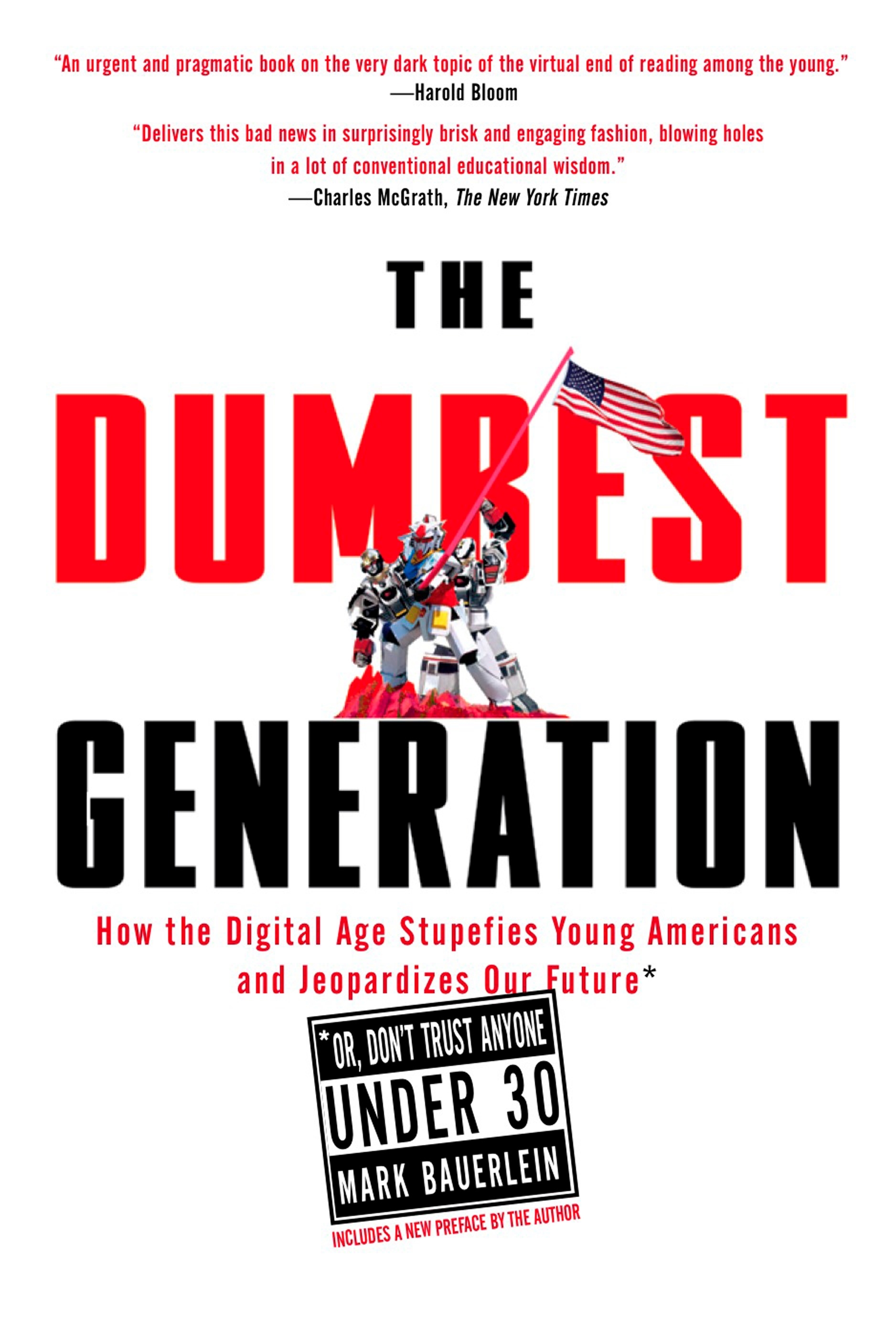
bostonglobe | Second-graders who can't tie shoes or zip jackets. Four-year-olds in Pull-Ups diapers. Five-year-olds in strollers. Teens and preteens befuddled by can openers and ice-cube trays. College kids who've never done laundry, taken a bus alone or addressed an envelope.

Are we raising a generation of nincompoops? And do we have only ourselves to blame? Or are some of these things simply the result of kids growing up with push-button technology in an era when mechanical devices are gradually being replaced by electronics?

Susan Maushart, a mother of three, says her teenage daughter "literally does not know how to use a can opener. Most cans come with pull-tops these days. I see her reaching for a can that requires a can opener, and her shoulders slump and she goes for something else."

Teenagers are so accustomed to either throwing their clothes on the floor or hanging them on hooks that Maushart says her "kids actually struggle with the mechanics of a clothes hanger."

Many kids never learn to do ordinary household tasks. They have no chores. Take-out and drive-through meals have replaced home cooking. And busy families who can afford it often outsource house-cleaning and lawn care.

"It's so all laid out for them," said Maushart, author of the forthcoming book "The Winter of Our Disconnect," about her efforts to wean her family from its dependence on technology. "Having so much comfort and ease is what has led to this situation -- the Velcro sneakers, the Pull-Ups generation. You can pee in your pants and we'll take care of it for you!"

are monkeys self-aware?


Video - monkey see, monkey know...,

The Scientist | Rhesus monkeys may recognize their own reflection in a mirror, indicating self-awareness--a trait traditionally reserved for humans, chimpanzees and orangutans and a topic of much debate among researchers, including Marc Hauser, professor of psychology at Harvard University and the recent subject of misconduct investigations.

The results, published in the September 29th issue of PLoS ONE, question the existence of a stark cognitive divide that separates higher primates from the rest of the animal kingdom.

"In most instances, monkeys do not show [self-awareness]," Christopher Coe, director of the Harlow Primate Laboratory at the University of Wisconsin-Madison, who was not involved in the work, said in an email to The Scientist. But the new study "indicates that rhesus monkeys can acquire this ability in the right setting and with the right tools."

For years, the Gallup mark test has been the standard method for assessing self-awareness. Researchers dye a small tuff of hair on an animal's head, and then give it access to a mirror. If the animal touched the mark while looking in the mirror, researchers concluded it understood the reflection to be its own. Humans over the age of two, chimpanzees, orangutans and potentially gorillas can conclusively pass this test. Monkeys, on the other hand, nearly always fail.

Thursday, September 30, 2010

rampant cheating on fbi domestic surveillance test

TPM | A significant number of FBI employees cheated on an exam intended to assess their skills on criminal investigations, national security investigations and foreign intelligence collection, according to a Justice Department Inspector General report released Monday.

When taking the computerized 51-question Domestic Investigations and Operations Guide (DIOG), some consulted with others while taking the exam, others used or distributed answers sheets or study guides that provided answers to the test and some employees "exploited a programming flaw to reveal the answers to the exam on their computers."

Supervisors -- including two Assistant Special Agents in Charge and a legal adviser -- were involved in such cheating and almost all of those who cheated falsely certified on the final question of the exam that they had not consulted with others, according to the OIG report.

In addition, some instructors taught to the test during training sessions and gave clues about what would be on the test. Instructors "stomped a foot several times, loudly, when they were covering a question that would be on the exam," and other instructors would mark their Power Point slides "with attention-getting signals - such as a cartoon character - if the information on that particular slide would be on the exam."

The FBI found that over 200 employees had completed the exam -- expected to take two hours -- in 20 minutes or less.

the odds must ALWAYS favor the house..., right?


Video - Black Hat DC 2010: Exploiting Lawful Intercept to Wiretap the Internet 1/6

NYTimes | Federal law enforcement and national security officials are preparing to seek sweeping new regulations for the Internet, arguing that their ability to wiretap criminal and terrorism suspects is “going dark” as people increasingly communicate online instead of by telephone.

Essentially, officials want Congress to require all services that enable communications — including encrypted e-mail transmitters like BlackBerry, social networking Web sites like Facebook and software that allows direct “peer to peer” messaging like Skype — to be technically capable of complying if served with a wiretap order. The mandate would include being able to intercept and unscramble encrypted messages.

The bill, which the Obama administration plans to submit to lawmakers next year, raises fresh questions about how to balance security needs with protecting privacy and fostering innovation. And because security services around the world face the same problem, it could set an example that is copied globally.

James X. Dempsey, vice president of the Center for Democracy and Technology, an Internet policy group, said the proposal had “huge implications” and challenged “fundamental elements of the Internet revolution” — including its decentralized design.

“They are really asking for the authority to redesign services that take advantage of the unique, and now pervasive, architecture of the Internet,” he said. “They basically want to turn back the clock and make Internet services function the way that the telephone system used to function.”

But law enforcement officials contend that imposing such a mandate is reasonable and necessary to prevent the erosion of their investigative powers.

“We’re talking about lawfully authorized intercepts,” said Valerie E. Caproni, general counsel for the Federal Bureau of Investigation. “We’re not talking expanding authority. We’re talking about preserving our ability to execute our existing authority in order to protect the public safety and national security.”

Investigators have been concerned for years that changing communications technology could damage their ability to conduct surveillance. In recent months, officials from the F.B.I., the Justice Department, the National Security Agency, the White House and other agencies have been meeting to develop a proposed solution.

Wednesday, September 29, 2010

money - the most powerful social technology

paeconreview | In Issue 53 of the real-world economics review Richard Smith called for ‘a practical, workable post-capitalist ecological economy, an economy by the people, for the people, that is geared to production for need, not for profit’ (2010:42). He suggests economic theorists should ‘go back to the drawing board’ to re-frame how such an economy would operate. In my book The Future of Money I have explored whether the money system could be a possible mechanism for achieving a socially just, democratically administered, sufficiency economy (2010a). A sufficiency economy would be one oriented to meeting people’s material needs to the minimum necessary to enable a high quality of life for all. My case for advocating the money system is that as a socially constructed intangible economic form it is most immediately amenable to collective social action. As Geoffrey Ingham has argued ‘money...is the most powerful of the social technologies’ (2004: 202). A major proviso is that even radial reform of the money system will not eliminate the private ownership and control of tangible economic resources, a key element of the capitalist economy, but it could provide a stepping stone to radical social change.

Those arguing for an ecologically sustainable economy point to the destructive nature of the capitalist market (Scott Cato 2006). This is mainly in terms of externalities and the drive for growth (Scott Cato 2009). Value is attributed to those activities and resources that can immediately access and generate money. Resources not already in private ownership are treated as free goods, and market prices do not take account of long term damage to the environment. The capitalist financial system also drives growth as the search for profits drives competition and expansion together with the reliance on debt-based bank credit to fund the monetary circuit (Rossi 2007, Parguez & Seccareccia 2000). Ecofeminist political economy adds to the ecological critique by pointing out that much of women’s work and lives is excluded from the money-based economy (Mellor 2010b). The market economy and the public economy both frame their activities in money terms, externalising unpaid community and domestic activities. The real economy in ecological and feminist terms would embrace all aspects of the provisioning conditions for human existence to include unpaid work and environmental resources , damage and resilience.

So why see money as the key to developing a sufficiency economy? It is true that money has had a bad press. Love of it is the root of all evil. It commodifies and alienates human relationships. It is the mechanism of the extraction of profit and capital accumulation. At the same time it is arguably a symbol of social trust in that people honour it in their dealings, and it can be, potentially if not actually, an instrument of social policy. What is even more important is the evidence, particularly in the recent financial crisis, that the only mechanism that stands behind money systems is the state as representing the collective economic resilience of the population. While the state can create and circulate money ex nihilo, it still relies on social trust and acknowledgement of that money to enable it to circulate, its power to tax and the collective activities of the people in accepting that money as a reward for labour.

end drug war, save billions in wealth

Cato | A new Cato Institute report examines the budgetary impact of ending the drug war and concludes that $88 billion could be saved each year (about $41 billion from canceled spending and about $47 billion in new tax revenue).

Here’s the executive summary:
State and federal governments in the United States face massive looming fiscal deficits. One policy change that can reduce deficits is ending the drug war. Legalization means reduced expenditure on enforcement and an increase in tax revenue from legalized sales.

This report estimates that legalizing drugs would save roughly $41.3 billion per year in government expenditure on enforcement of prohibition. Of these savings, $25.7 billion would accrue to state and local governments, while $15.6 billion would accrue to the federal government.

Approximately $8.7 billion of the savings would result from legalization of marijuana and $32.6 billion from legalization of other drugs.

The report also estimates that drug legalization would yield tax revenue of $46.7 billion annually, assuming legal drugs were taxed at rates comparable to those on alcohol and tobacco. Approximately $8.7 billion of this revenue would result from legalization of marijuana and $38.0 billion from legalization of other drugs.
Saving money that is otherwise wasted is just one of a dozen good reasons to end the drug war. But since policymakers have placed all of us into a financial jam, this report shows one way to improve our position. Voting against the drug war remains a risky vote but more politicians are concluding that it is a less painful vote than voting against other things the government spends money on.

Harvard economist Jeff Miron and his co-author Katherine Waldock have data on the federal budget and all the states. Check out how much money your state is wasting and spread the word to others. Fist tap Dale.

deleveraging is america's future

paeconreview | The latest Flow of Funds release by the US Federal Reserve shows that the private sector is continuing to delever. However there are nuances in this process that to some extent explain why a recovery appeared feasible for a while.

The aggregate data is unambiguous: the US economy is delevering in a way that it hasn’t done since the Great Depression, from debt levels that are the highest in its history. The aggregate private debt to GDP ratio is now 267%, versus the peak level of 298% achieved back in February 2009–an absolute fall of 31 points and a percentage fall of 10.3% from the peak.

water use in southwest heads for day of reckoning

NYTimes | Barring a sudden end to the Southwest’s 11-year drought, the distribution of the river’s dwindling bounty is likely to be reordered as early as next year because the flow of water cannot keep pace with the region’s demands.

For the first time, federal estimates issued in August indicate that Lake Mead, the heart of the lower Colorado basin’s water system — irrigating lettuce, onions and wheat in reclaimed corners of the Sonoran Desert, and lawns and golf courses from Las Vegas to Los Angeles — could drop below a crucial demarcation line of 1,075 feet.

If it does, that will set in motion a temporary distribution plan approved in 2007 by the seven states with claims to the river and by the federal Bureau of Reclamation, and water deliveries to Arizona and Nevada would be reduced.

This could mean more dry lawns, shorter showers and fallow fields in those states, although conservation efforts might help them adjust to the cutbacks. California, which has first call on the Colorado River flows in the lower basin, would not be affected.

But the operating plan also lays out a proposal to prevent Lake Mead from dropping below the trigger point. It allows water managers to send 40 percent more water than usual downstream to Lake Mead from Lake Powell in Utah, the river’s other big reservoir, which now contains about 50 percent more water than Lake Mead.

In that case, the shortage declaration would be avoided and Lake Mead’s levels restored to 1,100 feet or so.

Lake Powell, fed by rain and snowmelt that create the Colorado and tributaries, has risen more than 60 feet from a 2004 low because the upper basin states, Colorado, New Mexico, Wyoming and Utah, do not use their full allocations. The upper basin provides a minimum annual flow of 8.23 million acre feet to Arizona, Nevada and California. (An acre-foot of water is generally considered the amount two families of four use annually.)

Tuesday, September 28, 2010

dramatically-poisonous-economy-heading-to-catastrophic-collapse


Video - Manfred Max Neef

theintelhub | The economy is to serve the people, not the people to serve the economy — Manfred Max-Neef

Acclaimed economist Manfred Max-Neef, author of the award-winning book From the Outside Looking in: Experiences in ‘Barefoot Economics’ recently appeared in a must-see interview on Democracy Now where he says a second, more catastrophic crisis is unavoidable because our economic model is “dramatically poisonous.” Max-Neef explains that “Greed is the dominant value today in the world and as long as that persists, we’re done!” But he doesn’t just mean done economically, he means done as a species.

Going beyond facts and figures to describe economics, his philosophy is based on a macro-world view, where he accounts for the biosphere, human creativity, security and happiness, and life in all of its manifestations. He reveals that the majority of economists have great knowledge, more than ever before, but they lack understanding. The two differ as, “knowledge is a function of science, whereas understanding is holistic,” explained Max-Neef. Using the metaphor of love to simplify: we may read and accumulate great knowledge about love, but we can never fully understand it until we fall in love and experience it.

His philosophy of humanizing economics, or “Barefoot Economics,” stems from spending years living in and studying the culture of poverty to better understand the economics of it. He concludes that the poverty culture has entirely different principles than our modern culture, where they must depend on enormous creativity, cooperation and solidarity of people. In poverty, “you cannot be an idiot if you want to survive,” he quipped.

the utterly dismal theorem

Boulding | First Theorem: "The Dismal Theorem"

"If the only ultimate check on the growth of population is misery, then the population will grow until it is miserable enough to stop its growth."

Second Theorem: "The Utterly Dismal Theorem"

This theorem "states that any technical improvement can only relieve misery for a while, for so long as misery is the only check on population, the [technical] improvement will enable population to grow, and will soon enable more people to live in misery than before. The final result of [technical] improvements, therefore, is to increase the equilibrium population which is to increase the total sum of human misery."

Third Theorem: "The moderately cheerful form of the Dismal Theorem"

"Fortunately, it is not too difficult to restate the Dismal Theorem in a moderately cheerful form, which states that if something else, other then misery and starvation, can be found which will keep a prosperous population in check, the population does not have to grow until it is miserable and starves, and it can be stably prosperous."

the dismal science

Wikipedia | "The dismal science" is a derogatory alternative name for economics devised by the Victorian historian Thomas Carlyle in the 19th century. The term is an inversion of the phrase "gay science," meaning "life-enhancing knowledge", a reference to the technical skills of song and verse writing. This was a familiar expression at the time, and was later adopted as the title of a book by Nietzsche (see The Gay Science).

It is often stated that Carlyle gave economics the nickname "the dismal science" as a response to the late 18th century writings of The Reverend Thomas Robert Malthus, who grimly predicted that starvation would result as projected population growth exceeded the rate of increase in the food supply. Carlyle did indeed use the word 'dismal' in relation to Malthus' theory in his essay Chartism (1839):

The controversies on Malthus and the 'Population Principle', 'Preventative Check' and so forth, with which the public ear has been deafened for a long while, are indeed sufficiently mournful. Dreary, stolid, dismal, without hope for this world or the next, is all that of the preventative check and the denial of the preventative check.

However, the full phrase "the dismal science" first occurs in Carlyle's 1849 tract entitled Occasional Discourse on the Negro Question, in which he was arguing for the reintroduction of slavery as a means to regulate the labor market in the West Indies:

Not a "gay science," I should say, like some we have heard of; no, a dreary, desolate and, indeed, quite abject and distressing one; what we might call, by way of eminence, the dismal science.

Developing a deliberately paradoxical position,[citation needed] Carlyle argued that slavery was actually morally superior to the market forces of supply and demand promoted by economists, since, in his view, the freeing up of the labor market by the liberation of slaves had actually led to a moral and economic decline in the lives of the former slaves themselves.

Carlyle's view was attacked by John Stuart Mill and other liberal economists.

The teachings of Malthus eventually became known under the umbrella phrase "Malthus' Dismal Theorem". His predictions were forestalled by dramatic improvements in the efficiency of food production in the 20th century during the Green Revolution; yet the bleak end he proposed remains as a disputed future possibility.

Monday, September 27, 2010

wallyworld svp cracks under the hypocrisy

Watch live streaming video from cgi_plenary at livestream.com

Treehugger | Curveballs aplenty at the special session "Market-based Solutions for Protecting the Environment" at the 2010 Clinton Global Initiative. The panel, which included Matt Kistler, the Senior Vice President of Marketing Wal-Mart and Dr. Sanjayan, the lead scientist for the Nature Conservancy, convened to discuss how business can address issues like water shortages and climate change, and turn a profit in the process. The biggest surprise came at the end of the session, when Kistler teared up discussing the great scope of the problems pursuing sustainability and addressing climate change presents.

Needless to say, it was interesting to hear what Kistler had to say, and not just because of the twist at the end. He discussed the already-apparent benefits that Wal-Mart is seeing from instituting its much touted Sustainability Index, and attempting to green its processes from the supply chain up. Kistler claimed that the company had saved over $200 million dollars by making its shipping fleet more efficient alone. He insisted that every part of the program had been immediately good for the corporation's bottom line; that it was seeing sizable savings as a result.

But at 57:21, check out Kistler's closing remarks about why Wal-Mart will continue to pursue sustainability and climate-friendly policies: because the consumer will demand it, and companies like Wal-Mart may have no choice.

the end of capitalism? - let it die....,

New Deal 2.0 | This is the second installment of “The Influencers,” a six-part interview series that Lynn Parramore, the editor of New Deal 2.0 and Media Fellow at the Roosevelt Institute, is conducting in partnership with Salon. She talked to Lewis Lapham, the former longtime editor of Harper’s and the founder of Lapham’s Quarterly, about the nature of American-style capitalism — its beginning, its historical manifestation and, possibly, its end.

Lynn Parramore: Historically, what do you see as the dominant characteristics of America?
Lewis Lapham: It’s faith in the spirit and mechanics and moral value of capitalism. It is a country of expectant millionaires. You have the notions of risk, of labor put to a productive use, deferred pleasure - ideas that come out of our Puritan ancestry. And Puritans, by the way, were also venture capitalists. The plantation in Plymouth, and then in Massachusetts Bay, was intended to bring money to its investors in London.

Capitalism is the promise - it’s the bet on the future. It’s the hope of a new beginning over the next ridge of mountains, around the next bend in the river. It gives the common man a chance. That’s in the Declaration of Independence: life, liberty and the pursuit of happiness. The original wording was: life, liberty and property. But happiness and property were almost synonymous in the Calvinist mind!

Capitalism, as you mention, is future-oriented. Do you think it relies on historical amnesia?
Well, there’s a new book called “Relentless Revolution: A History of Capitalism,” by the eminent historian Joyce Appleby. And her argument - and I think it’s probably true - is that capitalism is an historical phenomenon. It’s not a given. It’s not human nature. It arises at the end of the 16th century in Holland, but then is developed over the next four centuries for the most part in England and America. It’s had a life span of four centuries.

Prior to, let’s say, the 16th century, you had warrior kings who disdained commerce. Commerce existed from the very beginning - you have trading going on in Islam, in the Indian Ocean, in China … this goes back thousands of years. But the hope of the government is stability, hierarchy, order, degree. People knew the stations to which they belonged, to which they were born. Until 1600, 80 percent of the people in England lived on farms, and there was no question of improving their stature. There was no place for their surplus labor to go until you begin to develop commercial venture, trade and so on.

But 18th- and 19th-century European imperialism is a dynamic of private enterprise rather than state enterprise. The Roman legions are in the service of the Roman so-called Republic, or Empire. But the East India Company is acting on behalf of its principal owners and stockholders and, to a certain extent, of the sailors. It’s evolving toward our present sense of venture capital. The capitalist idea is to turn loot to a productive purpose - to yoke it to the wheels of industry. And this, of course, comes along, during the four centuries [17th century to present] with a steeply rising curve of scientific discovery and technological advance, so you get to the steam engine, the railroad, the iron smelter, the telephone, the radio, the TV, the Internet. We shape our tools, and our tools shape us. And by that shaping us, they shape our attitudes, our moral sense, our sense of self-interest. Competition is the spirit elixir of capitalism. This is not true in the more traditional society where the emphasis is on community, hierarchy, order, where people are terrified of starvation.

19 facts about the deindustrialization of america that will blow your mind

The Economic Collapse | The United States is rapidly becoming the very first "post-industrial" nation on the globe. All great economic empires eventually become fat and lazy and squander the great wealth that their forefathers have left them, but the pace at which America is accomplishing this is absolutely amazing. It was America that was at the forefront of the industrial revolution. It was America that showed the world how to mass produce everything from automobiles to televisions to airplanes. It was the great American manufacturing base that crushed Germany and Japan in World War II. But now we are witnessing the deindustrialization of America. Tens of thousands of factories have left the United States in the past decade alone. Millions upon millions of manufacturing jobs have been lost in the same time period. The United States has become a nation that consumes everything in sight and yet produces increasingly little. Do you know what our biggest export is today? Waste paper. Yes, trash is the number one thing that we ship out to the rest of the world as we voraciously blow our money on whatever the rest of the world wants to sell to us. The United States has become bloated and spoiled and our economy is now just a shadow of what it once was. Once upon a time America could literally outproduce the rest of the world combined. Today that is no longer true, but Americans sure do consume more than anyone else in the world. If the deindustrialization of America continues at this current pace, what possible kind of a future are we going to be leaving to our children?

Any great nation throughout history has been great at making things. So if the United States continues to allow its manufacturing base to erode at a staggering pace how in the world can the U.S. continue to consider itself to be a great nation? We have created the biggest debt bubble in the history of the world in an effort to maintain a very high standard of living, but the current state of affairs is not anywhere close to sustainable. Every single month America does into more debt and every single month America gets poorer.

So what happens when the debt bubble pops?

The deindustrialization of the United States should be a top concern for every man, woman and child in the country. But sadly, most Americans do not have any idea what is going on around them.

For people like that, take this article and print it out and hand it to them. Perhaps what they will read below will shock them badly enough to awaken them from their slumber.

The following are 19 facts about the deindustrialization of America that will blow your mind....

Sunday, September 26, 2010

always after the fact...,

Wikipedia | Libet's experiments suggest that unconscious processes in the brain are the true initiator of volitional acts, and free will therefore plays no part in their initiation. If the brain has already taken steps to initiate an action before we are aware of any desire to perform it, the causal role of consciousness in volition is all but eliminated.

Libet finds that conscious volition is exercised in the form of 'the power of veto' (sometimes called free won't); the idea that conscious acquiescence is required to allow the unconscious buildup of the readiness potential to be actualized as a movement. While consciousness plays no part in the instigation of volitional acts, Libet suggested that it may still have a part to play in suppressing or withholding certain acts instigated by the unconscious. Libet noted that everyone has experienced the withholding from performing an unconscious urge. Since the subjective experience of the conscious will to act preceded the action by only 200 milliseconds, this leaves consciousness only 100-150 milliseconds to veto an action (this is because the final 50 milliseconds prior to an act are occupied by the activation of the spinal motor neurones by the primary motor cortex, and the margin of error indicated by tests utilizing the oscillator must also be considered).

Susan Blackmore's common sense interpretation is "that conscious experience takes some time to build up and is much too slow to be responsible for making things happen."[6]

Libet's experiments have received support from other research related to the Neuroscience of free will.

Video - Benjamin Libet tells us what free will is...

what "pastor" in his right mind?


Video - InternetGuide4Muslims summarizes the "bishop".

WaPo | Bishop Eddie L. Long built a religious empire just outside Atlanta by preaching a blend of the Gospel mixing faith, politics and finance - wrapped up in a flashy style - that propelled him to the pinnacle of the movement of large, independent African American mega-churches across the nation.

Now, after he was slapped with four lawsuits last week alleging he used his position to coerce young male members of his flock into sex acts, Long's future as a towering figure in the one of the country's most accomplished black communities and beyond is in question. On Sunday, Long is expected to take to the pulpit of his sprawling Lithonia church and address his 25,000-member congregation.

Many thousands more will be listening, and some are even flying to witness the event. The allegations have been a hot topic on black radio and Web sites since they came to light Tuesday, and black preachers across the country will continue the conversation from their pulpits Sunday.

It is, parishioners and observers say, a moment of undeniable crisis in the black church.

"The only person in the pantheon of black churches who is bigger than this is T.D. Jakes," said Anthea Butler, a religion professor at the University of Pennsylvania who was among those flying down to Georgia. "And Atlanta is the epicenter of black church life. . . . It's going to rock everything at the church, and people will really start to question these ministers."

Video - "Bishop" used the bible to justify "releasing his passion".

Saturday, September 25, 2010

the queen wanted a little gub'mint cheese....,

The Independent | Ministers were asked if money earmarked for schools, hospitals and low-income families could be used to meet soaring fuel bills. The Queen asked ministers for a poverty handout to help heat her palaces but was rebuffed because they feared it would be a public relations disaster, documents disclosed under the Freedom of Information Act reveal.

Royal aides were told that the £60m worth of energy-saving grants were aimed at families on low incomes and if the money was given to Buckingham Palace instead of housing associations or hospitals it could lead to "adverse publicity" for the Queen and the Government.

Aides complained to ministers in 2004 that the Queen's gas and electricity bills, which had increased by 50 per cent that year, stood at more than £1m a year and had become "untenable".

The Royal Household also complained that the £15m government grant to maintain the Queen's palaces was inadequate.

In search of more money-saving schemes, the Queen's deputy treasurer wrote to the Department for Culture, Media and Sport to ask whether the Royal Household would be eligible for a grant to replace four combined heat and power (CHP) units at Buckingham Palace and Windsor Castle.

He asked: "Community Energy can fund up to 40 per cent of the capital costs of implementing a community heating scheme... Since we are already grant-in-aid funded [the Queen receives £15m a year for the upkeep of her palaces] we would like to know whether the Household [would] be able to benefit from these grants. I look forward to your comments." Under this scheme administered by the Environment department, schools, hospitals, councils and housing associations have been awarded £60m for heating programmes which benefit people on low incomes.

the limits of permaculture...,


Video - Toby Hemenway - How Permaculture Can Save Humanity and the Earth, but Not Civilization

Duke Environment | Hemenway is a frequent teacher, consultant and lecturer on permaculture and ecological design throughout the U.S. and other countries. His writing has appeared in magazines such as Natural Home, Whole Earth Review and American Gardener. He is an adjunct professor in the School of Graduate Education at Portland State University, a Scholar-in-Residence at Pacific University, and a biologist consultant for the Biomimicry Guild. Fist tap Dale.

peak food soon?


Video - Survival Gardening Part I

Ragblog | Will we soon experience a global peak in food production, similar to peak oil?

It is too difficult and too soon to predict a global peak in world food production, but it is easy to see that some such event cannot be delayed much longer, and is quite likely to occur within the next five years. This despite the fact that global grain reserves seem to be adequate for now.

The World Bank writes that "it is too early to make conclusive statements on the impact of the very recent global wheat price spikes at the national and household level." The FAO has likewise stated that there does not currently appear to be a crisis, but that it is concerned about the amount of volatility in food markets. And that volatility might bode ill for progress toward overcoming challenges like those laid out in the Millennium Development Goals being discussed at the U.N. this week.

"These recent global staple price increases raise the risk of domestic food price spikes in low income countries and its consequent impacts on poverty, hunger and other human development goals," according to the Bank.

Peak food is pretty hard to determine compared to peak oil, partly since so much of its production is local. Global food demand can restructure in its demand over time to accommodate a reduction in food supply. Those who are hungry will tend to shift their consumption to cheaper calories, often at the expense of its nutritional content. Globally, the wealthier tend to favor animal protein produced from grain, foods imported from afar, and in general less energy efficient foods.

Grains are the most important global food commodities to focus on because they provide such a large percentage of the world's total food calories, and because they can be stored and traded to reduce local food shortages. Wheat and rice are the top human food grains by tonnage. Other commonly used animal feed grains like corn are termed coarse grains. Wheat tends to be more used globally to prevent regional hunger, whereas rice provides cheaper food calories but is more often produced and consumed locally.

Chipocalypse Now - I Love The Smell Of Deportations In The Morning

sky |   Donald Trump has signalled his intention to send troops to Chicago to ramp up the deportation of illegal immigrants - by posting a...