Saturday, June 12, 2010

simple operational incompetence...,

RollingStone | The Spill, The Scandal and the President - The inside story of how Obama failed to crack down on the corruption of the Bush years – and let the world's most dangerous oil company get away with murder.

It's tempting to believe that the Gulf spill, like so many disasters inherited by Obama, was the fault of the Texas oilman who preceded him in office. But, though George W. Bush paved the way for the catastrophe, it was Obama who gave BP the green light to drill. "Bush owns eight years of the mess," says Rep. Darrell Issa, a Republican from California. "But after more than a year on the job, Salazar owns it too."

During the Bush years, the Minerals Management Service, the agency in the Interior Department charged with safeguarding the environment from the ravages of drilling, descended into rank criminality. According to reports by Interior's inspector general, MMS staffers were both literally and figuratively in bed with the oil industry. When agency staffers weren't joining industry employees for coke parties or trips to corporate ski chalets, they were having sex with oil-company officials. But it was American taxpayers and the environment that were getting screwed. MMS managers were awarded cash bonuses for pushing through risky offshore leases, auditors were ordered not to investigate shady deals, and safety staffers routinely accepted gifts from the industry, allegedly even allowing oil companies to fill in their own inspection reports in pencil before tracing over them in pen.

"The oil companies were running MMS during those years," Bobby Maxwell, a former top auditor with the agency, told Rolling Stone last year. "Whatever they wanted, they got. Nothing was being enforced across the board at MMS."

Salazar himself has worked hard to foster the impression that the "prior administration" is to blame for the catastrophe. In reality, though, the Obama administration was fully aware from the outset of the need to correct the lapses at MMS that led directly to the disaster in the Gulf. In fact, Obama specifically nominated Salazar – his "great" and "dear" friend – to force the department to "clean up its act." For too long, Obama declared, Interior has been "seen as an appendage of commercial interests" rather than serving the people. "That's going to change under Ken Salazar."

Salazar took over Interior in January 2009, vowing to restore the department's "respect for scientific integrity." He immediately traveled to MMS headquarters outside Denver and delivered a beat-down to staffers for their "blatant and criminal conflicts of interest and self-dealing" that had "set one of the worst examples of corruption and abuse in government." Promising to "set the standard for reform," Salazar declared, "The American people will know the Minerals Management Service as a defender of the taxpayer. You are the ones who will make special interests play by the rules." Dressed in his trademark Stetson and bolo tie, Salazar boldly proclaimed, "There's a new sheriff in town."

Salazar's early moves certainly created the impression that he meant what he said. Within days of taking office, he jettisoned the Bush administration's plan to open 300 million acres – in Alaska, the Gulf, and up and down both coasts – to offshore drilling. The proposal had been published in the Federal Register literally at midnight on the day that Bush left the White House. Salazar denounced the plan as "a headlong rush of the worst kind," saying it would have put in place "a process rigged to force hurried decisions based on bad information." Speaking to Rolling Stone in March 2009, the secretary underscored his commitment to reform. "We have embarked on an ambitious agenda to clean up the mess," he insisted. "We have the inspector general involved with us in a preventive mode so that the department doesn't commit the same mistakes of the past." The crackdown, he added, "goes beyond just codes of ethics."

Except that it didn't. Salazar did little to tamp down on the lawlessness at MMS, beyond referring a few employees for criminal prosecution and ending a Bush-era program that allowed oil companies to make their "royalty" payments – the amount they owe taxpayers for extracting a scarce public resource – not in cash but in crude. And instead of putting the brakes on new offshore drilling, Salazar immediately throttled it up to record levels. Even though he had scrapped the Bush plan, Salazar put 53 million offshore acres up for lease in the Gulf in his first year alone – an all-time high. The aggressive leasing came as no surprise, given Salazar's track record. "This guy has a long, long history of promoting offshore oil drilling – that's his thing," says KierĂ¡n Suckling, executive director of the Center for Biological Diversity. "He's got a highly specific soft spot for offshore oil drilling." As a senator, Salazar not only steered passage of the Gulf of Mexico Energy Security Act, which opened 8 million acres in the Gulf to drilling, he even criticized President Bush for not forcing oil companies to develop existing leases faster.

Salazar was far less aggressive, however, when it came to making good on his promise to fix MMS. Though he criticized the actions of "a few rotten apples" at the agency, he left long-serving lackeys of the oil industry in charge. "The people that are ethically challenged are the career managers, the people who come up through the ranks," says a marine biologist who left the agency over the way science was tampered with by top officials. "In order to get promoted at MMS, you better get invested in this pro-development oil culture." One of the Bush-era managers whom Salazar left in place was John Goll, the agency's director for Alaska. Shortly after, the Interior secretary announced a reorganization of MMS in the wake of the Gulf disaster, Goll called a staff meeting and served cake decorated with the words "Drill, baby, drill."

Salazar also failed to remove Chris Oynes, a top MMS official who had been a central figure in a multibillion-dollar scandal that Interior's inspector general called "a jaw-dropping example of bureaucratic bungling." In the 1990s, industry lobbyists secured a sweetheart subsidy from Congress: Drillers would pay no royalties on oil extracted in deep water until prices rose above $28 a barrel. But this tripwire was conveniently omitted in Gulf leases overseen by Oynes – a mistake that will let the oil giants pocket as much as $53 billion. Instead of being fired for this fuckup, however, Oynes was promoted by Bush to become associate director for offshore drilling – a position he kept under Salazar until the Gulf disaster hit.

"Employees describe being in Interior – not just MMS, but the other agencies – as the third Bush term," says Jeff Ruch, executive director of Public Employees for Environmental Responsibility, which represents federal whistle-blowers. "They're working for the same managers who are implementing the same policies. Why would you expect a different result?"

sipri yearbook 2010 - armaments, disarmament, and international security

SIPRI | ‘The 12 chapters of SIPRI Yearbook 2010 and their accompanying appendices and documentation provide the single most comprehensive and in-depth assessment of developments in international security, armaments and disarmament over the past year’

Chapter 5. Military expenditure
Sample chapter (PDF)
Summary
Total global military expenditure in 2009 is estimated to have been $1531 billion. This represents an increase of 6 per cent in real terms compared to 2008, and of 49 per cent since 2000. Military expenditure comprised approximately 2.7 per cent of global gross domestic product (GDP) in 2009. All regions and subregions saw an increase in 2009, except the Middle East.

The global economic crisis had little impact on world military spending in 2009, as most major economies boosted public spending to counteract the recession, postponing deficit reduction. While military expenditure was not a major feature of economic stimulus packages, it was not generally cut either. Nine of the top 10 spenders increased military spending in 2009. However, some smaller economies less able to sustain large deficits did cut spending.

Natural resource revenues appear to be a significant driver of military expenditure in many developing countries, with rapidly rising revenues from oil and other commodities in recent years, due to increases in both price and production. This may lead to increased military spending as a means of protecting resources from internal or external threats, while resource revenues are often a source of funding for arms purchases. The drop in commodity prices in 2009 has slowed this trend in some cases.

The conflict in Afghanistan is proving increasingly costly to many of the countries with a substantial troop presence there and has also generated debates as to the focus of military spending, between equipment of use in current conflicts and major weapon platforms designed for power projection. In the UK a combination of the Afghanistan conflict, high deficits and an overambitious equipment programme have sharpened this debate.

US military spending is continuing to rise under the Obama Administration, partly due to the escalating conflict in Afghanistan. Spending is budgeted to rise further in 2010, and military spending is exempted from a general freeze on discretionary spending. The 2010 budget saw some refocusing of priorities, with cancellation of some major weapon systems and increased focus on information and communications technology, but no major strategic shift.

Military spending patterns in Afghanistan and Iraq both reflect the demands of rebuilding a country’s armed forces from scratch following external invasion and with continued requirement for substantial external funding.

Friday, June 11, 2010

remember where you read it first....,


Video - the great Brook Benton "Just a Matter of Time".

New Scientist | Children with autism appear to have a characteristic chemical signature in their urine which might form the basis of an early diagnostic test for the condition.

The finding also adds weight the hypothesis that substances released by gut bacteria are contributing to the onset of the condition.

Autism has previously been linked to metabolic abnormalities and gastrointestinal problems such as gut pain and diarrhoea. Several studies have also hinted at changes in gut bacteria in the faeces of children with autism.

To investigate whether signs of these metabolic changes might be detectable in children's urine, Jeremy Nicholson and colleagues at Imperial College London investigated 39 children with autism, 28 of their non-autistic siblings and 34 unrelated children.

Chemical fingerprint

Using nuclear magnetic resonance (NMR) spectroscopy to analyse the children's urine, they found that each of these groups had a distinct chemical fingerprint, with clear and significant differences between children with autism and unrelated controls.

"The signature that comes up is related to gut bacteria," says Nicholson. It is not yet clear whether the bacteria's metabolic products contribute to the development of autism, but it is a possibility worth investigating, he adds. A large proportion of autistic children have severe gastrointestinal problems that tend to appear at about the same time as the behavioural symptoms.

"It adds another link to the gut bacterial involvement in the onset of disorder," says Glenn Gibson of the University of Reading, UK, who has previously identified abnormally high levels of clostridium bacteria in children with autism.

One possibility is that the gut bacteria in children with autism are producing toxins that might interfere with brain development. One of the compounds identified in the urine of autistic children was N-methyl-nicotinamide (NMND), which has also been implicated in Parkinson's disease.

can the u.s. punish bp's shareholders?

NYTimes | Spewing oil and alienating Americans with its chief executive’s impolitic remarks, BP may be Public Enemy No. 1 in the United States. But in Britain, where the company is a mainstay of the stock market and a favorite of pension funds, investors and politicians are becoming increasingly angry at the blistering attacks from across the Atlantic.

BP’s share price, even after recovering some ground in New York trading on Thursday, has fallen more than 40 percent since the environmental catastrophe in April, and some analysts say the crisis could lead to the takeover or even the bankruptcy of one of Britain’s most valuable and iconic companies.

In that atmosphere, the stream of condemnations from Washington has stirred a protective backlash, even in this closest of American allies. Boris Johnson, the Conservative mayor of London, said Thursday that he was worried about “anti-British rhetoric” and “name-calling” from American politicians.

“When you consider the huge exposure of British pension funds to BP, it starts to become a matter of national concern if a great British company is being continually beaten up on the airwaves,” Mr. Johnson told BBC radio’s Today program.

Prime Minister David Cameron refused to criticize the United States, however, saying he sympathized with its “frustration” in dealing with its worst environmental disaster in memory. But the chancellor of the Exchequer, George Osborne, signaled careful support for BP, saying that he had spoken to its chief executive, Tony Hayward, and that it was important to remember “the economic value BP brings to people in Britain and America.”

BP is the third largest oil company in the world, after ExxonMobil and Royal Dutch Shell, with 80,000 employees worldwide as of last December, sales of $239 billion in 2009 and a market value — even after the recent losses — of more than $100 billion. At a time when Britain is desperate to reduce its deficit, BP is a huge contributor to British tax revenue, paying nearly $1.4 billion in taxes on its profits last year.

Its reputation for reliability and its generous dividends have long made it a favorite of British pension funds. The company’s dividend payments accounted for about 13 percent of the dividends handed out by British companies last year, according to FairPensions, a London-based charity.

Some Britons are irked at President Obama’s seeming determination to refer to the company as “British Petroleum” — even though it jettisoned that name in favor of initials years ago. In any case, they point out, it is truly a multinational company, traded on both the New York and London stock exchanges, with British and American nationals on its board of directors.

BP also has extensive holdings in the United States. It merged with Amoco, the former Standard Oil of Indiana, in 1998, and about 40 percent of its shares are held by American investors. It owns a refinery in Texas City, Tex., that is one of the world’s largest, and a 50 percent interest in the Trans Alaska Pipeline, in addition to a huge gasoline marketing operation.

But alarms went off in Britain when President Obama said earlier this week that he would have fired Mr. Hayward, BP’s chief executive, if Mr. Hayward worked for him and that he was looking for “whose ass to kick” in connection with the disaster. The Justice Department did not help matters when it said Wednesday that it was planning to take action to force BP to withhold its next dividend payment.

mega-disaster coverup?


Video - Matt Simons on magnitude of disaster.

Oilprice | WMR has been informed by sources in the US Army Corps of Engineers, Federal Emergency Management Agency (FEMA), and Florida Department of Environmental Protection that the Obama White House and British Petroleum (BP), which pumped $71,000 into Barack Obama's 2008 presidential campaign -- more than John McCain or Hillary Clinton, are covering up the magnitude of the volcanic-level oil disaster in the Gulf of Mexico and working together to limit BP's liability for damage caused by what can be called a "mega-disaster."

Obama and his senior White House staff, as well as Interior Secretary Ken Salazar, are working with BP's chief executive officer Tony Hayward on legislation that would raise the cap on liability for damage claims from those affected by the oil disaster from $75 million to $10 billion. However, WMR's federal and Gulf state sources are reporting the disaster has the real potential cost of at least $1 trillion. Critics of the deal being worked out between Obama and Hayward point out that $10 billion is a mere drop in the bucket for a trillion dollar disaster but also note that BP, if its assets were nationalized, could fetch almost a trillion dollars for compensation purposes. There is talk in some government circles, including FEMA, of the need to nationalize BP in order to compensate those who will ultimately be affected by the worst oil disaster in the history of the world.

Plans by BP to sink a 4-story containment dome over the oil gushing from a gaping chasm one kilometer below the surface of the Gulf, where the oil rig Deepwater Horizon exploded and killed 11 workers on April 20, and reports that one of the leaks has been contained is pure public relations disinformation designed to avoid panic and demands for greater action by the Obama administration, according to FEMA and Corps of Engineers sources. Sources within these agencies say the White House has been resisting releasing any "damaging information" about the oil disaster. They add that if the ocean oil geyser is not stopped within 90 days, there will be irreversible damage to the marine eco-systems of the Gulf of Mexico, north Atlantic Ocean, and beyond. At best, some Corps of Engineers experts say it could take two years to cement the chasm on the floor of the Gulf.

Only after the magnitude of the disaster became evident did Obama order Homeland Security Secretary Janet Napolitano to declare the oil disaster a "national security issue." Although the Coast Guard and FEMA are part of her department, Napolitano's actual reasoning for invoking national security was to block media coverage of the immensity of the disaster that is unfolding for the Gulf of Mexico and Atlantic Ocean and their coastlines.

From the Corps of Engineers, FEMA, the Environmental Protection Agency, Coast Guard, and Gulf state environmental protection agencies, the message is the same: "we've never dealt with anything like this before."

The Obama administration also conspired with BP to fudge the extent of the oil leak, according to our federal and state sources. After the oil rig exploded and sank, the government stated that 42,000 gallons per day was gushing from the seabed chasm. Five days later, the federal government upped the leakage to 210,000 gallons a day.

However, WMR has been informed that submersibles that are monitoring the escaping oil from the Gulf seabed are viewing television pictures of what is a "volcanic-like" eruption of oil. Moreover, when the Army Corps of Engineers first attempted to obtain NASA imagery of the Gulf oil slick -- which is larger than that being reported by the media -- it was turned down. However, National Geographic managed to obtain the satellite imagery shots of the extent of the disaster and posted them on their web site.

There is other satellite imagery being withheld by the Obama administration that shows what lies under the gaping chasm spewing oil at an ever-alarming rate is a cavern estimated to be around the size of Mount Everest. This information has been given an almost national security-level classification to keep it from the public, according to our sources.

maxed out...,

about that paper?

what now?

uh.., about that abiotic oil?

Thursday, June 10, 2010

set an example - let bp die...,

HuffPo | I was speaking to a neighbor recently, out here on the East End of Long Island, about the BP Oil disaster and the impact the spill is having on the Louisiana coast, it's wildlife and fishing industries. Eastern Long Island may be vastly different from the Gulf Coast in terms of culture and politics. However, both regions share a deep and historic link to their waters. Even today, areas on Long Island stretching from Riverhead to both Orient and Montauk Points seem linked, in a rather romanticized way, to a fishing past that has dwindled sharply over the past 40 years.

And yet, like my neighbor, I cannot imagine facing, here where I live, what Gulf Coast residents are facing now. The destruction in the Gulf region, like the Katrina debacle and the September 11th attacks, reminds us that we are one country and that the sudden loss or destruction of our nation's freedoms, monuments, culture, servicemen and women, natural resources, you name it, casts into sharp focus what is ours to protect and defend.

The Gulf of Mexico, at least that part of it that is ours to maintain and fish and enjoy, belongs to every American. Just like the Great Lakes, the Grand Canyon, Monterey Bay, The Rocky Mountains, Cape Cod, Park Avenue, the Lincoln Memorial, the Little League ball field in your town, the place you have coffee at every morning, or take yoga or the place you go to have coffee and make fun of yoga . What is happening down there is happening to you and to me. Because resources like the Gulf ARE this country. They belong to us. And if you aren't so goddamned fed up with this crap from the oil industry that you want to scream, then maybe you need to have some tar balls fall out of the sky on to your front lawn before you get it.

I wrote in a previous post that a major global oil company would have to go out of business as a sign that we were on the right track regarding effective energy policy reform. Let that company be BP. In the process of being litigated by the government of this country in pursuit of remediating this problem, let BP die. The oil business can only sustain itself through the corruption we now know was (is?) rampant at the Minerals Management Service. Some of those in charge at that agency should be put on trial for treason. Some of the neocons that visits this site will nonetheless defend BP. They'll say they broke no law. That the government approved everything that went on down there.

My response to that is "What government?" Disasters like this remind us of what we have that matters most. They also sadly remind us of what we don't have that we desperately need. When it comes to the oil industry, we have no government. We have just a bunch of drunken, thieving whores who shilled for Big Oil called the Minerals Management Service.

the more spills change, the more they stay the same..,


Video - Rachel Maddow uses the wayback machine from 1979.

EROSION OF THE MYTH OF ADMINISTRATORS OF THE COMMONS
"Indeed, the process has been so widely commented upon that one writer postulated a common life cycle for all of the attempts to develop regulatory policies. The life cycle is launched by an outcry so widespread and demanding that it generates enough political force to bring about establishment of a regulatory agency to insure the equitable, just, and rational distribution of the advantages among all holders of interest in the commons. This phase is followed by the symbolic reassurance of the offended as the agency goes into operation, developing a period of political quiescence among the great majority of those who hold a general but unorganized interest in the commons. Once this political quiescence has developed, the highly organized and specifically interested groups who wish to make incursions into the commons bring sufficient pressure to bear through other political processes to convert the agency to the protection and furthering of their interests. In the last phase e ven staffing of the regulating agency is accomplished by drawing the agency administrators from the ranks of the regulated." [pp. 60-61].

propaganda, state religion, and the flotilla attack


Video - Russia today covering British sailors captured by Iran

MediaLens | the hidden ideological source empowering much propaganda is the presumed legitimacy of the state and its actions. We are trained, not just to respect, but to revere the state, the shining "city upon a hill". We lower our heads before 'the flag' and the national anthem much as we would before religious idols. Indeed, people receive an insult to 'the flag' much as they would an insult to their God. This seems just 'the way things are' now, but in 1937 political analyst Rudolf Rocker explained how state managers had very consciously emulated organised religion in their attempts to manipulate the public mind:
"Every church is constantly striving to extend the limits of its power, and to plant the feeling of dependence deeper in the hearts of men. But every temporal power is animated by the same desire, so in both cases the efforts take the same direction. Just as in religion God is everything and man nothing, so in politics the state is everything, the subject nothing." (Rocker, Culture and Nationalism, Michael E. Coughlan, 1978, p.55)
Rocker added:
"The Crusader's cry, 'God wills it!' would hardly raise an echo in Europe today, but there are still millions of men who are ready for anything if the nation wills it! Religious feeling has assumed political forms." (Ibid, p.252)
'Balanced' news reporting of state action comes laden with this highly suspect, quasi-religious baggage. Notice how respectable Fickling's "troops" who merely "arrest" seem compared to the "militants" who "kidnap". The "troops" are "security forces", responsible agents of the hallowed state. A "militant" is any Tom, Dick or Harry with a gun. And of course a "terrorist" is a kind of devil.

It sounds much worse when journalists report that civilians have been killed by "militants" or "terrorists" than by "security forces" or "peacekeeping forces". The latter terms instantly tone down the psychological impact of state violence, suggesting that the motive was to maintain order - any civilian casualties must have been an unintended outcome, a tragic mistake. By contrast, the word "terrorist" suggests that civilian suffering was the intended outcome. To propose that "security forces" might be "terrorists" - that they might be intimidating through terror - is dizzying. It sounds like a contradiction in terms, a reversal of the truth.

The end result is that we are trained to react to violent acts, not on the basis of their objective legality and human cost, but on the basis of the perceived legitimacy of the people committing the act. Violence committed by authority figures will tend to be viewed as legitimate and well-intentioned. Violence committed by non-state actors or "rogue states" resisting the state will tend to be seen as illegitimate and malevolent.

This means that the public, in a sense, does not receive "news" - it receives the +same+ event repeated over and over again. The same "security forces" are always taking regrettable but necessary action against "terrorists" and "militants". The public no longer sees real, changing, complex events; it sees the same frozen, benevolent image of the world. As we have seen in recent years, almost literally any horror, any act of mass murder, can take place behind this image with few public attempts to intervene or stop what is happening.

It is the role of the mass media to use language to keep this frozen image fixed before the public mind.

Wednesday, June 09, 2010

peak oil and apocalypse then


Video - Addicted to war.

Miller-McCune | Based on the past experience of Japan, North Korea and Cuba, an Oxford researcher identifies three possible responses to peak oil: Predatory militarism, totalitarian retrenchment and socioeconomic adaptation.

Oil is the backbone resource of industrial society, but the Oil Age will come to an end, someday. The pessimists say the world reached maximum oil production in 2008. Middle-of-the-road optimists say peak oil won’t occur until 2030. Either way, production is already past its peak and on a terminal decline in 54 of the 65 largest oil-producing countries in the world, including Mexico, Norway, Indonesia and Australia. It’s been declining in the lower 48 states of the United States since 1970.

What will happen when cheap oil is no longer available and supplies start running short? In an interview with Miller-McCune.com, Jörg Friedrichs, a lecturer in politics at the University of Oxford, examines how different parts of the world would likely react to a peak oil scenario.

Despite its timeliness, Friedrichs’ examination of the global energy crunch was rejected a dozen times before it found a home in the August issue of Energy Policy. A pre-print version, a shortened version and a public discussion can be viewed online.

obama, not bp, is the villain of this piece

Independent | There is a lot of absurdity about. The international left has always hated the oil industry; the oil well and the motor car are two of capitalism's principal heraldic devices. It might have been hoped that the anti-oil nonsense would subside with the blowout of Marxism: not so. The poisonous gases merely found another vent: the extremities of the Green movement, and especially Greenpeace, which would like to deny mankind the energy resources upon which civilisation depends.

At the moment, the Greens are able to win naive support by exaggerating the threat which oil-drilling poses to the environment. No one wants oil in the sea; for a start, it is a waste of a valuable product. But as Tony Hayward has reminded us – unwisely: at some moments, it is impossible to deal with a political-hysteria blowout – there is an awful lot of sea. Oil is organic and as such bio-degradable, especially in warmer water. The 1991 oil spills after the first Gulf War were supposed to threaten an environmental catastrophe. It took about two years for the Persian Gulf to return to normal.

In the Gulf of Mexico, there are difficulties with fishing and tourism. These should not be exaggerated. Some of the lemming media would have us believe that the Louisiana coast is inhabited by pre-lapsarian fisher-folk whose arcadian tranquility has now been violated by the brutalities of BP. In reality, oil accounts for 80 per cent of Louisiana's gross domestic product. Many of the fishermen have relatives in the oil industry. The price they obtain for their catch is heavily influenced by the buoyancy of the oil dollar. BP has made it clear that those whose livelihoods are affected will be compensated. Five hundred loss adjusters are now at work, and have already accepted more than 31,000 claims. Has anyone ever met an insurance claimant who understated his loss?


The real threat to Louisiana's economy, and to America's, comes from President Obama. His moratorium on offshore drilling will cost jobs, despite the recent evidence that the American private-sector recovery is weak. But the President is not interested in jobs, except one: his own. In one respect, it is surprising that recent events have redounded so badly on Mr Obama. Government agencies were on the scene rapidly. There was a much greater sense of grip than over Hurricane Katrina. But the Gulf spillage appears to have crystallised many Americans' doubts about their President.

There is a problem. In the Liberal media, Mr Obama's rhetorical skills have been grotesquely overrated. He is not a good speaker. Presidents Reagan and Clinton were naturals, while George Bush Jnr could give a superb performance from a prepared text. But Barack Obama's delivery is cold and introverted. The presidency is a strange office, its incumbents caught between regular illusions of omnipotence and equally regular frustrations of Congressional constraint. The only way to break out of Lilliput is to use the White House as a bully pulpit. This President cannot do that, because he cannot make Americans feel good about themselves.

There may be an explanation for this. Nobody knows what Mr Obama believes. During his brief period in the Senate, he took ultra-left wing positions on almost everything. This delighted Democrat activists, and turned him into a presidential candidate. Once he had secured his base, he dumped almost all the leftism in pursuit of electability. But there was a price to pay for all this manoeuvring: the loss of his political soul. That means a chronic political crisis. A President who does not know who he is cannot reassure his fellow Americans.

Instead, he has to defame BP. To listen to Mr Obama, one might have thought that BP was run by George III and Lord North, with Lord Cornwallis in charge of safety – and there is worse.

It has been 10 years since BP stopped calling itself British Petroleum (patriots could be tempted to conclude that its present misfortunes are divine punishment). Yet the President constantly reverts to the old name, as if "British" were a term of abuse. Not only is Britain the US's most important ally. BP has 24,000 American employees and 10,000 British ones. So when he denigrates this great company, Mr Obama is damaging US interests as well as British ones. There is another inescapable conclusion. He has no interest in either.

lucrative externalities....,

Guardian | The oil firms' profits ignore the real costs. The energy industry has long dumped its damage and, like the banks, made scant provision against disaster. Time to pay up. Has BP ever made a profit? The question looks daft. The oil company posted profits of $26bn last year. There's no doubt that BP has been pumping money into the pockets of its shareholders. The question is whether this money is what the company says it is. BP calls it profit. I call it the provision the firm should be making against future liabilities.

Despite an angry letter from two US senators and a warning from Barack Obama about spending big money on their shareholders while nickel-and-diming coastal people, despite the fact that it has no idea what its total liabilities in the Gulf of Mexico will be, BP seems to be planning to pay a dividend this year. It's likely to amount to more than $10bn. As the two senators noted, by moving money "off the company's books and into investors' pockets", BP "will make it much more difficult to repay the US government and American communities".

Pollution has been defined as a resource in the wrong place. That's also a pretty good description of the company's profits. The great plumes of money that have been bursting out of the company's accounts every year are not BP's to give away. They consist, in part or in whole, of the externalised costs the company has failed to pay, and which the rest of society must carry.

Does this sound familiar? In the 10 years preceding the crash, the banks posted and disposed of stupendous profits. When their risky ventures failed, they discovered that they hadn't made sufficient provision against future costs, and had to go begging from the state. They had classified their annual surplus as profit and given it to their investors and staff long before it was safe to do so.

the ambush of helen thomas


Video - Russia Times on Helen Thomas sacking.

Counterpunch | Let’s say Thomas is saying that the Zionists should have stayed in Europe (where anti-Semitism has greatly diminished in the last half-century, typically flourishing now mainly as a result of Israeli policy towards Palestinians) rather than pursuing their agenda in Palestine under Turkish rule or the British mandate. Maybe she’s saying that it was wrong for the Zionists to terrorize Palestinians into fleeing their villages in the diaspora of 1948. Maybe she’s saying that it’s wrong for Israel to accept any Jew (as defined by the rabbinical establishment) as a citizen while denying hundreds of thousands of Arabs the right to return to their homeland. If so, many agree with her. I do, certainly.

But there are some who demand that we all accept a certain understanding of Israel. Everyone must, to avoid charges of anti-Semitism, agree on these points:
1. The establishment of the state of Israel was absolutely necessary, to prevent the annihilation of the Jewish people in a future holocaust. (This is of course an unproveable assertion. The global Jewish population today is about what it was in the 1910s---about 16 million---and if it is declining it’s mostly because of birth control and intermarriage. The prospect for future Auschwitzes seems minimal.)

2. The Jewish state must be within the boundaries of the ancient state of Israel, as it existed during the (legendary) reign of King David, as described in the Bible. It is the right of Jews to reconstitute that state, from which they were wrongly driven. It has always been theirs, no matter where they roamed. It is their “birthright” to live in Israel. (Tens of millions of Christian Zionists embrace this notion, noting that God, in the Bible, made the Jews his Chosen People and gave them that land. Enough said!)

3. The establishment of the modern state of Israel was the result of a just and humane struggle. The displacement of hundreds of thousands of Palestinian Arabs was their own fault, or a consequence of propaganda from Arab regimes urging them to flee. (Israeli historians like the estimable Ilan Pappe have effectively disproven this.)

4. The occupation of the lands invaded in 1967 is necessary as a security measure against Arab anti-Semitism, irrational anti-Jewish hate. (You can maybe advocate withdrawal from the territories, and even promote a two-state solution, without being called anti-Semitic. But if you note matter-of-factly that the occupation is against international law, is cruelly implemented, and produces enormous suffering, expect charges of anti-Semitism.)
If you don’t agree that Israel is a moral exemplar and light to the world, “the only democracy in the Middle East” just attending reasonably to its security needs against a world that is (for no good reason) hostile to itself, you can be hounded, harrassed, intimidated, discredited, denied tenure, fired. Helen was fired. That’s the real outrage here.

“So we waited. And of course, during the waiting of it, the flotilla happened.” Yes. A 19 year old Turkish-American boy (among nine others) was shot to death at close range in the head and back in international waters by Israeli hijackers wo’ve subsequently claimed that that their victims wanted to “lynch” them. They effectively conveyed the message: “Don’t mess with Israel.” And then 89 year old Helen got ambushed (lynched?) by this innocent-looking kid on the street.

The message? Shut up, you critics of Israel, you terrorists, you anti-Semites!

I hope Helen Thomas keeps talking and writing. She’s understood and exposed the brutal realities of recent history, and is much too young to shut up now.

Tuesday, June 08, 2010

the monster is us

SFGate | There is, you have to admit, a sort of savage grace, a tragic and terrible beauty, to the BP oil spill.

Like any good apocalyptic vision of self-wrought hell, the greatest environmental disaster in U.S. history has its inherent poetry. You see that creeping ooze of black, that ungodly wall of unstoppable darkness as it slowly, inexorably invades the relatively healthy, pristine waters adjacent, and you can't help but appreciate the brutal majesty, the fantastic, reeking horror of this new manifestation of black death we have brought upon ourselves, as it spreads like a fast cancer into the liquid womb of Mother Nature herself.

Really, it's not just the incredible photographs of the spill that are, in turns, heartbreaking, stunning, otherworldly and downright Satanic in their abject revulsion. It's not just the statistics that tell us how many millions of gallons might ultimately be spilled, or the stunned scientists who can only hypothesize how this unprecedented catastrophe might affect the fragile food chain and distress the ocean's ecosystems at the very root level.

It's not even the endless, heartrending tales of livelihoods lost, industries destroyed, coastlines ravaged or wildlife killed. The fact is, any one of these aspects alone is enough to poison your soul for as long as you wish to wallow in that murky state of fatalism and doom. It is nothing but bleak.

I think the most disturbingly satisfying thrill of this entire event -- and it is, in a way, a perverse thrill -- comes from understanding, at a very core level, our shared responsibility, our co-creation of the foul demon currently unleashed.

What a thing we have created. What an extraordinary horror our rapacious need for cheap, endless energy hath unleashed; it's a monster of a scale and proportion we can barely even fathom.

Because if you're honest, no matter where you stand, no matter your politics, religion, income or mode of transport, you see this beast of creeping death and you understand: That is us. The spill may be many things, but more than anything else it is a giant, horrifying mirror.

i take responsibility......,

CommonDreams | As the multi-directional and multi-depth oil swarm keeps encircling the Gulf of Mexico, strangling the livelihood of its people, the life of its flora and fauna, with its implacably deadly effect, Obama and his supposedly street smart advisors, led by Rahm Emanuel, started out with a political blunder. Presidential specialist, Professor Paul Light at New York University put his finger on it when he said: "The White House made a deliberate political calculation to stand off...to sort of distance themselves from BP, and they've been hammered on that."

Early on, Defense Secretary Robert Gates told him that the federal government does not possess superior technology to BP. And BP CEO Tony Hayward admitted that BP was not prepared for such a blowout. He said "What is undoubtedly true is that we did not have the tools you would want in your tool kit." Gates really meant that Uncle Sam had nothing superior to nothing or, in less charitable words, was completely out to lunch with the chronic deregulators who still infect our national government.

Obama's cool is turning cold. He is not reacting fast enough to the public rage that is building up and over-riding his vacuous statements about taking responsibility and being briefed daily. Much of this public rage, incidentally, is coming from the southern Gulf rim, whose elected politicians consistently opposed any regulation of their campaign contributing oil companies in order to avert just these kinds of disasters. Only Florida's Congressional delegation said-stay out of Florida's waters.

Politico reported that "Obama skipped the memorial service for the 11 workers killed on the rig earlier this week, instead flying to California, where he collected $1.7 million for Democrats and toured a solar panel plant. On the day that the significant clots of oil started appearing on the Louisiana coast, Obama was sitting down for an interview to talk hoops with TNT's Marv Albert."

He must move to properly sequester all the assets of BP and Transocean to fully pay for their damage, thus assuring Americans that BP will not be able to concoct another Exxon/Valdez escape strategy. He must scour the world of knowledge and experience regarding capping underseas oil blowouts, and not just wait week after week for BP to come up with something.

Nobody says that being president is an easy job, even in the best of times. But a President, who can go all out spending hundreds of billions of dollars in Iraq and Afghanistan in ways that bleed the taxpayers and breed more anti-American fighters, in part to protect Big Oil in the Middle East, better come back home and stop Big Oil's war here in the Gulf of Mexico. That's how he'd better start defining "homeland security."

should this be the last generation?

NYTimes | Schopenhauer’s pessimism has had few defenders over the past two centuries, but one has recently emerged, in the South African philosopher David Benatar, author of a fine book with an arresting title: “Better Never to Have Been: The Harm of Coming into Existence.” One of Benatar’s arguments trades on something like the asymmetry noted earlier. To bring into existence someone who will suffer is, Benatar argues, to harm that person, but to bring into existence someone who will have a good life is not to benefit him or her. Few of us would think it right to inflict severe suffering on an innocent child, even if that were the only way in which we could bring many other children into the world. Yet everyone will suffer to some extent, and if our species continues to reproduce, we can be sure that some future children will suffer severely. Hence continued reproduction will harm some children severely, and benefit none.

Benatar also argues that human lives are, in general, much less good than we think they are. We spend most of our lives with unfulfilled desires, and the occasional satisfactions that are all most of us can achieve are insufficient to outweigh these prolonged negative states. If we think that this is a tolerable state of affairs it is because we are, in Benatar’s view, victims of the illusion of pollyannaism. This illusion may have evolved because it helped our ancestors survive, but it is an illusion nonetheless. If we could see our lives objectively, we would see that they are not something we should inflict on anyone.

Here is a thought experiment to test our attitudes to this view. Most thoughtful people are extremely concerned about climate change. Some stop eating meat, or flying abroad on vacation, in order to reduce their carbon footprint. But the people who will be most severely harmed by climate change have not yet been conceived. If there were to be no future generations, there would be much less for us to feel to guilty about.

So why don’t we make ourselves the last generation on earth? If we would all agree to have ourselves sterilized then no sacrifices would be required — we could party our way into extinction! Fist tap Nana.

getting ready for life with less oil..,

NYTimes | As oil continued to pour into the Gulf of Mexico on a recent Saturday, Jennifer Wilkerson spent three hours on the phone talking about life after petroleum.

For Mrs. Wilkerson, 33, a moderate Democrat from Oakton, Va., who designs computer interfaces, the spill reinforced what she had been obsessing over for more than a year — that oil use was outstripping the world’s supply. She worried about what would come after: maybe food shortages, a collapse of the economy, a breakdown of civil order. Her call was part of a telephone course about how to live through it all.

In bleak times, there is a boom in doom.

Americans have long been fascinated by disaster scenarios, from the population explosion to the cold war to global warming. These days the doomers, as Mrs. Wilkerson jokingly calls herself and likeminded others, have a new focus: peak oil. They argue that oil supplies peaked as early as 2008 and will decline rapidly, taking the economy with them.

Located somewhere between the environmental movement and the bunkered survivalists, the peak oil crowd is small but growing, reaching from health food stores to Congress, where a Democrat and a Republican formed a Congressional Peak Oil Caucus.

And they have been resourceful, sharing the concerns of other “collapsitarians,” including global debt and climate change — both caused by overuse of diminishing oil supplies, they maintain.

Many people dispute the peak oil hypothesis, including Daniel Yergin, the Pulitzer Prize-winning author of “The Prize: The Epic Quest for Oil, Money and Power” and chairman of IHS Cambridge Energy Research Associates, a company that advises governments and industry. Mr. Yergin has argued that new technology continues to bring more oil.

Andre Angelantoni is not taking that chance. In his home in San Rafael, Calif., he has stocked food reserves in case an oil squeeze prevents food from reaching market and has converted his investments into gold and silver.

The effects of peak oil, including high energy prices, will not be gentle, said Mr. Angelantoni, a Web designer whose company, Post Peak Living, offers the telephone class and a handful of online courses for life after a collapse.

“Our whole economy depends on greater and greater energy supplies, and that just isn’t possible,” he said. “I wish I could say we’ll quietly accept having many millions of people unemployed, their homes foreclosed. But it’s hard to see the whole country transitioning to a low-energy future without people becoming angry. There’s going to be quite a bit of social turmoil on the way down.”

can science solve life's mysteries?

Guardian | Each of us lives intensely within herself or himself, continuously assimilating past and present experience to a narrative and vision that are unique in every case yet profoundly communicable, whence the arts. And we all live in a great reef of collective experience, past and present, that we receive and preserve and modify. William James says data should be thought of not as givens but as gifts, this by way of maintaining an appropriate humility in the face of what we think we know. The gifts we bring to the problem of making an account of the mind are overwhelmingly rich, severally and together. This is not an excuse for excluding them from consideration. History and civilisation are an authoritative record the mind has left, is leaving, and will leave, and objectivity deserving the name would take this record as a starting point. In practical terms, this would mean doing as the humanists have done since the building of the library of Alexandria, more or less. Humankind never ceases to express itself in new terms, and the data at hand are inevitably flawed and partial. But the complexity of the object, the human brain, and all associated phenomena are at the centre of the question, inextricable from it. The schools of thought I have criticised exclude the great fact of human exceptionalism, though no one would deny that it is a pure expression of the uniqueness of the human brain. A primary assumption of the evolutionary model behind neo-Darwinism is that development can be traced back through a series of subtly incremental changes. At what for our purposes is the terminus of all these changes there emerges, voila, the world as we know it. The neatness of this argument has always bothered me, but this is no refutation of it, nor am I interested in refuting it. I wish only to point out that there are certain things it should not be taken to imply. For example, it does not imply that a species carries forward an essential similarity to its ancestors. A bird is not a latter-day dinosaur. We can assume the ancestors ate and slept and mated, carrying on the universal business of animal life. Still, whatever the shared genetic history of beast and bird, a transformative change occurred over the millennia, and to find the modern sparrow implicit in the thunder lizard is quite certainly an error, if one wishes to make an ornithological study of sparrow behaviour. On the same grounds, there is no reason to assume our species resembles in any essential way the ancient primates whose genes we carry. It is a strategy of parascientific argument to strip away culture-making, as if it were a ruse and a concealment within which lurked the imagined primitive who is for them our true nature.

Here is another instance of evolution, to illustrate my point. The universe passed through its unimaginable first moment, first year, first billion years, wresting itself from whatever state of nonexistence, inflating, contorting, resolving into space and matter, bursting into light. Matter condenses, stars live out their generations. Then, very late, there is added to the universe of being a shaped stick or stone, a jug, a cuneiform tablet. They appear on a tiny, teetering, lopsided planet, and they demand wholly new vocabularies of description for reality at every scale. What but the energies of the universe could be expressed in the Great Wall of China, the St Matthew Passion? For our purposes, there is nothing else. Yet language that would have been fully adequate to describe the ages before the appearance of the first artifact would have had to be enlarged by concepts like agency and intention, words like creation, that would query the great universe itself. Might not the human brain, that most complex object known to exist in the universe, have undergone a qualitative change as well? If my metaphor only suggests the possibility that our species is more than an optimised ape, that something terrible and glorious befell us, a change gradualism could not predict – if this is merely another fable, it might at least encourage an imagination of humankind large enough to acknowledge some small fragment of the mystery we are.

Monday, June 07, 2010

why torture is necessary?


Video - Shock Doctrine short movie.

truthout | Naomi Klein's 2007 book "The Shock Doctrine" took 466 pages to flesh out the worldview that can even be proud of torture, as Dick Cheney and Karl Rove have confessed to be. Though her book is a hard read, we need a better understanding of the marriage of greed and violence that has become our world's greatest enemy. Klein would side with the Na'vi, though her research shows the Quaritches and their corporate masters almost always win.

Human history confirms Klein's research: the combined forces of greed and violence usually win. History also offers the testimony of General Smedley Butler (1881-1940), who wrote "War Is a Racket". One of only two Americans to win the Medal of Honor on two separate occasions, his words were as courageous as his actions, especially when he spoke about the real purpose of war:
"The flag follows the dollar and the soldiers follow the flag.... I spent most of my time being a high-class muscle-man for Big Business, for Wall Street and for the Bankers. In short, I was a racketeer, a gangster for capitalism.... I helped make Mexico, especially Tampico, safe for American oil interests in 1914. I helped make Haiti and Cuba a decent place for the National City Bank boys to collect revenues in. I helped in the raping of half a dozen Central American republics for the benefits of Wall Street. I helped purify Nicaragua for the international banking house of Brown Brothers in 1909-1912. I brought light to the Dominican Republic for American sugar interests in 1916. In China I helped to see to it that Standard Oil went its way unmolested."
In the United States of 2010, the greediest corporations have won, and are consolidating their strength for a long reign. We need to understand how they can employ a degree of violence, torture and murder that simply paralyzes most of us.

The Prototype of Disaster Capitalism
Naomi Klein calls it "disaster capitalism"; she says the French call it "savage capitalism." Both names reflect the (so far) unstoppable power of violence and greed. The economist associated with the golden age of this supercharged greed was Milton Friedman who, along with others from "the Chicago School" of economics, showed many leaders from South America to first-world countries how to become wealthy by selling out their countries, offering national properties and resources at a fraction of their worth to corporate bidders - mostly from the United States. The Chicago School developed the wrecking ball that has been used in nearly all the episodes of disaster capitalism. However, the prototypical model was the CIA-backed coup of 1965 in Indonesia. Sukarno, Indonesia's first elected president, saw the International Monetary Fund and World Bank as agents of American greed and dreams of empire. He threw them out of the country. Naomi Klein describes what happened when Suharto came to power as dictator:
His use of terror was so merciless, so far beyond even the worst expectations, that a people who only weeks earlier had been collectively striving to assert their country's independence were now sufficiently terrified that they ceded total control to Suharto and his henchmen. Ralph McGehee, a senior CIA operations manager during the years of the coup, said Indonesia was a "model operation.... You can trace back all major, bloody events run from Washington to the way Suharto came to power. The success of that meant that it would be repeated, again and again.

While citizens were distracted by the terror, a group of US economists from the University of California at Berkeley handed out "tax holidays," and within two years, Indonesia's natural wealth - copper, nickel, hardwood, rubber and oil - was being divided up among the largest mining and energy companies in the world.[1]
After Indonesia, this bloody pattern of shock, awe and robbery continued in Chile, Uruguay, Brazil and Argentina - as well as in larger first-world countries - including Britain, Russia and the United States.

wall street's war

Rolling Stone | It's early May in Washington, and something very weird is in the air. As Chris Dodd, Harry Reid and the rest of the compulsive dealmakers in the Senate barrel toward the finish line of the Restoring American Financial Stability Act – the massive, year-in-the-making effort to clean up the Wall Street crime swamp – word starts to spread on Capitol Hill that somebody forgot to kill the important reforms in the bill. As of the first week in May, the legislation still contains aggressive measures that could cost once-indomitable behemoths like Goldman Sachs and JP Morgan Chase tens of billions of dollars. Somehow, the bill has escaped the usual Senate-whorehouse orgy of mutual back-scratching, fine-print compromises and freeway-wide loopholes that screw any chance of meaningful change.

The real shocker is a thing known among Senate insiders as "716." This section of an amendment would force America's banking giants to either forgo their access to the public teat they receive through the Federal Reserve's discount window, or give up the insanely risky, casino-style bets they've been making on derivatives. That means no more pawning off predatory interest-rate swaps on suckers in Greece, no more gathering balls of subprime shit into incomprehensible debt deals, no more getting idiot bookies like AIG to wrap the crappy mortgages in phony insurance. In short, 716 would take a chain saw to one of Wall Street's most lucrative profit centers: Five of America's biggest banks (Goldman, JP Morgan, Bank of America, Morgan Stanley and Citigroup) raked in some $30 billion in over-the-counter derivatives last year. By some estimates, more than half of JP Morgan's trading revenue between 2006 and 2008 came from such derivatives. If 716 goes through, it would be a veritable Hiroshima to the era of greed.

Whatever the final outcome, the War for Finance Reform serves as a sweeping demonstration of how power in the Senate can be easily concentrated in the hands of just a few people. Senators in the majority party – Brown, Kaufman, Merkley, even a committee chairman like Lincoln – took a back seat to Reid and Dodd, who tinkered with amendments on all four fronts of the war just enough to keep many of them from having real teeth. "They're working to come up with a bill that Wall Street can live with, which by definition makes it a bad bill," one Democratic aide explained in the final, frantic days of negotiation.

On the plus side, the bill will rein in some forms of predatory lending, and contains a historic decision to audit the Fed. But the larger, more important stuff – breaking up banks that grow Too Big to Fail, requiring financial giants to pay upfront for their own bailouts, forcing the derivatives market into the light of day – probably won't happen in any meaningful way. The Senate is designed to function as a kind of ongoing negotiation between public sentiment and large financial interests, an endless tug of war in which senators maneuver to strike a delicate mathematical balance between votes and access to campaign cash. The problem is that sometimes, when things get really broken, the very concept of a middle ground between real people and corrupt special interests becomes a grotesque fallacy. In times like this, we need our politicians not to bridge a gap but to choose sides and fight. In this historic battle over finance reform, when we had a once-in-a-generation chance to halt the worst abuses on Wall Street, many senators made the right choice. In the end, however, the ones who mattered most picked wrong – and a war that once looked winnable will continue to drag on for years, creating more havoc and destroying more lives before it is over.

europe is heading for a depression...,

Counterpunch | Despite a nearly-$1 trillion rescue operation, financial conditions in the eurozone continue to deteriorate. All the gauges of market stress are edging upwards and credit default swaps (CDS) spreads have widened to levels not seen since the weekend of the emergency euro-summit. Libor (the London Interbank Offered Rate) is on the rise and liquidity is draining from the commercial paper and money markets. According to the Federal Reserve, the total amount of (foreign banks’) commercial paper has shrunk 15 percent or $32 billion since late April. Central bank officials insist that there's no chance of another Lehman-type meltdown, but their actions don't match their words. Apart from the massive $920 billion EU Stabilization Fund, the European Central Bank has beefed-up its liquidity facilities and is aggressively purchasing state bonds from struggling countries in the south. Without the ECB's assistance, the slow-motion slide into recession could turn into a full-blown market crash. Brussels has every reason to be worried.

EU banks are over-leveraged, under-capitalized, and too exposed to emerging market debt. In the next 12 months, they'll have to roll over more than $400 billion in loans in a market where funding is scarce and liquidity is drying up. The ECB should present a plan for restructuring Greek debt now instead of trying to keep the bubble afloat and hoping for a miracle.

The run on the shadow system is forcing more banks to seek funding from the ECB. The central bank has loaned out more than $850 billion and that figure is expected to rise. The ECB's balance sheet is proof that the wholesale funding system is broken and needs basic structural change. The EU is moving forward with a raft of regulatory reforms on everything from hedge funds to naked shorts, from corporate governance to a financial transaction tax, from tighter oversight on CDS to revamping the ratings agencies. So far, however, the shadow banking system has escaped their attention, which is unfortunate. The system is inherently unstable and will lead to more serious crises in the future. Financial institutions that act as banks (investment banks, hedge funds, insurers) must be regulated as banks, that's the bottom line. The dangers of maximizing leverage and unsupervised credit expansion, should be clear to everyone by now.

Sunday, June 06, 2010

pariah nation


Video - Obama rained out....,

Counterpunch | In the opinion of much of the world, Israel is descending to the status of South Africa in the final years of apartheid (in which period, it has just emerged, Israel was trying to sell South Africa nuclear weapons) – a pariah nation.

In February the Tel Aviv–based Reut Institute presented a big report to the Israeli cabinet, long in the making, called “The Delegitimization Challenge: Creating a Political Firewall.” It has sinister recommendations for a strategy of “offense.” Israel’s government is embarking on a methodical assault on human rights groups and kindred NGOs seen as delegitimizers. It’s not paranoid to expect COINTELPRO-type black-bag jobs sponsored by Israel on solidarity groups here and around the world.

Israel is plunging into deeper darkness. As the Israeli journalist Gideon Levy recently told one interviewer: “In the last year there have been real cracks in the democratic system of Israel.… It’s systematic—it’s not here and there. Things are becoming much harder.” And Levy also wrote in Ha’aretz, “When Israel closes its gates to anyone who doesn’t fall in line with our official positions, we are quickly becoming similar to North Korea. When right-wing parties increase their number of anti-democratic bills, and from all sides there are calls to make certain groups illegal, we must worry, of course. But when all this is engulfed in silence, and when even academia is increasingly falling in line with dangerous and dark views…the situation is apparently far beyond desperate.”

A year ago Obama gave his famous speech in Cairo, addressing the Muslim World in a constructive manner. He vowed “to seek a new beginning between the United States and Muslims around the world”, declaring, “Islam is a part of America” and “is an important part of promoting peace.”

It was a great act, but one utterly disconnected from the realities of American politics. Wimps love to be crowd-pleasers. But a year later the crowd – world opinion, in this instance – is remembering the speech as one betrayed commitment after another.

It’s clear enough the White House knew of the impending Israeli attack on the relief flotilla and contented itself with a private, purely pro forma call for restraint. In other words, a green light. It may even encouraged the lethal violence, as its own signal to Turkey that its initiative with Brazil to defuse the Iran crisis had not found favor with the US government.

The public White House response to Israel’s international piracy was comical in its wimpishness. “The United States deeply regrets the loss of life and injuries sustained and is currently working to understand the circumstances surrounding this tragedy,” deputy White House press secretary Bill Burton demurely declared in Chicago.

A friend of mine gave a good parody of the servile posture of the US government and press: “I think,” he wrote to me, “that matters are close to the point where if Hillary Clinton and a group of senior American officials were meeting the Israeli leaders for negotiations, and Netanyahu expressed his displeasure at the American positions by pulling out a gun and shooting her dead, then having the entire American delegation beaten to death by his security guards, there would probably be a small item buried in the next days' American newspapers that due to conflict with the Israelis, Obama had decided to nominate a new Secretary of State.”

There’s a political price to be paid for manifest wimpery. Obama is running up a hefty bill.

hijacking of the truth: film evidence destroyed

Independent | Protesters say Israel had an assassination list. Israel says soldiers fired only in self-defense. So what really happened on 31 May?

A military spokesman, Lt Col Avital Leibowitz, insisted soldiers acted in self-defense and that she "was not aware" of any list. But one thing is fast becoming clear – many of the dead were shot multiple times at point-blank range. One was a journalist taking photographs. "A man was shot ... between the eyebrows, which indicates that it was not an attack that took place from self-defence," Hassan Ghani, a passenger, said in an account posted on YouTube. "The soldier had time to set up the shot." Mattias Gardell, a Swedish activist, told the TT news bureau: "The Israelis committed premeditated murder ... Two people were killed by shots in the forehead, one was shot in the back of the head and one in the chest."

When Israeli troops had subdued the ship, they rounded up the passengers, bound their wrists, in some cases forcing activists into stress positions, and prevented them from using toilets. Mr Elshayyal said he was given just three sips of water before he was taken off the ship more than 24 hours later.

Their ordeal, of course, was not yet over. Accused of entering Israel illegally, the captives were transferred to an Israeli prison, where many were held in cramped cells and denied phone calls. Furious, Turkey sent three planes to transport the activists out of Israel, threatening to sever all diplomatic ties if they were not all released.

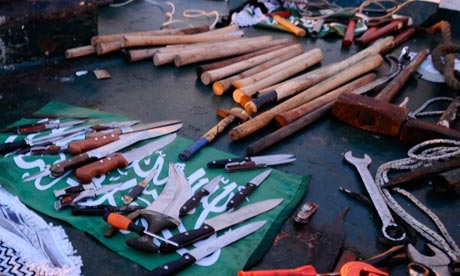
Meanwhile, much of the video footage confiscated from Marmara passengers remains undisclosed, and Israel has sought to undermine some eyewitness accounts by alleging some of the passengers were terrorist sympathisers bent on martyrdom.

Questions remain unanswered on both sides. But without a full and transparent airing of all the evidence, the truth of that dreadful night on the Marmara may never come to light.

In the meantime, the organisers say they will seek again and again to breach Israel's defences. Scottish protester Ali El-Awaisi said: "We sent six ships this time. Next time it will be 30 ships."

who will win the media battle?

Guardian | Reporting by mainstream media on the Gaza flotilla attack was unbalanced and dominated by Israel's edited version of events. The provenance of photographs of weapons supposedly found on the boats has been questioned in the blogosphere.

From the moment that the Israeli naval commandos launched their attack on the flotilla aiming to break the siege of Gaza by carrying humanitarian aid to the territory, the struggle by both sides to dominate how the media covered the events – a struggle that began days in advance of the 4am attack on Monday – entered a completely new phase.

Soon after the commandos landed on the Mavi Marmara, the Turkish ship carrying more than 600 of the activists, the live satellite broadcasts from the vessel were cut. From that point on, the Israeli authorities seized almost complete control of how evidence of what was taking place could be made public. Video of the last footage broadcast by the journalists on board was immediately available from sources such as al-Jazeera and the IHH (the Turkish Foundation for Freedoms and Human Rights and Humanitarian Relief), but it showed a very confusing picture: there were badly injured passengers, yet it was impossible to know how they had been injured.

What the world has been watching since then is either edited video shot by the Israelis or other video shot by activists, confiscated by the Israelis and subsequently edited and made available through Israeli sources.

In an operation reminiscent of the first week or so of the Israeli offensive against Gaza in winter 2008-2009, the Israeli PR machine succeeded in getting the major news outlets to focus on its version of events and to use the Israeli authorities' discourse for a crucial 48 hours. (One example of how this was being done is a leaked, sophisticated briefing paper with key talking points, compiled using official government sources and pro-government Israeli media, issued through the World Zionist Organisation on 1 June.)

This time, however, commentators in the Israeli media, on the left and the right, were immediately slamming the commando attack as a failure. The repeated screening of the video, taken from an Israeli assault craft, of the commandos abseiling down ropes onto the Mavi Marmara and then being set upon by the activists waiting for them on the deck, became the defining image of the capture of the boats. Posted by the IDF on YouTube, by Wednesday it had attracted more than 600,000 views.

The activists' actions were described by Israeli spokespersons as a premeditated terrorist attack by al-Qaida sympathisers, using clubs, knives and guns, carried out with the intention of "lynching" the commandos who were carrying out an entirely legal and peacefully executed operation.

Saturday, June 05, 2010

knuckledragging tail wags dog....,


Video - ultra-orthodox brigade violently protests digital video.

Independent | The amazing thing in all this is that so many Western journalists – and I'm including the BBC's pusillanimous coverage of the Gaza aid ships – are writing like Israeli journalists, while many Israeli journalists are writing about the killings with the courage that Western journalists should demonstrate. And about the Israeli army itself. Take Amos Harel's devastating report in Haaretz which analyses the make-up of the Israeli army's officer corps. In the past, many of them came from the leftist kibbutzim tradition, from greater Tel Aviv or from the coastal plain of Sharon. In 1990, only 2 per cent of army cadets were religious Orthodox Jews. Today the figure is 30 per cent. Six of the seven lieutenant-colonels in the Golani Brigade are religious. More than 50 per cent of local commanders are "national" religious in some infantry brigades.

There's nothing wrong with being religious. But – although Harel does not make this point quite so strongly – many of the Orthodox are supporters of the colonisation of the West Bank and thus oppose a Palestinian state.

And the Orthodox colonists are the Israelis who most hate the Palestinians, who want to erase the chances of a Palestinian state as surely as some Hamas officials would like to erase Israel. Ironically, it was senior officers of the "old" Israeli army who first encouraged the "terrorist" Hamas to build mosques in Gaza – as a counterbalance to the "terrorist" Yasser Arafat up in Beirut – and I was a witness to one of their meetings. But it will stay the same old story before the world wakes up. "I have never known an army as democratic as Israel's," the hapless French philosopher Bernard-Henri LĂ©vy said a few hours before the slaughter.

Yes, the Israeli army is second to none, elite, humanitarian, heroic. Just don't tell the Somali pirates.

the shadow over israel


Video - Who knows what evil lurks in the hearts of men....,

Haaretz | Recently I was in Israel. The Israelis I met could not have been more welcoming. I saw many impressive accomplishments and creative projects, and talked with many different people. The sun was shining, the waves waving, the flowers were in bloom. Tourists jogged along the beach at Tel Aviv as if everything was normal.

But… there was the Shadow. Why was everything trembling a little, like a mirage? Was it like that moment before a tsunami when the birds fly to the treetops and the animals head for the hills because they can feel it coming?

“Every morning I wake up in fear,” someone told me. “That’s just self-pity, to excuse what’s happening,” said someone else. Of course, fear and self-pity can both be real. But by “what’s happening,” they meant the Shadow.

I’d been told ahead of time that Israelis would try to cover up the Shadow, but instead they talked about it non-stop. Two minutes into any conversation, the Shadow would appear. It’s not called the Shadow, it’s called “the situation.” It haunts everything.

The Shadow is not the Palestinians. The Shadow is Israel’s treatment of the Palestinians, linked with Israeli’s own fears. The worse the Palestinians are treated in the name of those fears, the bigger the Shadow grows, and then the fears grow with them; and the justifications for the treatment multiply.

The attempts to shut down criticism are ominous, as is the language being used. Once you start calling other people by vermin names such as “vipers,” you imply their extermination. To name just one example, such labels were applied wholesale to the Tutsis months before the Rwanda massacre began. Studies have shown that ordinary people can be led to commit horrors if told they’ll be acting in self-defense, for “victory,” or to benefit mankind.

Chipocalypse Now - I Love The Smell Of Deportations In The Morning

sky |   Donald Trump has signalled his intention to send troops to Chicago to ramp up the deportation of illegal immigrants - by posting a...