racket |I’m going to be interviewed on MSNBC today by Mehdi Hasan, the author of a book called Win Every Argument. I’m looking forward to it as one would a root canal or a rectal.
I
accepted the invitation because it would have been wrong to refuse, on
the off chance he was planning a good-faith discussion. If you’re
reading this, things have gone another way.
I last appeared on MSNBC six years ago, on January 13, 2017, to talk with Chris Hayes and of all people Malcolm Nance, about the then-burgeoning Trump-Russia scandal.
The
Trump-Russia story was white-hot and still in its infancy. That same
day, news leaked from Israel that Americans warned the Mossad not to
share information with the incoming administration, because Russia had “leverages of pressure”
on Trump. Asked by Chris about the scandal generally, I made what I
thought was a boring-but-true observation, that we in the media didn’t
“have any hard evidence” of a conspiracy, just not a lot to go on. This
was the TV equivalent of a shrug.
Nance jumped on
this in a way I remember feeling was unexpected and oddly personal.
“Matt’s a journalist. I’m an intelligence officer,” he snapped. “There
is no such thing as coincidence in my world.” Chris jumped in to note
reporters have different standards, and I agreed, saying, “We haven’t
seen anything that allows us to say unequivocally that x and y happened last year.”
“Unequivocally”seemed
to trigger Nance. With regard to the DNC hack, he said, “That evidence
is unequivocal. It’s on the Internet.” As for “these links possibly with
the Trump team,” he proclaimed, “You’re probably never going to see the
CIA’s report.” Nance went on to answer “no” to a question from Chris
about whether leaks “were coming from the intelligence community,” Chris
wrapped up with a sensible suggestion that we all not rely on a parade
of “leaks and counter-leaks,” and the segment was done.
To
this day I get hit probably a hundred times a day with the question,
“What happened to you, man?” What happened? That segment happened, but
to MSNBC, not me.
That exchange between Nance and me was symbolic
of a choice the network faced. They could either keep doing what
reporters had done since the beginning of time, confining themselves to
saying things they could prove. Or, they could adopt a new approach, in
which you can say anything is true or confirmed, so long as a politician
or intelligence official told you it was.
We know how that worked
out. I was never invited back, nor for a long time was any other
traditionally skeptical reporter, while Nance — one of the most careless
spewers of provable errors ever to appear on a major American news
network — became one of the Peacock’s most familiar faces.
andrewcollins | Is civilisation
the legacy of a race of human angels known as Watchers and Nephilim?
Andrew Collins, author of FROM THE ASHES OF ANGELS, previews his history
of angels and fallen angels and traces their origin back to an extraordinarily
advanced culture that entered the Near East shortly after the end of
the last Ice Age.
Angels
are something we associate with beautiful Pre-Raphaelite and renaissance
paintings, carved statues accompanying gothic architecture and supernatural
beings who intervene in our lives at times of trouble. For the last
2000 years this has been the stereotypical image fostered by the Christian
Church. But what are angels? Where do they come from, and what have
they meant to the development of organised religion?
Many
people see the Pentateuch, the first five books of the Old Testament,
as littered with accounts of angels appearing to righteous patriarchs
and visionary prophets. Yet this is simply not so. There are the three
angels who approach Abraham to announce the birth of a son named Izaac
to his wife Sarah as he sits beneath a tree on the Plain of Mamre.
There
are the two angels who visit Lot and his wife at Sodom prior to its
destruction. There is the angel who wrestles all night with Jacob at
a place named Penuel, or those which he sees moving up and down a ladder
that stretches between heaven and earth. Yet other than these accounts,
there are too few examples, and when angels do appear the narrative
is often vague and unclear on what exactly is going on. For instance,
in the case of both Abraham and Lot the angels in question are described
simply as `men', who sit down to take food like any mortal person.
Influence
of the Magi
It was not until post-exilic times - ie after the Jews returned from
captivity in Babylon around 450 BC - that angels became an integral
part of the Jewish religion. It was even later, around 200 BC, that
they began appearing with frequency in Judaic religious literature.
Works such as the Book of Daniel and the apocryphal Book of Tobit contain
enigmatic accounts of angelic beings that have individual names, specific
appearances and established hierarchies. These radiant figures were
of non-Judaic origin. All the indications are that they were aliens,
imports from a foreign kingdom, namely Persia.
The
country we now today as Iran might not at first seem the most likely
source for angels, but it is a fact that the exiled Jews were heavily
exposed to its religious faiths after the Persian king Cyrus the Great
took Babylon in 539 BC. These included not only Zoroastrianism, after
the prophet Zoroaster or Zarathustra, but also the much older religion
of the Magi, the elite priestly caste of Media in north-west Iran. They
believed in a whole pantheon of supernatural beings called ahuras, or
`shining ones', and daevas - ahuras who had fallen from grace because
of their corruption of mankind.
Although
eventually outlawed by Persia, the influence of the Magi ran deep within
the beliefs, customs and rituals of Zoroastrianism. Moreover, there
can be little doubt that Magianism, from which we get terms such as
magus, magic and magician, helped to establish the belief among Jews
not only of whole hierarchies of angels, but also of legions of fallen
angels - a topic that gains its greatest inspiration from one work alone
- the Book of Enoch.
The
Book of Enoch
Compiled in stages somewhere between 165 BC and the start of the Christian
era, this so-called pseudepigraphal (ie falsely attributed) work has
as its main theme the story behind the fall of the angels. Yet not the
fall of angels in general, but those which were originally known as
'Œrin ('Œr in singular), `those who watch', or simply `watchers'
as the word is rendered in English translation.
The
Book of Enoch tells the story of how 200 rebel angels, or Watchers,
decided to transgress the heavenly laws and `descend' on to the plains
and take wives from among mortal kind. The site given for this event
is the summit of Hermon, a mythical location generally association with
the snowy heights of Mount Hermon in the Ante-Lebanon range, north of
modern-day Palestine (but see below for the most likely homeland of
the Watchers).
The
200 rebels realise the implications of their transgressions, for they
agree to swear an oath to the effect that their leader Shemyaza would
take the blame if the whole ill-fated venture went terribly wrong.
After
their descent to the lowlands, the Watchers indulge in earthly delights
with their chosen `wives', and through these unions are born giant offspring
named as Nephilim, or Nefilim, a Hebrew word meaning `those who have
fallen', which is rendered in Greek translations as gigantes, or `giants'.
andrewcollins | In both the book of Genesis (chapter six) and
the book of Enoch, the rebel Watchers are said also to have come upon the Daughters
of Men, i.e. mortal women, who gave birth to giant offspring called Nephilim.
For this transgression against the laws of Heaven, the renegades were incarcerated
and punished by those Watchers who had remained loyal to Heaven. The rebel Watchers'
offspring, the Nephilim (a word meaning "those who fell), were either killed
outright, or were afterwards destroyed in the flood of Noah. Some, however, the
book of Numbers tells us, survived and went on to become the ancestors of giant
races, such as the Anakim and Rapheim.
I wrote that the story of the Watchers
is in fact the memory of a priestly or shamanic elite, a group of highly intelligent
human individuals, that entered the Upper Euphrates region from another part of
the ancient world sometime around the end of the last Ice Age, c. 11,000-10,000
BC. On their arrival in what became known as the land or kingdom of Eden (a term
actually used in the Old Testament), they assumed control of the gradually emerging
agrarian communities, who were tutored in a semi-rural life style centred around
agriculture, metal working and the rearing of animal live stock. More disconcertingly,
these people were made to venerate their superiors, i.e. the Watchers, as living
gods, or immortals.
The precise same region of the Near East, now thought
to be the biblical Garden of Eden, has long been held to be the cradle of civilization.
Here a number of "firsts" occurred at the beginning of the Neolithic
revolution, which began c. 10,000-9000 BC. It was in southeast Turkey, northern
Syria and northern Iraq, for example, that the first domestication of wild grasses
took place, the first fired pottery and baked statues were produced, the first
copper and lead were smelted, the first stone buildings and standing stones were
erected, the first beautification of the eyes took place among woman, the first
drilled beads in ultra hard stone were produced, the first alcohol was brewed
and distilled, etc., etc. In fact, many of the arts and sciences of Heaven that
the Watchers are said to have revealed to mortal kind were all reported first
in this region of the globe, known to archaeologists as Upper Mesopotamia, and
to the people of the region as Kurdistan.
Sean Thomas acknowledges my help
at the beginning of the The Genesis Secret, which follows exactly the same themes
as From the Ashes of Angels (and my later book Gods of Eden, published in 1998),
including the fact that the Watchers and founders of Eden were bird man, i.e.
shamans that wore cloaks of feathers, and that local angel worshipping cults in
Kurdistan, such as the Yezidi, Yaresan and Alevi, preserve some semblance of knowledge
regarding the former existence of the Watchers or angels as the bringers of civilization.
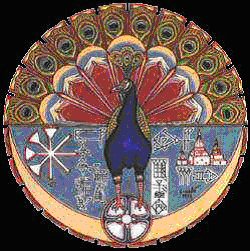
Their leader, they say was Azazel, known also as Melek Taus (or Melek Tawas),
the "Peacock Angel". Azazel is a name given in the book of Enoch for
one of the two leaders of the rebel Watchers (the other being Shemyaza).
It
is an honour for my work to be acknowledged in this manner by Sean Thomas, especially
as The Genesis Secret has become a bestseller (as was From the Ashes of Angels
in 1996). I won't spoil the plot, so will not reveal Sean's conclusions, or indeed
the climax of the book, although I must warn you that it is extremely gory in
places!
gurdjieffandhypnosis | Gurdjieff ’s ontological universe is sacred and monotheistic. The mythological panorama in the First Series—where Beelzebub the “devil,” despite his youthful sins and archangelic powers still seeks, and is overjoyed by, his eventual pardon by our “COMMON FATHER OMNI-BEING ENDLESSNESS,” “MAKER CREATOR”—leaves no doubt that in Gurdjieff ’s universe only one god rules. Gurdjieff ’s “devil” is subordinate to God. But the “devil” of Gurdjieff is not what humans have portrayed him to be—at least no longer. It is true that Beelzebub, like other members of his “tribe” has hoofs and a tail, and regains (eventually upon his pardon) his horns; however, he is a passionate, kind, and benevolent angel, telling fairy tales to his grandson Hassein, and is deeply concerned about the affairs of his God’s universe and the fate of those poor creatures on that remote planet, the Earth.1 Perhaps it was out of “revolutionary” concerns, in fact, that he had rebelled in his youth against what he considered to be “illogical” in the government of the universe (B:52), and because of this had been banished with his “comrades” by His “All-lovingness and All-forgiveness … to one of the remote corners of the Universe, namely to the solar system ‘Ors’ whose inhabitants call it simply the ‘Solar System’” (B:52; capitals here and hereafter in quotes are in the original). But now, having earned pardon and reconciliation and already received them from God, Beelzebub is on a journey back to his home planet.
The most significant conclusion to draw from the cosmic picture painted by Gurdjieff in the First Series commonly titled Beelzebub’s Tales his Grandson is that the dualism of “good” and “evil” does not exist as an objective fact in his universe. This is a shock Gurdjieff imparts to his reader’s mind from the very outset. Evil does not objectively exist, and what evil may exist, it is a human construct. This dualism (as in the case of heaven and hell, as we shall see later) is simply a product of human mind and behavior, made up once by a certain learned human being whom, for the purpose of historical tangibility, Gurdjieff imaginatively calls “a certain Makary Kronbernkzoin” (B:1127). Although Kronbernkzoin’s “evil” human act of making up this dualism is later discovered and condemned in the planet Purgatory where his higher-being-body resides, his invention has already infected humans across generations as a belief system:
“… after long and complicated researches, it became clear to them that the fundamental cause of the whole abnormality of the psyche of the threebrained beings arising on this planet was that a very definite notion arose and began to exist, that outside the essence of beings, as it were, there are two diametrically opposite factors—the sources of ‘Good’ and the sources of ‘Evil’—which are just the instigators for all their good and bad manifestations.
“It was then established by them that this universally disseminated maleficent idea, the data for which gradually became crystallized in each of them during their formation into preparatory age, already dominates their common psyche at their responsible existence and becomes on the one hand a tranquillizer and justifier of all their manifestations and on the other hand the fundamental impeding factor for the possibility which arises in certain of them for the self-perfecting of their higher being-parts.” (B:1125–26)
Gurdjieff ’s God, thus, represents all goodness. “Everything, without exception, all sound logic as well as historical data, reveal and affirm that God represents absolute goodness; He is all-loving and all-forgiving” (L:24: italics in the original). If there was a so-called “Devil” (i.e., Beelzebub)—with a power somewhat equal to God at one time—who in his youth rebelled against God “by way of pride” proper to any “young and still incompletely formed individual” (L:24), the act itself of relegating such a force to a “beloved son” was still an act of an absolutely all-powerful God. This interpretation can be derived from the following passage in the Third Series where Gurdjieff, in search of a technique for uninterrupted remembering of his higher self or “I,” arrives at the universal analogy of God and the Devil:
At the same time why should He, being as He is, send away from Himself one of His nearest, by Him animated, beloved sons, only for the “way of pride” proper to any young and still incomplete individual, and bestow upon him a force equal but opposite to His own? … I refer to the “Devil.” (L:24:italics in the original)
For Gurdjieff, therefore, the universe has one Creator and a unitary source of origin, while Beelzebub, or the so-called “Devil,” who is a beloved son of God and who in youth became rebellious but later repented and was forgiven, is not an objective source of evil in this world. The association, by humans, of their own evil acts to Beelzebub as an angel and “beloved son of God” is thereby not justified. The human evil is really of their own making. The question still remains, however: Why is there (human) evil in a universe created by a God of all-goodness? ___________________________________________________________________________________ 1. According to J. Walter Driscoll, “Gurdjieff claimed that his ideas are rooted in tradition now lost or largely unavailable in modern societies. The figure of a pardoned Beelzebub provides a striking example of an authentic but little known mythopoetic tradition that Gurdjieff exploits. His Beelzebub is alien to conventional Judeo-Christian traditions where ‘fallen angels’ are condemned for eternity—never pardoned, let alone elevated to a quasi-redemptive status. A unique scriptual and mythological tradition that was familiar to Gurdjieff and which contains a clear echo of the pardoned fallen angel, can be found among the Yezidi (pronounced Ya-she-dees and sometimes spelled Yazidis), a unique Kurdish tribe” (2004a:6–8). As cited by Driscoll from The Encyclopedia of the Orient, “The Yezidi creed has elements from Zoroastrianism, Manicheism, Judaism, Christianity, and Islam” (Ibid.:7; also found at http://www.i-cias.com/e.o/index.htm). Driscoll also draws on the work of Giuseppe Furlani (1940) to substantiate his observation that for Yezidis indeed Malek Ta’us, or Angel Peacock, corresponding to the Devil in Christianity and Islam, “is supreme among the angels, who, after his fall and repentance, has been re-installed by God in his original and pre-eminent position” (Driscoll, 2004a:6–8). Of significance for Gurdjieff was the strange ritual he observed among Yezidis when he was a child (M:65–66), when he saw a Yezidi child could not get out of a circle drawn around him. Echoing this theme, Driscoll cites the following from Philip Kreyenbroek (1995) in Yezidism: Its Background: “… oaths are administered by drawing a circle on the ground. The inside of the circle is declared to be ‘the property of Melek Tawus,’ an observance which is paralleled in Zoroastrianism” (161). For another authoritative study of the Yezidis see John S. Guest’s Survival Among the Kurds: A History of the Yezidis (1993).
wikipedia | The Yazidi (also Yezidi, Êzidî, Yazdani, ایزدیان, Եզդիներ, Езиды) are a Kurdish- and Arabic-speaking ethno-religious community who practice an ancient syncretic religion linked to Zoroastrianism and early Mesopotamian religions.[12][13][14] They live primarily in the Nineveh Province of northern Iraq, a region once part of ancient Assyria. Additional communities in Armenia, Georgia and Syria have been in decline since the 1990s, their members having migrated to Europe, especially to Germany.[15] The Yazidi believe in God as creator of the world, which he has placed under the care of seven "holy beings" or angels, the "chief" (archangel) of whom is Melek Taus, the "Peacock Angel." In Zoroastrian-like tradition, the Peacock Angel
embodied humanity's potential for both good (light) and bad (dark)
acts, and due to pride temporarily fell from God's favor, before his
remorseful tears extinguished the fires of his hellish prison and he
reconciled with God. Some followers of other monotheistic religion
jokingly or mistakenly re-cast the Peacock Angel as the unredeemed evil deity Satan[16][17],
which has incited centuries of persecution of the Yazidi as "devil
worshippers" by some followers of these religions. Persecution of
Yazidis has continued in their home communities within the borders of
modern Iraq, under both Saddam Hussein and fundamentalist Sunni Muslim revolutionaries.[18]
wikipedia | The Yazidi consider Tawûsê Melek an emanation of God and a benevolent angel who has redeemed himself from his fall and has become a demiurge who created the cosmos from the Cosmic egg. After he repented, he wept for 7,000 years, his tears filling seven jars, which then quenched the fires of hell.
Tawûsê Melek is sometimes transliterated Malak Ta'us, Malak Tawus, Malak Tawwus or Malik Taws. Melek was borrowed from the Arabic term "king" or "angel". Tawûs is uncontroversially translated "peacock"; in art and sculpture, Tawûsê Melek is depicted as peacock. However, peacocks are not native to the lands where Tawûsê Melek is worshipped. Among early Christians, the peacock represented immortality on account of the folk belief that its flesh does not decay after death, and this symbolism has passed into Yazidi beliefs.[6] Consequently, peacock imagery adorns Yazidi shrines, gateways, graves, and houses of worship.
The Kitêba Cilwe
"Book of Illumination", which claims to be the words of Tawûsê Melek,
and which presumably represents Yazidi belief, states that he allocates
responsibilities, blessings and misfortunes as he sees fit and that it
is not for the race of Adam
to question him. Sheikh Adî believed that the spirit of Tawûsê Melek is
the same as his own, perhaps as a reincarnation. He is believed to have
said:
I was present when Adam was living in Paradise, and also when Nemrud threw Abraham
in fire. I was present when God said to me: 'You are the ruler and Lord
on the Earth'. God, the compassionate, gave me seven earths and throne
of the heaven.
Yazidi accounts of creation differ from that of Judaism, Christianity and Islam. They believe that God first created Tawûsê Melek from his own illumination (Ronahî)
and the other six archangels were created later. God ordered Tawûsê
Melek not to bow to other beings. Then God created the other archangels
and ordered them to bring him dust (Ax) from the Earth (Erd)
and build the body of Adam. Then God gave life to Adam from his own
breath and instructed all archangels to bow to Adam. The archangels
obeyed except for Tawûsê Melek. In answer to God, Tawûsê Melek replied,
"How can I submit to another being! I am from your illumination while
Adam is made of dust." Then God praised him and made him the leader of
all angels and his deputy on the Earth. (This likely furthers what some
see as a connection to the Islamic Shaytan, as according to the Quran
he too refused to bow to Adam at God's command, though in this case it
is seen as being a sign of Shaytan's sinful pride.) Hence the Yazidis
believe that Tawûsê Melek is the representative of God on the face of
the Earth, and comes down to the Earth on the first Wednesday of Nisan
(April). Yazidis hold that God created Tawûsê Melek on this day, and
celebrate it as New Year's Day. Yazidis argue that the order to bow to
Adam was only a test for Tawûsê Melek, since if God commands anything
then it must happen. (Bibe, dibe). In other words, God could have
made him submit to Adam, but gave Tawûsê Melek the choice as a test.
They believe that their respect and praise for Tawûsê Melek is a way to
acknowledge his majestic and sublime nature. This idea is called
"Knowledge of the Sublime"
(Zanista Ciwaniyê). Sheikh Adî has observed the story of Tawûsê Melek and believed in him.[7]
Yazidis believe that good and evil both exist in the mind and spirit
of human beings. It depends on the humans, themselves, as to which they
choose. In this process, their devotion to Tawûsê Melek is essential,
since it was he who was given the same choice between good and evil by
God, and chose the good.
NYTimes | WHEN the snowstorm hit a week ago Saturday, Evan Sidel was driving home from the supermarket, having stocked up on soup ingredients, thinking she and her two daughters would have a cozy evening in. But while she was unpacking the groceries, the power went out with an audible bang, said Ms. Sidel, who lives in a 100-year-old farmhouse in Wilton, Conn.
“You could literally hear the transformer exploding,” she said.
Then things went south fast, escalating perilously like the plot of an action movie, or “Spider-Man: Turn Off the Dark” in previews. As Ms. Sidel pulled an old land-line telephone out of the closet, one birch tree crashed into the side of her house and another into her front door.
“I called a friend who said, ‘My generator has just kicked in, come on over.’ I got out through the garage, drove over the lawn to the street, and I stayed at my friend’s house until Wednesday,” she recounted. “My girls generator-hopped all over town all week, thrilled to have a different sleepover every night. But another friend of mine has four kids, and she was not so lucky. You can’t generator-hop with a family that size. I have nothing but gratitude for all my generator hosts.”
In another part of town, Christopher Peacock, the high-end kitchen man, was charging a few lights and the refrigerator, along with his family’s computers and cellphones, on a small gasoline-powered manual generator he set out in his driveway, snaking a web of extension cords from the living room.
But Mr. Peacock has well water, and with not enough power for the pump, his family grew not just colder but grubbier as the week progressed. On Wednesday, he; his wife, Jayne; and their 11-year-old son fled to Cape Cod, where they have a summer house.
“School is canceled, so why not?” he said. “It’s like a war zone here. The thing is, I am waiting for, and am in line for, a permanent generator installation. I’ve got one essentially on order, but they’re all back-ordered since Irene. I am definitely feeling some generator envy.”
Mr. Peacock was not alone in this feeling. The back story to the recent biblical weather was the Great Generator Divide. With hundreds of thousands of households without power last week — nearly 800,000 in Connecticut alone — who had a generator (and how big it was) was the second most urgent topic in New Jersey, New York and Connecticut. Generator envy ran wide and deep as the staccato growl and smoky breath of portable generators defined the haves and the have-nots in many neighborhoods.
In Greenwich, Conn., some chilly residents shivered while their neighbors’ mega-units (the whole-house kind that kick on automatically and emit a sound hardly louder than a cat’s purr) powered not just furnaces, washers and dryers, garage doors and electric gates, “but the mood lighting on their trees,” Leslie McElwreath, a broker at Sotheby’s International Realty there, said wonderingly, impressed by her neighbor’s generator prowess (and his spotlighted trees).
Indeed, in a town like Greenwich, where the accouterments of the high-end houses are super-sized, generator power is now a selling point, as home theaters, heated driveways and wine grottos were in years past, said Robert Bland, the brokerage manager of the Sotheby’s office in Greenwich.
“You can’t even open your garage door or your electric gates if you don’t have a generator,” he said. “And with the weather so unpredictable, it’s become a required amenity.”
JVKohl | Human physical attraction may not cognitively equate with definitive indications of sexual preferences or definitive sexual behavior, because sexual preferences can be cognitively denied and sexual behavior can be suppressed. Thus, when comparing human and non-human animal behavior, it is difficult to separate cognitive effects, like thoughts, from unconscious affects, like neuroendocrine changes, that may be manifest as human emotions. Therefore, sex researchers cannot be sure whether they are sampling some vague unconscious affect of human behavior that is not cognitively considered by their subjects—and not considered in the study design or the data analysis.
The failure to fully consider unconscious affects that may be manifest as opportunistic behavioral tendencies leads to a lack of clear findings, and the underlying biological underpinnings of sexual preferences can readily be missed. Accordingly, the reporting of incongruous and ill-defined results that are, nonetheless, meaningfully interpreted, is problematic. Meaningful results require an important consideration in any scientific endeavor; we must first get the model right!
No model is consistently used in the scientific study of human sexuality. For example, the effect of auditory stimuli in songbirds or visual stimuli like the colorful plumage of the peacock’s tail are used as examples of sensory input from the social environment that somehow influences sexual behavior in some species. In contrast, the effect of olfactory/pheromonal input from the social environment is more typically used as an example of sensory input that influences levels of hormones and sexual behavior in mammals.
A consistent mammalian model that links olfactory/pheromonal input from the social environment to hormonal influences on sexual behavior should help to reduce disparate findings and debate over inconsistent results from studies of human sexual behavior. Currently, disparate findings and debate tend to weakly support a false nature versus nurture dichotomy. This false dichotomy might well be eliminated from further consideration if individual studies began to more fully address a causal link between nature and nurture. Such a link can be addressed within the context of a developmental model of how olfactory/pheromonal input influences sexual preferences and how these sexual preferences influence sexual behavior.
In non-human animals, a causal relationship must exist among the development of sexual preferences for attractive physical features and how these preferences are manifest in sexual behavior. This causal relationship must develop before sexual preferences or sexual behaviors are expressed. Whether or not it is acknowledged, such a causal relationship appears to exist before human sexual preferences are fully developed and long before adult sexual behavior is expressed. Extension to humans of the mammalian olfactory/pheromonal model presented here addresses a causal relationship that includes the unconscious affect of olfactory/pheromonal input from the social environment on hormones and the development of sexual preferences manifest in the expression of sexual behavior.
The Independent | During a long hard winter, nothing warms the cold blood of the Western armchair revolutionary more than the sight of a bunch of attractive dark-skinned people out on the streets having a right old revolution. In a country where public schoolboys swinging on the Cenotaph passes as righteous insurrection, the sight of so many ordinary people protesting is understandably exhilarating. The recent 95-page report by Human Rights Watch, "Work on Him Until He Confesses": Impunity for Torture in Egypt, shows how the Mubarak government has consistently failed to investigate and prosecute police accused of the most vicious attacks. Whereas the only wounds one can imagine Charlie Gilmour sustaining would be if he fell off his pony and landed face down on that silver spoon he keeps secreted in his gob.
Nick Clegg has just popped up on breakfast TV gushing on about how "exciting" events in Egypt are, with all the wide-eyed wonder of a tweenager experiencing Bieber Fever. Even me, as an evil Zionist cheerleader – I find it hard not to cheer at the thought of Mubarak being toppled from his perch. This alleged friend of democracy and Israel has overseen a rotten time in the country he dictates to, during which persecution of Christians and silly slanders against Israel – the Zionist sharks of Sharm el Sheikh – have flourished.
It would be wonderful to think that what replaces Mubarak will be better. But here's the thing about Middle Eastern regimes: they're all vile. The ones that are "friendly" are vile and the ones that hate us are vile. Revolutions in the region have a habit of going horribly wrong, and this may well have something to do with the fact that Islam and democracy appear to find it difficult to co-exist for long.
It's hard to believe now, but I recall being 19 and delighted when the Iranian Revolution happened. As a good Communist kiddy, I'd grown up with my dad's fairly accurate horror stories of how SAVAK, the Shah's secret police, burned the arms off of opponents, leaving them as "human snakes". I remember how disgusted I was when Andy Warhol said "It bothers me that people are being tortured in Persia – but the Empress is a personal friend" as an excuse for hanging out with the Pahlavi family.
And now look at Iran. It's not strictly Middle Eastern, but its Islamism brings it into the orbit of the region, so much so that – naughty! – WikiLeaks recently revealed that certain Muslim countries actually want Israel to attack it and wipe out its nuclear potential. And its revolution has led to it being run by an even more vile regime than that of the late, unlamented Peacock Throne. As reported in this newspaper earlier this week, Iran now executes an average of one person every eight hours.
"I put for the general inclination of all mankind, a perpetual and restless desire of power after power, that ceases only in death." -- Thomas Hobbes
Six billion or so of you humans are imprisoned in a status-driven social paradigm. You are bound and determined to increase your social status -- i.e., increase the size of your peacock tail. The only way for you to increase the size of your peacock tail is to deplete natural resources. I call this process the Peacock/Peahen Spectacle.
All of the organizations comprising your society -- be they branches of government, universities, corporations, politicians, churches, and philanthropies -- work to support the genetic drive for increased status. The leading members of those social organizations (i.e. highest status individuals) work to increase the status of the organizations and in the process, increase their own personal status. Throughout this process, opinions expressed by dissenting individuals are suppressed. Dissent within the overarching paradigm is not conducive to the achievement of high status.
In addition to being among the most powerful genetic drives, the genetic drive for status is utterly insatiable, in other words, if your neighbor appears to increase his status beyond yours, then you must work harder to increase your status and get ahead of him (buy more-expensive car, bigger house, better job, etc.). This tendency is commonly referred to as "keeping up with the Joneses".
All high status individuals within your social paradigm deliberately lie (many subconsciously though none the less obviously) to further their drive to increased status. Moreover, no high status individual is willing to lose social status by admitting lies, errors, or omissions in the decisions that they've taken pursuant to their status-seeking aims. So, not only do all of the organizations within your society work in concert to promote this paradigm, but, all the current high-status individuals leading these social organizations are genetically-biased against telling the truth because it threatens to cost them their hard-won social status.
When people are frustrated in their endless drive to increase status, they often resort to violence. The only alternative to public violence is the endless conversion of finite natural resources into ever-more-marvelous peacock tails - thus it is that the Peacock/Peahen Spectacle operates within a system of governance via dopamine hegemony.
With fewer natural resources available for conversion into ever-more-fabulous and more widely sought-after peacock tails - the insatiable and infinite genetic drive for increased status must inevitably lead to a new world war over finite natural resources.
How to Be Happy
-
It wasn’t until my mid-thirties that I learned how to be happy. I think
part of this was simply growing older, maturity bringing sweet respite from
many of...
Art Shows
-
I took a long time off from art shows. I have two pieces in two shows this
summer.
One is at the Rockford Art Museum Midwestern Bienielle. Good old Rockfor...
Gabriel Rockhill, The Pied Piper of Stalinism
-
As interpreted from a Marxist perspective Gabriel Rockhill’s book, Who Paid
the Pipers of Western Marxism? (Monthly Review Press, 2025), is full of
interes...
Celebrating 113 years of Mama Rosa McCauley Parks
-
*February 4, 1913 -- February 4, 2026*
*Some notes: The life of the courageous activist Mama Rosa McCauley Parks*
Mama Rosa's grandfather Sylvester Ed...
Return of the Magi
-
Lately, the Holy Spirit is in the air. Emotional energy is swirling out of
the earth.I can feel it bubbling up, effervescing and evaporating around
us, s...
Covid-19 Preys Upon The Elderly And The Obese
-
sciencemag | This spring, after days of flulike symptoms and fever, a man
arrived at the emergency room at the University of Vermont Medical Center.
He ...
-
(Damn, has it been THAT long? I don't even know which prompts to use to
post this)
SeeNew
Can't get on your site because you've gone 'invite only'?
Man, ...
First Member of Chumph Cartel Goes to Jail
-
With the profligate racism of the Chumph Cartel, I don’t imagine any of
them convicted and jailed is going to do too much better than your run of
the mill ...